
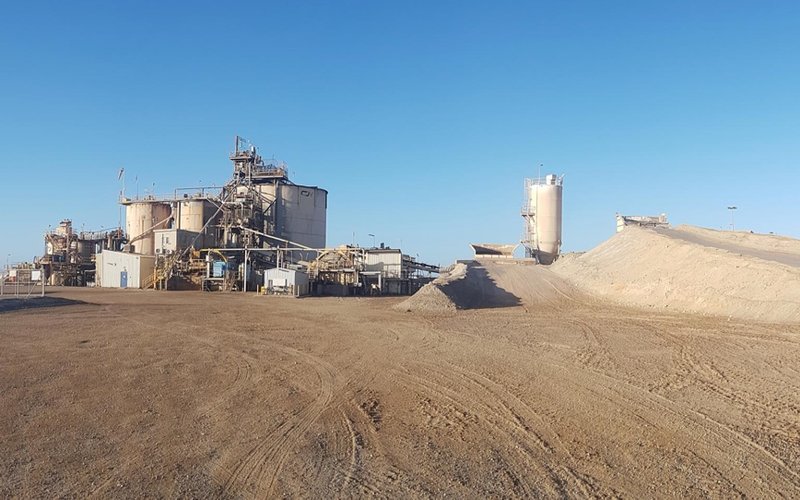
Barton Gold (ASX: BGD) (OTCQB: BGDFF) has continued its great recent run of success with the analysis of a new seismic survey at the Tarcoola gold project in South Australia identifying significant follow-up exploration opportunities.
This year, the company has reaped millions in golden benefits through a clean-up and preservation program at the historic Central Gawler Mill and more recently has significantly expanded its rich Tunkillia gold project with a major drilling program.
Now the company is looking to quickly follow up on the successful results of its Tarcoola seismic survey.
Completed in August by HiSeis, the detailed seismic survey incorporated a combination of accelerated weight drop and Vibroseis trucks.
New structures analysed
Barton managing director Alex Scanlon said the survey has successfully mapped a number of new and previously untested structures across the Tarcoola goldfield.
Initial analysis has also suggested that the gold mineralisation is closely associated with deeper-tapping sub-vertical structures similar to those at the Perseverance fault that had previously been highlighted at Tarcoola as the control for the mineralisation of the Perseverance mine.
“We are excited to see the Tarcoola goldfield’s detailed architecture for the first time since its discovery 130 years ago,” Mr Scanlon said.
“With little modern exploration and a history of high-grade production from over 600 shallow historical workings, the potential for exciting new discoveries is significant. We are analysing these results in combination with our other data sets and expect to drill test our highest-priority exploration targets during early 2024.”
Historic location
The Tarcoola area is known as the home of South Australia’s gold history and the site of the state’s 1893 gold rush, producing approximately 77,000 ounces of gold at 37.5 grams per tonne from 1900-1955.
This year’s seismic acquisition campaign followed the completion of high-definition reprocessing of historical seismic data around Tarcoola by Barton during 2020.
That work helped the company better understand the local structural architecture, with the results confirming the location and orientation of the Perseverance fault and identified a system of major structures analogous to the Perseverance fault across the historical Tarcoola goldfield.
The subsequent August 2023 seismic survey over this target area acquired more than 40 line-km of data along five lines to develop a higher-resolution model of nearby structures.
Similarities to Perseverance
The Perseverance Mine was operated during 2017 and 2018 with an average ore grade of ~3.8 g/t gold, ultimately sent to the company’s Central Gawler mill during 2018.
Mr Scanlon says the latest analysis indicates a corridor of Perseverance fault-like structures located just west of the open pit.
The new model also suggests that gold tends to occur in association with early NE trending structures in the footwall of NNE trending sinistral basin faults and in the footwall of later NW trending faults.
According to Mr Scanlon, this is the first time that known gold occurrences are able to be put into a structural framework. Larger occurrences appear to be closely associated with deep-tapping sub-vertical structures like the Perseverance fault, with several such structures newly identified through this seismic analysis.
Ongoing activities
Barton’s activities this year at Tarcoola, Tunkillia and the Central Gawler Mill are highlights of the company’s strategic leadership position in a region where it holds around 5,000 sq km in tenements over the best historical ground.
The company plans to use that advantage to create South Australia’s largest independent gold producer.
Stage one of that strategy is to develop a low cost/low risk open pit opportunity at Tarcoola and the successful seismic results are an important step in that plan.
