
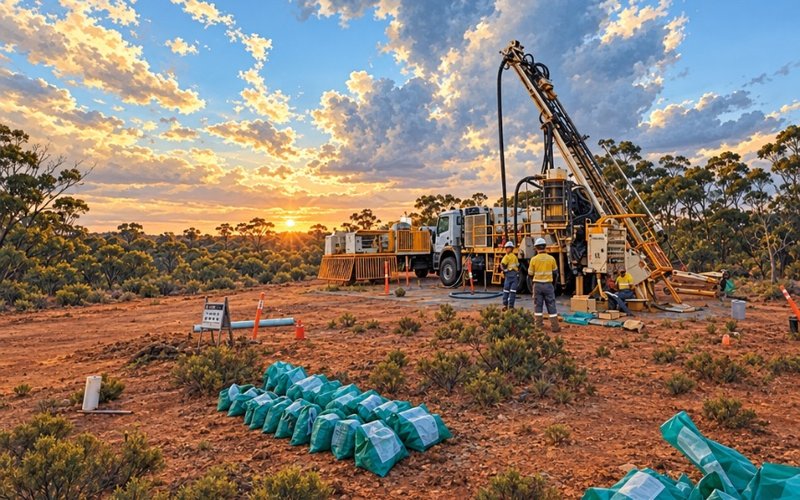

- 018/8 Dulcie Central holes hit gold across 600m corridor.
- 02Best: 6m at 4.14g/t, incl. 3m at 7.75g/t.
- 03Final assays due late Oct; maiden resource under review.
Zenith Minerals (ASX: ZNC) has returned further gold intersections from its Consolidated Dulcie gold project in Western Australia, strengthening evidence of mineralisation between the Dulcie North and Dulcie deposits.
All eight newly assayed reverse circulation holes at Dulcie Central intersected gold within a corridor spanning the gap of approximately 600 metres separating the deposits.
The strongest result was 6m at 4.14 grams per tonne gold from 123m including 3m at 7.75g/t, the best intersection to date from the latest drilling program.
With results now received for 24 of the 34 completed holes, Zenith expects the remaining assays in late October before deciding whether the corridor supports a maiden mineral resource estimate on mining lease M77/599.
Gold Across Central Corridor
The latest holes bring the total number assayed at Dulcie Central to 14, all of which have encountered gold in the area separating the two established deposits.
Other notable central-corridor intersections included 10m at 0.84g/t from 48m and 3m at 1.59g/t from 45m, with several holes returning multiple mineralised zones.
The new drilling again encountered the mafic, ultramafic, and banded iron formation sequence identified in earlier work, providing further geological context for the corridor interpretation.
Zenith completed the broader 34-hole, 4,601m RC program on 16 September, reporting initial results for nine holes in late September and a further 15 holes in the latest batch.
Ten outstanding holes are all located at Dulcie Central, leaving the full extent and continuity of mineralisation to be assessed once their assays are available.
Scott’s Grey Adds Higher Grades
At Scott’s Grey, drilling designed to test extensions to an existing inferred mineral resource returned 4m at 3.05g/t from 71m and 2m at 2.40g/t from 142m.
The stronger Scott’s Grey interval included a 1m section at 7.17g/t, while the third hole produced two narrow, low-grade intersections.
Results from Dulcie South were more modest, led by 1m at 3.86g/t from 128m and 3m at 0.93g/t from 122m.
All five holes from Dulcie South have now been reported, allowing Zenith to include those results alongside Scott’s Grey in its review of the existing Dulcie resource.
Resource Decision to Follow
“Every Dulcie Central hole assayed so far has intersected gold, with SRRC182 returning the strongest intersection of the program to date,” managing director Andrew Smith said.
“We expect the final results from the program in late October, and will report them as they are received.”
The company will assess whether geological and grade continuity is sufficient to prepare a maiden estimate for M77/599 rather than assume the positive intersections already establish a resource.
Its existing Consolidated Dulcie inferred mineral resource stands at 21.3 million tonnes grading 1.0g/t gold for 675,000 ounces across the wider project.
Once the final assays are evaluated, Zenith will also consider whether the Scott’s Grey and Dulcie South results justify updating the existing Dulcie mineral resource estimate.
Get the wire before the market opens.
The ASX small-cap stories that matter, filed before 9am AEST. Curated by the Small Caps desk.