
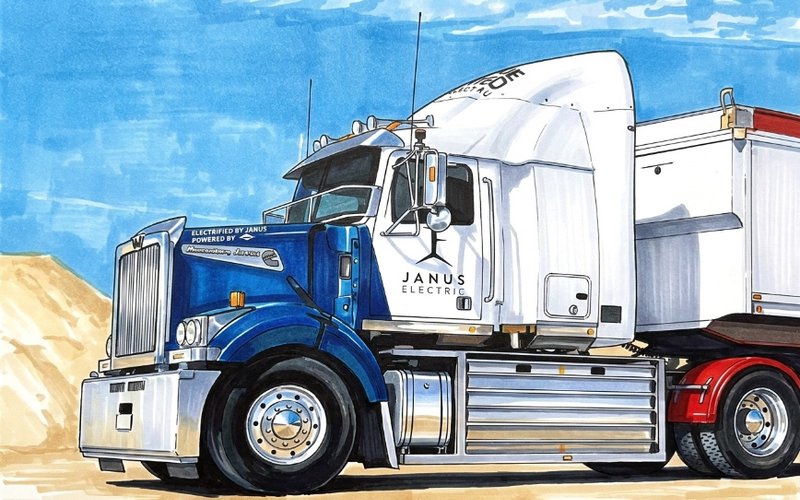

- 01Full-stack heavy freight electrification OS.
- 02Conversion Module + swappable batteries + charging network.
- 03Recurring revenue via battery hire and services.
Janus Electric’s (ASX: JNS) core proposition is a full-stack heavy-freight electrification model built around diesel-to-electric truck conversions, swappable batteries, charging hubs and software, with the aim of reducing fleet adoption friction while creating recurring revenue per active truck.
The company is not positioning itself as a single-product EV seller; it is trying to build an operating system for heavy road transport electrification.
The strategic appeal is straightforward: fleets may be able to electrify existing diesel trucks through the Janus Conversion Module rather than waiting for a full replacement cycle, while also using Janus Side Batteries, Janus Charge and Change Stations and the company’s software platform as part of one system.
Management’s stated objective is broader than one-off hardware sales, with the business intended to develop recurring ecosystem revenue from battery and charging infrastructure usage over time.
The cautious bull case is that Janus could become more valuable as installed-base density rises, because each truck conversion can potentially pull through battery hire, energy consumption, service, maintenance and software-linked usage revenue.
The central debate is not whether the concept is interesting, but whether Janus can move from a low-volume conversion business to a repeatable operating platform with enough utilisation, reliability and capital support to scale.
Why This Matters
Heavy freight is one of transport decarbonisation’s harder categories because fleets need high utilisation, minimal downtime and practical depot or corridor infrastructure. Janus is explicitly built around those constraints through conversion, swap-ready batteries and charging infrastructure.
Its model matters because it aims to lower adoption friction for operators that may prefer to retrofit existing trucks rather than replace them outright, especially where operational downtime and capital budgets are major barriers. The software and infrastructure layer matters strategically because the company is trying to embed itself in fleet operations, not just sell a conversion kit.
There is also a network-density angle: the company already describes an Australian charging-station network across New South Wales, Victoria, South Australia, Western Australia and Queensland.
If the model works, the value could come less from any one truck sale and more from building a durable ecosystem around active commercial vehicles, battery usage and energy throughput.
How The Company Wins
Janus’s best chance of winning is through integration: the Janus Conversion Module, Janus Side Battery, Janus Charge and Change Station, software platform, and New South Wales production and battery-assembly facility together create a more complete fleet offering than a standalone conversion product would.
That integrated stack can matter commercially because fleets adopting one part of the system may have reasons to stay inside the broader Janus ecosystem for batteries, charging, monitoring and asset management.
A second advantage would come from operational standardisation. Management’s milestones around Gen 2 production readiness, cycle time of no more than two days per kit, and output of 50 kits per month imply that scale economics depend on making conversions more manufacturable and less bespoke.
Battery reliability is another potential differentiator. The Electrovaya relationship is intended to improve durability and payload economics, with disclosed specs including up to 14,000 cycles versus approximately 5,000, 12% more usable energy, around 500kg lower tare weight and a warranty of 6 years or 8,000 cycles.
The company can also improve its quality profile if revenue mix shifts toward ongoing usage. FY25 already showed a blend of product revenue, ongoing revenue and service and maintenance revenue, which is important because recurring revenue tends to deserve higher confidence than lumpy conversion sales.
Still, any moat remains provisional. Janus only wins if conversion economics, hub utilisation, battery performance and customer adoption reinforce one another faster than funding pressure, competitors or execution issues interrupt the rollout.
Proof Points
The company had completed 25 truck conversions as of the prospectus date, giving it at least a real, operating base rather than a pre-commercial concept. Operationally, that base had reached 25 converted trucks in operation, 3,360 swaps, 591,073 commercial kilometres and 1.13m kWh of energy used, which is early but tangible evidence that the model is functioning in the field.
Revenue mix is beginning to show the shape of the platform thesis. FY25 total revenue was A$1.70m, including A$1.04m product revenue, A$464k ongoing revenue and A$196k service and maintenance revenue.
The December half-year added more detail: total revenue was A$1.24m, including A$586k conversion revenue, A$287k battery hire and A$151k energy consumption revenue. The March-quarter update reported A$896k of operational income, including A$472k of truck conversion and charge-station sales and A$424k of recurring and subscription revenue, which suggests recurring revenue is becoming more visible even at small scale.
On infrastructure usage, the disclosed Australian nodes across Moorebank, Port Melbourne and Port Adelaide had collectively recorded 1,103 battery swaps and 408,244 kWh of charged energy.
At the site level, Moorebank had 5 operating trucks, capacity for up to 20 trucks, 553 swaps and 221,244 kWh charged year to date; Port Melbourne had 2 operating trucks, capacity for 20 trucks, 450 swaps and 150,000 kWh charged to date; and Port Adelaide had 3 operating trucks, capacity for 10 trucks, 100 swaps and 37,000 kWh charged to date.
Moorebank’s charging setup was also expanded with an existing 180kW JCCS and a new 360kW quad-bay charger, adding stated capacity of 6.2 MWh per day to the existing 3.1 MWh per day. That shows Janus is building infrastructure ahead of fuller utilisation.
Internationally, Janus has disclosed an initial California Ability Trimodal pilot of approximately US$1.25m, a subsequent California order from EVC valued at approximately A$1.6m, and two HVIP vouchers secured at US$112,500 per vehicle for initial conversions.
More recently, Janus announced a A$10m US truck-conversion order that lifted the stated order book to 45 vehicles, while an ASX trading halt was put in place pending a material update on a material contract through 17 July 2026 unless released earlier.
Funding support has also progressed, with firm commitments for a A$4.5m placement in May 2026. The cleansing prospectus was issued to facilitate trading of 26,450,000 placement shares, while the cleansing offer itself was nominal and not intended to raise capital.
Catalysts To Watch
The main catalyst is evidence that Janus is genuinely moving from a low-volume conversion business to a repeatable operating platform. That is the strategic milestone underlying the whole thesis.
Management’s manufacturing targets are another key checkpoint: Gen 2 production readiness by 30 June, cycle time of no more than 2 days per kit and production of 50 kits per month by 31 December 2026. If those targets start looking achievable, the investment case becomes more credible.
Investors should also watch whether recurring ecosystem revenue becomes a larger share of the mix, especially battery hire, energy consumption and subscription-style revenue. That would support the claim that the model can evolve beyond one-off sales.
Hub utilisation trends at existing Australian sites matter too, particularly whether battery swaps and charged energy rise enough to support attractive economics for additional stations rather than simply proving technical operation. Commercial follow-through in North America is also important, given Janus is pursuing opportunities in the United States and Canada.
Battery standardisation and reliability outcomes under the Electrovaya arrangement remain a gating factor. Durability, cycle life and payload characteristics are likely to shape fleet confidence and scale.
Key Risks
Execution risk is the biggest one: the company is early-stage and historically loss-making, and the challenge is not proving a concept truck can run but proving that conversion throughput, infrastructure rollout and software-backed operations can scale reliably. The business still has to show that operating complexity can be reduced rather than multiplied.
Funding risk remains central. The March-quarter baseline showed cash of A$2.1m, net cash burn of A$527k per quarter and approximately four quarters of reported funding, while the longer-term strategy implies A$8m–A$12m for Horizon 1 and A$138m–A$187m across all horizons.
Dilution risk is real because the capital base is expanding. At prospectus lodgement Janus had 118,010,470 ordinary shares on issue and 16,417,191 options outstanding, and total shares on issue would rise to 144,460,570 if the placement and cleansing offer shares are issued.
Utilisation risk matters because early station activity is encouraging but not yet conclusive. Moorebank’s May activity of 82 swaps and 28.4MWh charged shows operation, but not yet proof that a broader hub network will earn attractive returns.
Customer concentration risk is significant, with the top three customers representing 79% of FY25 revenue. Any delay, payment issue or program change from a small number of fleets could materially affect results.
Competition and technology risk should not be understated. The filing itself describes the shares as speculative and highlights early-stage, product performance, manufacturing, customer payment, commercialisation and technology obsolescence risks.
What would change my mind positively: sustained growth in recurring revenue, improving hub utilisation, evidence that conversion cycle times are falling toward management targets, and proof that funding is sufficient to reach the next scale milestone without repeated distress capital.
Bottom Line
Janus Electric is pursuing a differentiated idea in a difficult market: electrifying heavy freight through a retrofit-plus-infrastructure ecosystem rather than waiting for fleets to replace entire truck fleets. The attraction is clear if conversions drive recurring battery, energy and service revenue, but the company is still early, capital-hungry and execution-sensitive.
For investors, this looks more like a platform thesis to monitor for proof of repeatability than a de-risked growth story today.
Get the wire before the market opens.
The ASX small-cap stories that matter, filed before 9am AEST. Curated by the Small Caps desk.