
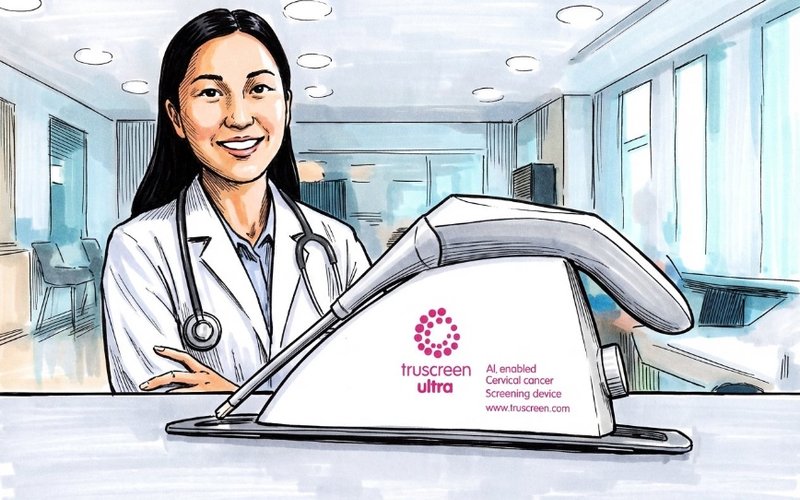

- 01Major China study validates TruScreen's superior performance.
- 02Guideline integration in China expected to drive near-term adoption.
- 03Ongoing Vietnam program expands global reach and market presence.
TruScreen Group (ASX: TRU) announced strong validation results from a major Chinese study for its cervical cancer screening tool, positioning it for guideline integration and wider adoption, alongside its ongoing deployment in Vietnam.
Conducted between 2018 and 2021, the study spanned 64 hospitals across 9 Chinese provinces and involved 14,982 women.
The study’s findings, published in BMC Cancer, demonstrated TruScreen's superior performance compared to Liquid Based Cytology (LBC).
TruScreen achieved a CIN2+ sensitivity of 87% and a CIN3+ sensitivity of 90%, outperforming LBC in detecting high-grade cervical abnormalities.
Furthermore, TruScreen's performance was comparable to hrHPV DNA for both CIN2+ and CIN3+ detection, with the device recording an Area Under the Curve (AUC) of 0.72 for CIN2+ and 0.7 for CIN3+.
Guideline Integration and Market Entry
The strong clinical validation from this major study is expected to significantly support upcoming Chinese guideline updates for cervical cancer screening.
There is anticipated momentum for TruScreen's integration into both CSCCP and COGA guidelines, with an Expert Consensus and the second edition of the COGA Blue Book expected in 2026.
China represents a substantial market opportunity for TruScreen, with approximately 476 million screening-age women.
Inclusion in national screening guidelines could drive widespread adoption and integration into public health programs.
This move aligns with the World Health Organisation's (WHO) 2030 targets for cervical cancer elimination, positioning TruScreen to help address the global screening gap, particularly in emerging markets.
Vietnam Screening Program Progress
Beyond China, TruScreen is also making inroads in other emerging markets.
The company launched a five-year cervical screening program in Ho Chi Minh City, Vietnam, in April 2025.
This community-based initiative aims to screen 260,000 women using the TruScreen Ultra device.
The program is a collaborative effort, forged through partnerships with the Ho Chi Minh City Public Health Association and Gorton Health Services.
This deployment expands TruScreen’s global reach, with devices currently deployed in 29 countries.
Commercialisation and Execution Risks
TruScreen's robust clinical validation in China is a significant catalyst for near-term adoption driven by guideline integration.
Coupled with its ongoing expansion in emerging markets like Vietnam, the company is well-positioned to capitalise on global screening targets, though successful commercial execution remains key.
However, while the clinical validation is a positive step, investors should note that there is no visible revenue data provided in relation to these advancements.
The adoption and commercial success of TruScreen's technology will depend on successful procurement, funding, and the effective rollout of screening programs.
The company also faces ongoing competition from established cervical cancer screening methods, including traditional cytology and hrHPV DNA workflows.
Successful execution of market entry strategies in China and the continued progress of programs in markets like Vietnam are crucial for TruScreen’s growth trajectory.
Get the wire before the market opens.
The ASX small-cap stories that matter, filed before 9am AEST. Curated by the Small Caps desk.