

There are always plenty of debates about the success or otherwise of US President Donald Trump.
However, you only need to look at two simple numbers to demonstrate his absolute failure, at least in the short term, on two key economic areas—trade and the economy.
Tariff War Not Paying Off
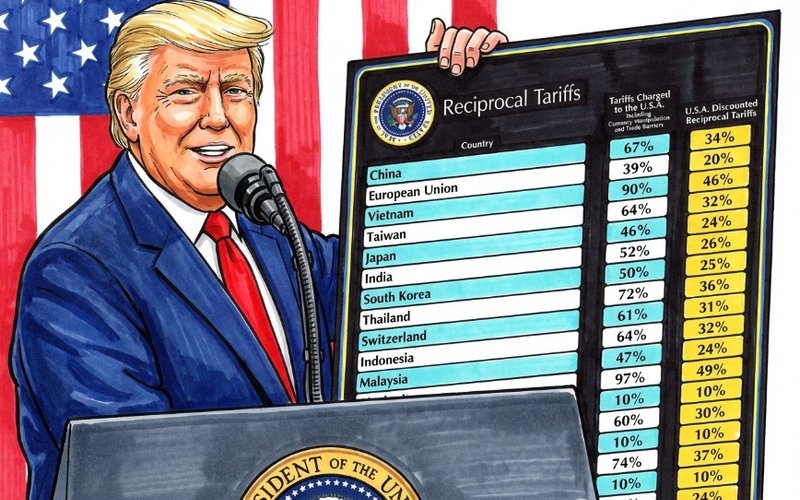
One of Trump’s key aims has been to revolutionise international trade by heaping tariffs on other countries.
The result, he claimed, would be that the US would end up with a booming economy as industry returned and the country would also be awash with cash from the tariffs.
China was a particular target and was hit with punitive tariffs and plenty of rhetoric along with claims that US factories would be revived.
Just last week after a year of this tariff approach China quietly announced the world’s largest ever trade surplus - almost $1.8 trillion.
China has found plenty of new customers for any products that were no longer being sent to the US and has also successfully worked around the tariff barriers with some interesting strategies.
The sheer scale of the Chinese numbers surprised virtually all analysts and once again showed that China remained by far the world’s largest supplier of electric cars and was also still dominating areas such as electronics and simple AI chips.
Chinese Trade Surplus Still Rising
It doesn’t seem to be a flash in the pan either with outbound shipments across all categories up by 6.6% in December – showing that the current record trade surplus is highly likely to be bettered next year.
It is true that exports to the US were down by 20% but this may also be misleading because China managed to skirt around the tariff wall a little by supplying goods through other countries with lower tariffs with the US.
Chinese exports to Asia and Africa were booming and even rose to Europe.
Budget Deficit Continues to Grow
The other figure that should be ringing alarm bells in the US is that its already hefty budget deficit is ballooning.
For December alone, it reached an incredible record amount of $US145b ($A217b), up 67% or $US58b ($A87b) from a year earlier.
Naturally there were a raft of “excuses” such as record outlays due to calendar shifts in benefit payments and receipts but the fact remains that despite all of the high-profile slashing of government spending by DOGE, the US budget deficit is rising inexorably.
Worryingly, revenue from tariffs may also be flattening out.
With some new trade deals having cut tariffs on some nations such as Korea and China, tariffs seem unlikely to be able to move the needle much on the US Budget deficit.
At the same time, the Supreme Court is also due to rule soon on the legality of the tariffs, potentially leaving a really big dent in customs receipts.
Military spending was booming in December and while the overall deficit for the first three months of the fiscal year was down slightly and receipts were up, interest on government debt remains a crushing burden for US taxpayers.
Government Spending at New Record
Outlays for the first three months of fiscal 2026 also hit a record, reaching a staggering $US1.827t ($A2.735t), up $US33b ($A49b) or 2% from the same period a year earlier.
US Treasury public debt interest alone grew by 15% or $US46b ($A69b) to $US355b ($A531b).
That sharp rise in debt servicing costs was driven by two things – a rise in the overall debt load and a rise in the weighted average interest rate paid by the Treasury to 3.32% in December from the 3.28% paid a year earlier.
All of the high visibility slashing of DOGE has failed to make an impact on spending or debt and with debt per taxpayer now above US$355,000 per taxpayer and the US Federal debt to GDP ratio closing in on 125%, it won’t take much of a rise in interest rates to turn a worrying situation into a truly alarming one.
Get the wire before the market opens.
The ASX small-cap stories that matter, filed before 9am AEST. Curated by the Small Caps desk.