

- 01Kuro returned up to 40.3% manganese.
- 0248 of 122 holes had significant hits; 31 topped 20%.
- 03Trek will rank targets for 2027 drilling.
Trek Metals (ASX: TKM) has returned manganese grades of up to 40.3% from its final drilling assays at the Kuro discovery within the Christmas Creek project in Western Australia.
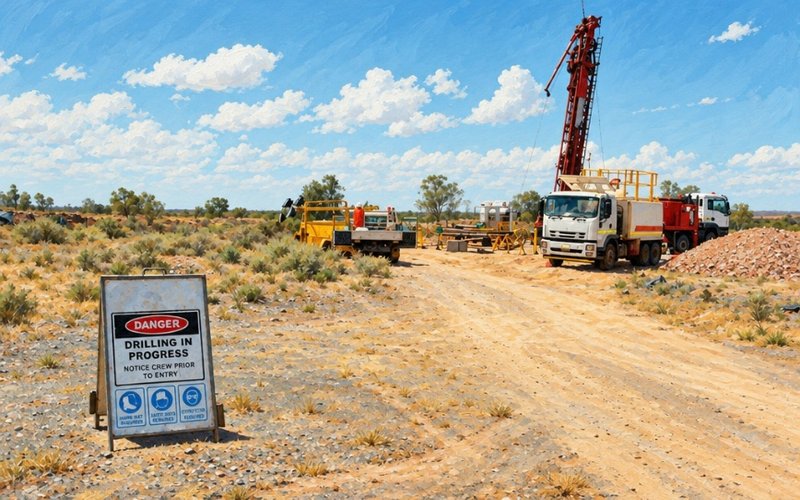
The strongest result was 25 metres grading 31.4% manganese from 18m downhole, including a 12m interval grading 40.3%, as Trek completed its first manganese drilling season.
Across two drilling phases, 48 of 122 holes at Kuro delivered significant manganese intersections, including 31 holes with grades exceeding 20%.
The latest work closes the 2026 campaign and gives Trek a new set of geological and geophysical data to assess before selecting targets for next year.
Shallow Grades Define Discovery
Phase two involved 50 reverse circulation holes testing electrical chargeability anomalies around the initial Kuro discovery, with 10 returning significant manganese intersections above 5%.
Six of those holes contained intersections above 20%, while other notable results included 6m grading 24.4% from 9m and 6m grading 21.1% from 7m.
The main 25m intersection also contained an 8m interval grading 29.9%, and its highest individual one-metre assay reached 49.9% manganese.
All significant intersections in the final batch were encountered between 5m and 51m downhole, with the results broadly matching Trek’s interpretation that mineralisation deepens towards the south-east.
Mixed Regional Results
Outside Kuro, Trek completed drilling at the Nicks, Willis, Austin, Price, and Coogan prospects, with the final batch covering 70 holes across the project.
The Nicks, Willis, and Austin programs did not return significant copper or gold mineralisation, while narrow rare earth and niobium results at Price were isolated and adjacent samples were low.
Three holes tested an induced polarisation anomaly at Coogan intersected disseminated sulphides that may account for the geophysical response, however, the assayed intervals did not yield significant copper or gold mineralisation, prompting Trek to abandon a fourth planned hole.
“While the overall volume of mineralisation we have delineated at Kuro so far is limited, we have discovered what could be an entirely new district with the potential to host multiple centres of mineralisation across a vast distance,” chief executive Derek Marshall said.
“Our expanded tenure package encompasses geology that is highly prospective and virtually untested for high-grade manganese, and we see huge potential to build on this discovery.”
Targeting Wider Potential
Trek is combining drilling results with airborne surveys, ground geophysics, surface geochemistry, and geological mapping to rank prospects for the 2027 field season.
Its exploration effort will extend beyond the areas already drilled at Kuro as the group assesses whether other centres of mineralisation may be present across its wider Christmas Creek holdings.
Further target selection and drilling will determine whether Trek can extend the discovery and establish sufficient geological continuity for a future resource assessment.
“The reasons that Trek entered the region have been validated, with a new discovery coming out of this under-explored part of Western Australia,” Mr Marshall added.
“Trek remains well-funded, with an excellent working relationship with the local stakeholders, and a large landholding with excellent geological potential still to be explored.”
Get the wire before the market opens.
The ASX small-cap stories that matter, filed before 9am AEST. Curated by the Small Caps desk.