

- 01Iron ore moved from annual benchmarks to spot pricing.
- 02Copper may be next; TC/RCs are key.
- 03ABC Commodities IPO bids are open.
Follow this link for your 0.25 points CPD accreditation
Before we get stuck in, one for the diary.
ABC Commodities is heading to market with its IPO, and we have put everything you need in one place on InvestHouse: the research, the media interviews, the prospectus and the bid button.
Bids are open to all investors, retail and sophisticated, so there is no velvet rope on this one.
Do your homework, read the prospectus, watch the interviews and if it stacks up for you, get your bid in before the books close.
View the ABC Commodities offer, research and prospectus on InvestHouse.
Right. To the main event. This week I want to talk about the most boring sounding fight in mining, which may turn out to be one of the most important. It is about treatment charges. Stay with me, I promise there is money in it.
Iron Ore’s Once-a-Year Birthday Party
Younger readers may not believe this, but for about 40 years iron ore had one price a year. One of the big miners (BHP, Rio or Vale) would sit down with one of the big steelmakers, traditionally a Japanese mill, and they would agree a number. That was the "benchmark". The rest of the industry fell in behind it, and the price held from 1 April for the next twelve months. Very civilised. Probably very good lunches.
Then China happened.
Through the 2000s, Chinese steel demand went vertical and supply could not keep up. A spot market grew in China, mostly Indian ore landed at Chinese ports, and it traded well above the benchmark. The miners worked out they were leaving a lot of money on the table. The benchmark jumped 71.5% in 2005, then rose another 65% or more in 2008, with some products nearly doubling. BHP's Marius Kloppers was saying openly that the annual system had to go.
2009 is when it came apart. The GFC hit, and the China Iron and Steel Association took over China's side of the talks and demanded big cuts. The Japanese and Koreans settled with Rio for about 33% off. China would not sign, and Fortescue went around everyone and did its own deal with the Chinese. Then in July, Chinese authorities detained Rio's Shanghai iron ore team, including Australian Stern Hu, in the middle of negotiations. He was later jailed for bribery and stealing commercial secrets. Hard to talk price with someone who has just locked up your negotiator.
By 2010 the miners had had enough. They moved to quarterly pricing based on a three month average of the spot indexes. Quarterly soon became monthly, then pricing straight off spot. Futures followed, first in Singapore and then in Dalian, and these days Chinese traders move the price more than any boardroom does.
So a commodity that once had a single price for the whole year now reprices every few seconds. Keep that in mind, because copper is walking down the same road.
Copper's Turn
First, a quick explainer, because "TC/RCs" is the sort of term that makes people reach for the remote. When a copper mine digs up ore, it crushes it and concentrates it into a powder that is roughly a quarter copper. That concentratethen goes to a smelter, which turns it into the pure copper metal you see trading on the LME. Normally the miner pays the smelter a fee for doing that work: the treatment charge (per tonne of concentrate) and the refining charge (per pound of copper). Together, TC/RCs.
Like iron ore used to, copper sets an annual benchmark for those fees. A big miner (lately Chile's Antofagasta) agrees terms with the Chinese smelters, and long term supply contracts around the world key off that number. Talks traditionally kick off at LME Week in London in October and wrap up around CESCO Week in Shanghai, which started today.
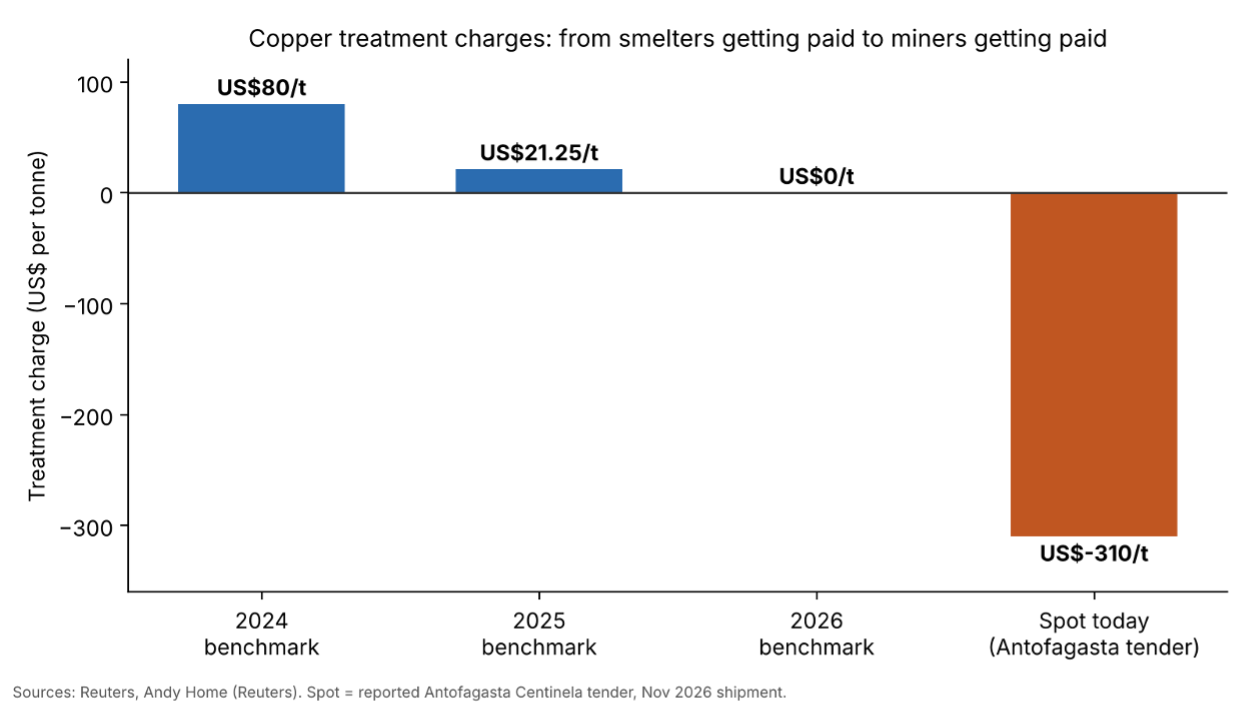
Here is the problem. There is not enough concentrate to go around. China has built smelters faster than the world has built mines, and a run of mine outages has made it worse. So the fee has collapsed. The benchmark was US$80 a tonne in 2024, US$21.25 in 2025 and zero for 2026. In the spot market it has gone well below zero.
Antofagasta recently sold a 10,000 tonne parcel from its Centinela mine at a treatment charge of negative US$310 a tonne, and Teck reportedly sold Highland Valley material in the minus US$370s.
Read that again. The smelters are now paying the miners for the privilege of processing their concentrate. That is the equivalent of the panel beater paying you to fix your car.
Robert Friedland v the Benchmark
This week's note was sparked by Robert Friedland. Yes, that Robert Friedland, Ivanhoe Mines founder and executive chair, so not exactly a neutral observer, but he has been right about copper more often than most.
Ahead of LME Week he posted that for the first time ever there is a real chance no annual benchmark is agreed for 2027. If that happens, concentrate contracts move to rolling spot index pricing. His words: "We cannot understate how significant a change this is."
As CESCO Week opened today he doubled down. The gap between what miners and smelters think the 2027 benchmark should be is the widest it has ever been. The miners, led by Antofagasta, actually want to keep the annual system, but at a deeply negative number. He also says Chinese smelters have signalled they will accept a "sizeable" negative benchmark.
If they do, the non-Chinese custom smelters (the ones that buy concentrate from other people's mines) simply cannot compete and could go out of business. Even if a number is agreed, he thinks part of the market will refuse to use it, which he calls "the beginning of the end".
And the shift is already happening. In July Antofagasta agreed spot indexed sales with some Chinese smelters, breaking a practice that goes back decades. That is exactly how iron ore went: a few side deals, then the whole thing tips.
What it All Means, in Plain English
Miners get paid more for every tonne. Negative treatment charges are effectively a bonus on top of the copper price. For a concentrate producer, that falls straight to margin.
The price of concentrate starts moving daily. No more one number for the year. Earnings get lumpier, but in a shortage the lumps are mostly in the miners' favour.
Smelters outside China get squeezed hard. Chinese smelters can survive on scale, by-product credits (sulphuric acid, gold, silver) and state support. Others cannot, and some will close.
Power shifts upstream. Whoever holds the concentrate holds the cards. That is great news for mines, and even better news for mines that have not yet signed away their output.
Where are the Opportunities?
Not all copper stocks are created equal here, so let me break it into types. These are examples to research, not recommendations, and you should do your own work or speak to your adviser.
Producers selling concentrate. The most direct beneficiaries. On the ASX the bigger names are Sandfire (ASX: SFR) and Capstone Copper (ASX: CSC, TSX: CS), which Macquarie has flagged as its picks for higher copper. For more torque there are AIC Mines (ASX: A1M), Hillgrove Resources (ASX: HGO), and Develop Global (ASX: DVP); and at the higher risk end where better concentrate terms make a bigger difference to thin margins, Aeris Resources (ASX: AIS) and 29Metals (ASX: 29M).
In Canada, look at Taseko (TSX: TKO), whose Gibraltar mine is already reporting lower charges thanks to favourable offtake contracts, Hudbay (TSX: HBM), and Eldorado Gold (TSX: ELD), which picked up Foran's McIlvenna Bay mine, now producing copper and zinc concentrates with gold and silver credits.
Developers that have not sold their offtake yet. This is where I think the real leverage is. When smelters and traders are desperate for feed, they will pay up front to lock in future supply through offtake prepayments and other non-dilutive funding. That means less money raised from shareholders and less dilution.
Names to look at include Hot Chili (ASX: HCH, TSXV: HCH) in Chile, which gives you ASX and Canadian exposure in one, and KGL Resources (ASX: KGL) at Jervois in the Northern Territory, which has kept marketing flexibility over its copper.
Concentrate with gold and silver in it. In a world of negative treatment charges, smelters live on by-products. Concentrate rich in precious metals is worth more to them, so those producers get better terms.
Who loses? Custom smelters outside China, and there is a home grown example. Glencore's Mount Isa smelter and Townsville refinery needed a A$600 million government rescue in October 2025 to keep running until the end of 2028, and Glencore says they are still losing money because of falling treatment charges and the concentrate shortage. That is a twist for north west Queensland miners like AIC, which trucks its concentrate to Mount Isa. They win on terms today, but could lose their local smelter after 2028 and face a longer, costlier trip to market.
And who does not care? Cathode producers such as Cyprium Metals (ASX: CYM) and Marimaca (ASX: MC2), which make copper metal on site through SX-EW and never touch a smelter. They benefit from the copper price, but negative TC/RCs do nothing for them. Know what you own.
Why this Matters for Sophisticated Investors
Here is the bit I really want you to take away. When the market shifts power to whoever holds the concentrate, the best deals happen early, at the developer stage, before the offtake is signed and before the big funds turn up. Those deals are usually done through placements to sophisticated investors under section 708, not on the open market.
If you qualify as a sophisticated investor and you are not already on our list, you are missing those conversations. Put your hand up, tell us what you are looking for, and we will make sure you see the deals before they are done.
Before You Go: Theory of Thing
If you have read this far, you have earned some ear candy. On the latest Theory of Thing, Heath Moss and I cover the Microsoft 365 outage that knocked out Outlook and Teams worldwide, what Nvidia looks like after Jensen Huang, whether China is done with US chips, rising yields after a hot CPI print, and how small caps can survive a tough market.
Listen to "The World Logs Off and Jensen Logs Out" (Season 13, Episode 10).
All the best,
James
General advice warning: This article contains general information only and does not take into account your objectives, financial situation or needs. Companies mentioned are examples for further research, not recommendations. Consider the relevant prospectus or offer document and seek professional advice before investing.
Get the wire before the market opens.
The ASX small-cap stories that matter, filed before 9am AEST. Curated by the Small Caps desk.