

- 01Fed up 25bp; gold muted.
- 02Oil falls; copper wobbles on tariffs.
- 03Gold central-bank demand up; Q2 289t; 89% add.
- 04JPM sees endgame uncertainty; Gold Conf near.
Earn CPD by reading this article!
Well, that was a week. The Fed hiked and didn't cut, gold shrugged, oil's still acting like Tehran hasn't opened a phone line in six months, and somewhere in Adelaide Heath Moss is still explaining why the Swans can win a final they've no business winning. Let's get into it.
We recorded a ripper episode of The Theory of Thing this week with Kerry Stevenson, founder of Gold Events and the woman behind the Australian Gold Conference.
Do yourself a favour and give it a listen.
Heath opened with the macro wrap and the headline is the Fed raised rates twenty five basis points on a print most reckoned was tame, and the market didn't love it.
The ten year briefly popped a five handle before settling back under five percent, the two year's around four seventy, and the thirty year will pay you five twenty eight a year for the rest of your natural life if you fancy locking it in.
Copper wobbled on tariff delay chatter then bounced on a softer US dollar, and oil gapped down to the mid nineties on not much at all, which tells you how jumpy this tape's become.
Then Kerry did what Kerry does best, making central banks printing money sound both terrifying and completely rational at once.
World Gold Council data has central bank buying rebounding hard in the June quarter to 289 tonnes, with 89 percent of banks surveyed planning to keep adding over the next twelve months.
Her line still stands up: you can't print gold, but you sure as hell can print trillions of dollars of paper. It is not the price of gold going up, it is the value of your currency going down.
Which brings us to the Australian Gold Conference, running 13 to 15 October at Crown Towers Sydney. Early bird tickets are $199 until the end of the month, which for three days including Rick Rule, Jordan Eliseo and Alexander Scanlon on stage is an absolute steal.
There's a free education evening on the Tuesday for anyone who's never bought an ounce of bullion, and a proper deep dive across Wednesday and Thursday for everyone else. I'll be there on the mic, so come and say g'day.
JPMorgan’s Lack of a View
That's JPMorgan's own words, in their Oil Markets Weekly note out on 17 September, titled, appropriately, Dry Powder.
Natasha Kaneva's commodities team have been modelling this conflict since it started, and for the first time they've thrown their hands up and admitted they don't know how to model the endgame.
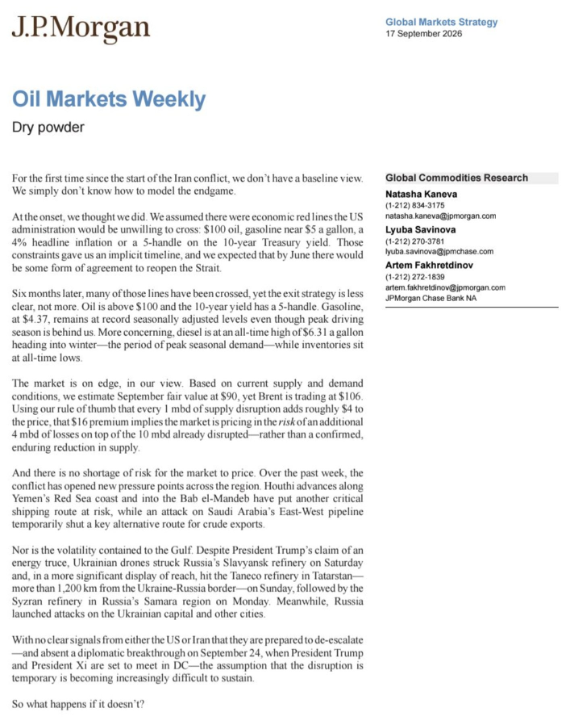
JPMorgan Global Commodities Research, Oil Markets Weekly, 17 September 2026
Worth sitting with why. At the start JPM figured there were red lines Washington wouldn't cross, $100 oil, petrol near $5, 4 percent inflation, a five handle on the ten year, and a deal to reopen the Strait by June would follow.
Six months on, every line's been crossed and there's still no exit ramp. Oil's above $100, the ten year's got its five handle, petrol's at $4.37, a record for this time of year, and diesel is the real horror story, an all time high of $6.31 a gallon heading into winter with inventories at rock bottom.
Kerry made the same point on the pod before I'd even read the JPM note, that diesel quietly runs the world and nobody clocks it until the price doubles.
JPM reckons September fair value for oil is around $90, but Brent's trading at $106. Using their own rule of thumb that every one million barrels a day of disruption is worth about four bucks, that gap prices in the risk of another four million barrels a day going missing, on top of the ten million already knocked out.
That's fear, not a confirmed loss, and it's earned. In the last week the Houthis have pushed further into the Bab el Mandeb, Saudi's East West pipeline copped a hit, and Ukrainian drones reached Russia's Slavyansk, Taneco and Syzran refineries, Taneco 1,200 kilometres inside Russia, while Moscow keeps hammering Kyiv right back. Nobody's blinking.
The date to circle is 24 September, when Trump and Xi sit down in Washington. If that goes nowhere, don't expect the barrel to calm down.
Copper's Quiet Warning
While oil gets all the headlines, Paola Rojas has been quietly banging the drum on copper inventories, worth your time even though her full piece sits behind a paywall.
Her thesis is that a market can survive lower inventories on their own, or declining discovery rates, falling ore grades, or blown out permitting timelines, but not all four at once. Her framing is that warehouse stock levels are where that combined stress eventually shows up, whether the market's watching for it or not.
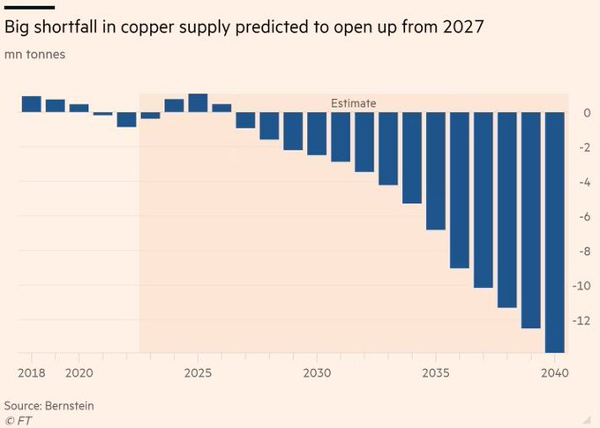
Source: FT / Bernstein
The chart above, out of the FT via Bernstein, does the job better than I can. A cumulative supply deficit opening up from 2027 and stretching to somewhere between twelve and thirteen million tonnes by 2040. That's a structural hole in the global copper supply chain that discovery simply isn't filling.
Every EV, every data centre, every grid upgrade wants more copper than the last decade delivered. File this one under the slow burning story that eventually becomes the only story.
Tungsten: Where the critical minerals war gets real
Now for some actual work. ZeroHedge ran a piece this week on tungsten that deserves more attention than it's getting, because unlike most critical minerals panic pieces this one's got real policy teeth.
The UK government has already put £71 million into restarting a domestic tungsten mine, which tells you how seriously London's taking this.
Almonty Industries chief executive Lewis Black keeps drawing a comparison to 2008, when Japan and South Korea failed to properly fund critical minerals security and paid for it a decade later. His point is the West risks the same mistake with a metal that's irreplaceable in armour piercing rounds, cutting tools and defence supply chains.
Prices tell their own story. Tungsten's sitting around $3,000 a tonne WO3 basis in the US and Europe and hasn't moved much, but China's domestic price is climbing on a raw material shortage of their own. Then there's the mess Beijing's created for everyone else.
China banned the Responsible Business Alliance, a certification body with more than 600 members including Apple, Tesla, Microsoft and Amazon, on 5 August, disrupting the certification Western buyers need to prove their tungsten isn't conflict sourced.
On top of that, from 1 January 2027 the Pentagon extends its ban on Chinese, Russian, Iranian and North Korean tungsten to cover the entire upstream, ore, feedstock and recycled material, regardless of where it's processed, closing the old loophole where Chinese ore got a quick stopover elsewhere before landing in a US defence contract.
Zimbabwe's banned tungsten ore and concentrate exports since July, and Vietnam, the world's second largest producer at roughly 3,400 tonnes a year, is drafting its own proposal to pull tungsten off its export list. Every move tightens the noose right as defence budgets ramp up.
Unsurprisingly the market's paying attention. Jefferies initiated Almonty with a Buy, citing a tightening market. Almonty's also partnered with Rwanda's government, Africa's largest tungsten producer, and tapped Sandvik's Wolfram Bergbau und Hütten unit to process tailings at its Los Santos mine in Spain.
When the majors start locking down tailings deals, the easy tonnes are already spoken for.
See You at AMIC
Quick plug before we go. Small Caps will be at the 15th Annual Australian Microcap Investment Conference, 20 to 21 October at the Sofitel Melbourne on Collins.
Twenty four ASX companies under $300 million market cap presenting, with keynotes from Salter Brothers and ausbiz.
Two days well spent if you're building out a microcap watchlist.
And finally...
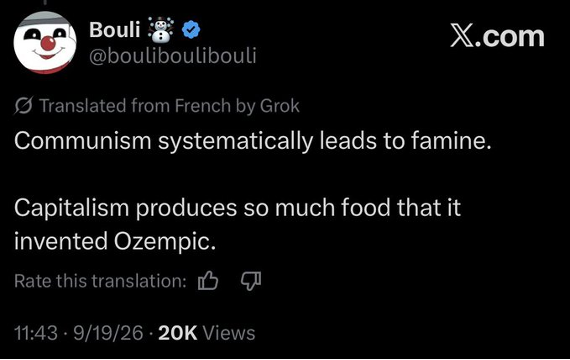
I'll leave you with this one, translated from French by Grok, because it made me laugh harder than anything an economics paper has managed in years.
See you next week.
James
Get the wire before the market opens.
The ASX small-cap stories that matter, filed before 9am AEST. Curated by the Small Caps desk.