

- 01Talnode-C passed 8,000+ cycles at 75% capacity.
- 02~5x conventional life; potential 1m km EV range.
- 03KRI customer pilots underway; 2030 scale-up target.
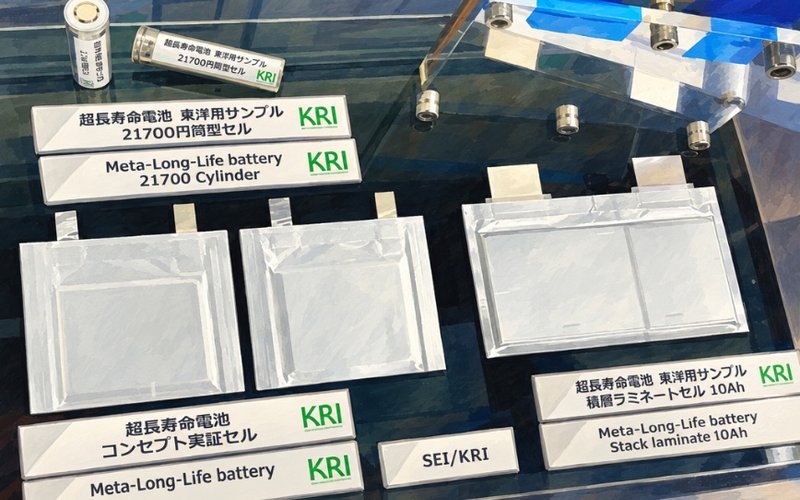
Talga Group’s (ASX: TLG) Talnode-C natural graphite anode has demonstrated solid performance in a revolutionary ultra-long-life lithium-ion battery developed by Osaka Gas contract research and development subsidiary KRI Inc.
The anode has achieved over 8,000 cycles in testing to date to 75% capacity retention —approximately five times the lifespan of conventional lithium-ion cells — and has the potential for an estimated 1 million kilometres cumulative driving range in EVs.
The longer cycle life could maximise the value of battery power in high-utilisation applications and support better total cost of ownership for fleet and robotaxi operators (via lower costs per kilometre), as well as for battery energy storage systems (via lower costs per kilowatt-hour delivered).
KRI’s advanced low-resistance graphite battery cell design provided the stability, homogeneity, and rate capability needed to achieve more uniform electrode reactions over time.
Pilot sample cells containing Talnode-C are now being evaluated by KRI customers including automotive manufacturers and energy suppliers, targeting scale-up to commercialisation and mass production in 2030.
Longer Cycle Life
Talnode-C is a coated spherical purified natural graphite produced by Talga from its Swedish graphite resources using renewable energy and wholly owned process technology to deliver a low emissions footprint, competitive cost and defence-grade supply chain resilience.
In KRI’s evaluation, the smaller, highly crystalline natural graphite particles of Talnode-C used in an optimised electrode have shown low reactivity and high stability, contributing to very long cycle life.
Higher cycle life supports the need for fewer replacements per vehicle-kilometre, reducing the embedded carbon footprint per kilometre driven, complementing Talnode-C’s renewable energy production route and Talga’s Swedish traceable supply chain.
KRI’s technology combined with the Talnode-C anode demonstrates a practical and sustainable path towards long-life batteries, with the potential for batteries that outlast a vehicle and deliver associated positive impacts for society.
Energy Market Potential
Talga managing director Mark Thompson said Talnode-C’s performance in KRI’s ultra-long-life battery was a strong validation of its potential in high-growth mobility and energy storage markets.
“A five-fold increase in battery lifespan improves economics, reduces battery replacements and lowers emissions, addressing major pain points for sector leaders,” he said.
“Natural graphite rarely achieves this lifespan and KRI’s results show that our highly crystalline, homogenous small-flake graphite can outperform synthetic graphite and deliver less reactivity and greater stability over long lifecycles when used optimally.”
“We are proud to support Japanese innovation and a highly respected research institute such as KRI, together with its partners, towards commercialisation.”
Battery Degradation Issues
KRI has previously identified non-uniform electrode reactions as a major cause of lithium-ion battery degradation.
Under fast charging, cold temperatures, or as a cell ages, some parts of an electrode work harder than others and once a cell’s “critical load point” is exceeded, secondary degradation such as lithium plating and gas generation follows, accelerating capacity fade.
KRI’s ultra-long-life lithium-ion battery optimises cell components such as electrodes, active materials, electrolytes, and separators to promote lithium-ion transport and reaction uniformity.
It uses readily available scalable materials with a low environmental impact and is designed to be compatible with existing cell-making lines.
When compared to conventional cells, KRI’s lithium-ion battery can demonstrate a 50% reduction in non-uniform reaction along with a significantly raised critical load point that enables fast and low-temperature charging while suppressing lithium plating, over a lifespan that exceeds 1,600 cycles.
Get the wire before the market opens.
The ASX small-cap stories that matter, filed before 9am AEST. Curated by the Small Caps desk.