
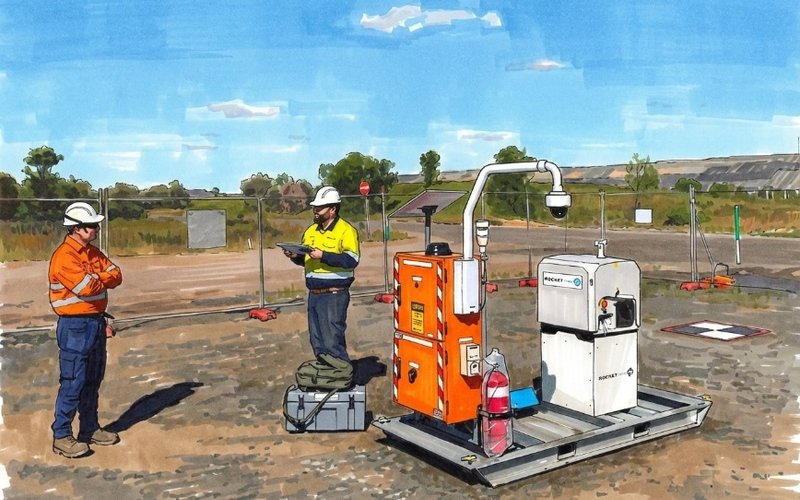

- 01Skylink testing with Tier-1 mining client.
- 02Real-time mission dispatch and data delivery.
- 03SiteTube integrates for end-to-end drone data workflow.
Technology services company RocketDNA (ASX: RKT) has launched the initial testing phase of its Skylink operating system platform with an active deployment to an undisclosed Tier-1 global mining customer.
Developed to meet growing demand in mission requests, the proprietary software product is designed to help manage flight dispatch, resource allocation, and data delivery at scale.
It will enable real-time mission dispatch, prioritisation, and completion tracking for the mining customer, as well as faster deployment, improved operating efficiency and more consistent delivery across the customer’s multi-site operations.
Skylink enables enterprise customers to actively manage mission requests, drawing mission polygons, assigning priority levels and receiving real-time status updates from anywhere, with users able to request drone missions on demand or schedule them in advance, triggering flights at repeated intervals for consistent and reliable data delivery.
Game-Changing Technology
Managing director Christopher Clark said Skylink technology would be a game-changer for mining customers.
“We have effectively built an operating system that unlocks the power of on-demand drone data combined with operational transparency and centralised management, giving our customers the confidence to deploy our autonomous systems at scale,” he said.
“It creates an opportunity for third-party original equipment manufacturers and other software providers to integrate and trigger autonomous drone missions from anywhere in the world, unlocking custom artificial intelligence and geospatial applications that can provide cost savings, improved productivity and increased safety.”
The software can integrate with RocketDNA’s existing SiteTube product, allowing for end-to-end drone data requests and visualisation within a single seamless workflow.
Staged Version Upgrades
Mr Clark said Skylink would continue to evolve through staged version upgrades.
Future releases will focus on deeper automation, integration of autonomy, and expanded system interoperability.
Over time, the software will look to support higher levels of automation (one-to-many operations), enhanced analytics capability, and co-ordinated drone operations across multiple sites.
Engagement with Tier 1 customers will accelerate the product’s refinement and inform future version upgrades ahead of a broader commercial rollout.
Get the wire before the market opens.
The ASX small-cap stories that matter, filed before 9am AEST. Curated by the Small Caps desk.