

Strong results from a field program at Red Mountain Mining’s (ASX: RMX) Utah project in the US have supported the company’s antimony exploration model as it expands its landholding in the area with 19 additional claims.
The new claims cover the southern extension of the major north-to-south trending structural corridor the company believes controls mineralisation at the large and high-grade Antimony Canyon project owned by American Tungsten and Antimony (ASX: AT4).
Antimony Canyon has a defined conceptual exploration target of between 12.8 million tonnes and 15.6Mt grading up to 1.5% antimony for between 96,000 tonnes and 234,000t metal.
Mapping analysis by Red Mountain suggests the host rocks and extensions of the large epithermal mineralising system being targeted at Antimony Canyon are also present within its own project area.
Satellite imagery identified spectral signatures similar to Antimony Canyon that Red Mountain plans to use to map the location of prospective structures and conductive targets beneath cover for on-ground follow-up work, including drill testing.
Northern Claims Extension
Red Mountain’s southern claims area sits higher within the Tertiary volcanic sequence than the northern claims area, with exposures of pre-Quarternary geology comprising the late Tertiary volcanic and sedimentary units that overly the basal volcaniclastic and fluvial sediments of the Flagstaff Formation.
However, it is considered likely that the Flagstaff Formation and the tuffaceous volcaniclastic units that host antimony mineralisation at Antimony Canyon extend into the southern claims at relatively shallow depths.
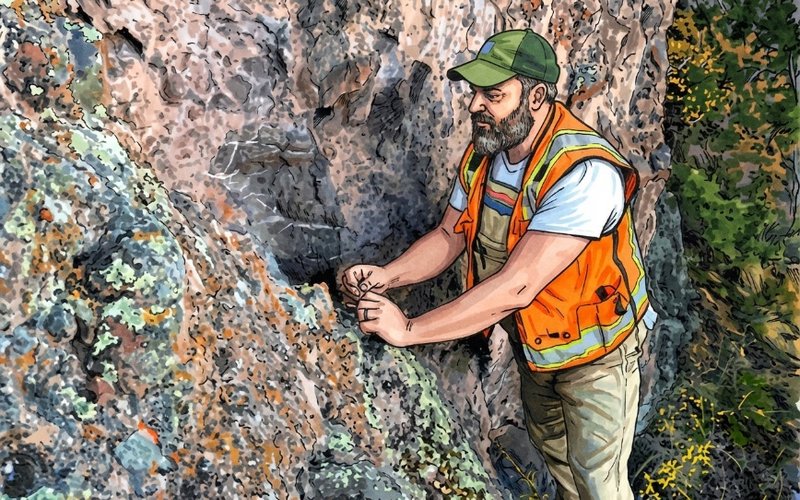
“Where Tertiary volcanic basement is exposed in the southern claims area, it typically occurs as steep, fault-controlled exposures of volcanic breccias and welded tuffs showing pervasive silicification and patchy iron-oxide alteration and local zones of strong fault-controlled quartz veining, which is consistent with the upper portion of an epithermal system and suggests excellent potential for concealed antimony mineralisation at depth,” the company said.
Potential Antimony Mineralisation
Results from American Tungsten’s second phase of systematic rock chip and channel sampling at Antimony Canyon identified multiple samples returning more than 1% antimony, including best results of 29.4% from the Little Emma deposit, 25.24% from the Pluto Workings, and 17.94% from the Gem Mine zone.
Significantly for Red Mountain, American Tungsten discovered a new high-grade “northern extension” that returned up to 3.59% antimony and highlighted the potential for significant antimony mineralisation north and south along strike from Antimony Canyon, including into the Utah project area.
Red Mountain will prioritise additional surface mapping to follow up surface exploration targets from the satellite data and identify, characterise, and sample any relevant outcropping structures and lithologies.
The company is planning to use high-resolution drone magnetics to locate the undercover extensions of structures associated with mineralisation at Antimony Canyon, Northern Extension, and Drywash Canyon.
It will then use this exploration to define prospective areas for more intensive follow-up work, model the extent of subsurface hydrothermal systems, and test both shallow and deeper targets with reverse circulation and/or diamond drilling.
Get the wire before the market opens.
The ASX small-cap stories that matter, filed before 9am AEST. Curated by the Small Caps desk.