
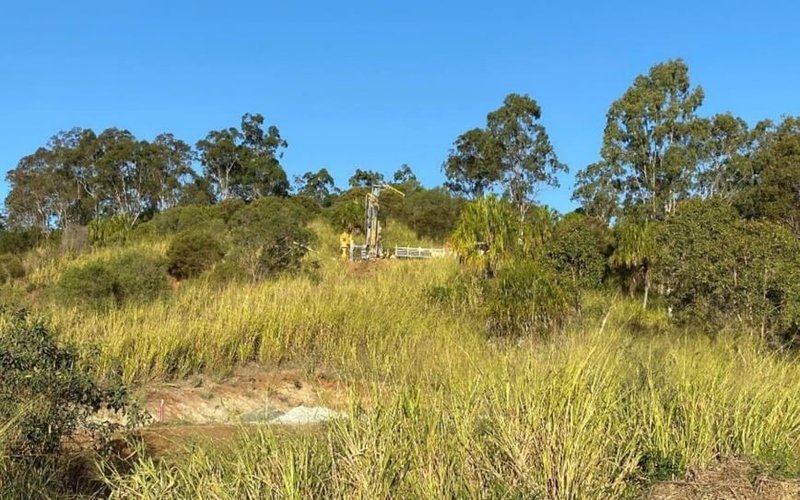

QMines (ASX: QML) has continued its run of drilling success at the Mt Chalmers copper-gold project near Rockhampton in Queensland with more positive returns contained within a new set of assay results.
The latest set of drilling results has again highlighted the high-grade mineralisation potential of the southern end of the Mt Chalmers West Lode.
The company has already identified a new volcanic hosted massive sulphide (VHMS) body in an area now known as Mt Chalmers Southwest located on the southwest side of the West Lode.
To date, the company has completed 14 reverse circulation (RC) drill holes for 1,771m at the sparsely drilled Mt Chalmers Southwest site, with laboratory tests confirming visible base metal mineralisation.
Managing director, Andrew Sparke, said a number of holes have intersected the new VHMS body, which is located outside of the previous mining area, and partly outside of the current resource.
High-grade hits
Significantly, drilling to date in the current program in the West Lode has intersected a number of high-grade copper equivalent grades of up to 9.69% copper equivalent.
Individual polymetallic grades of up to 3.48 grams per tonne gold, 636 grams per tonne silver, 3.56% copper, 5.78% lead and 9.44% zinc over 1.0 metre intervals have also been returned from hole MCRC064.
“The company has completed the initial southwest drilling program, at what appears to be a faulted extension of the West Lode,” Mr Chalmers said.
“Drilling has extended the volcanic hosted massive sulphide mineralisation which will be added into the Mt Chalmers resource model in due course.”
Upside identified
The company has been buoyed by the promising results from hole MCRC064 which produced a possible wide down-dip intersection of 67m at 2.31% copper equivalent.
The hole was drilled at a relatively low angle to the mineralisation due to difficult terrain. The company believes MCRC64 shows excellent continuity of grade within the VHMS at the southwest area of the West Lode.
To help test the true width of the mineralisation, a follow-up hole, MCRC068, was drilled from the opposite direction and produced 5m at 3.90% copper equivalent from 79 metres.
Further drilling confirmed the body is approximately 100m long by 40m wide and 5m thick, dipping at 45 degrees towards the southeast.
Faulted West Lode VHMS
QMines now believes the VHMS is a faulted part of the Mt Chalmers West Lode.
Past work has shown that major faults at Mt Chalmers may not only dislocate the deposit, but separate high-grade and thicker mineralisation from lower grade and thinner extensions of the same stratigraphic horizon.
The company suggests that the faults are likely conduits for mineralised fluids which have preferentially precipitated to one side of these faults, originally the downthrown side, although the West Lode and Main Lode have most likely been upthrown by resurgent doming of the Ellrott Rhyolite.
Mr Chalmers said it is becoming increasingly likely that further additional VHMS mineralisation may exist in association with local (and regional) faults and this knowledge is now being applied to other prospects.
Taking aim at Artillery Road now
QMines is now focusing its exploration drilling activities on following up the recent Artillery Road discovery before commencing exploration at multiple new electromagnetic targets generated earlier this year.
The company is also working to complete the planned pre-feasibility study on the Mt Chalmers project with the company assessing the potential for a stand-alone mining operation.
QMines is also looking to follow up results from the recently completed initial geological reconnaissance and mapping at the Tracker 1 anomaly at Mt Chalmers.
Tracker 1 is located approximately 2.5 kilometres from the Artillery Road prospect.
The recent field reconnaissance work identified outcropping gossan with visible malachite and azurite copper mineralisation with the gossan rock chip samples assaying up to 2.67% copper.
VTEM analysis has identified conductors immediately to the north, labelled VT23. Drill targeting of the stringer zone has been planned, and ongoing mapping may identify additional targets.
Get the wire before the market opens.
The ASX small-cap stories that matter, filed before 9am AEST. Curated by the Small Caps desk.