

- 01Capricorn corridor: 3-4 km of gold gravels south of Peninsula.
- 02Bulk: coarse 13.5 g/t, fine 6.3 g/t.
- 03202 ha lease; small-scale, low-cost operation; bulk testing.
Peregrine Gold (ASX: PGD) has identified gold-bearing paleo gravels extending for approximately three kilometres to 4km immediately south of the Peninsula prospect within its Newman gold project in Western Australia.
The newly named Capricorn prospect emerged from bulk sampling and follow-up geochemical work that confirmed widespread gold anomalism within the shallow gravel system.
Peregrine has lodged a mining lease application covering approximately 202 hectares as it evaluates the prospect’s potential to support a small-scale, lower-cost gold operation.
The company is also assessing whether the broad dispersion of detrital gold points to an additional concealed bedrock source beyond the known auriferous quartz vein at Peninsula.
Sampling Defines Broad Corridor
Initial orientation work comprised seven bulk samples of approximately 500 kilograms collected as far as 120 metres south of the Peninsula quartz vein and processed using a small dry blowing unit.
Although those bulk samples were not submitted for geochemical assay, Peregrine observed gold particles in the panned concentrates and subsequently completed systematic channel sampling along the drainage corridor.
The company collected 61 samples at nominal 100m spacings, with results received for 36 samples and assays from the remaining 25 still pending.
Reported results include a peak coarse-fraction fire assay of 13.526 grams per tonne gold, accompanied by 6.344g/t from the corresponding fine fraction, while other fine-fraction samples returned 1.828g/t and 1.172g/t gold.
Gravel Geometry Takes Shape
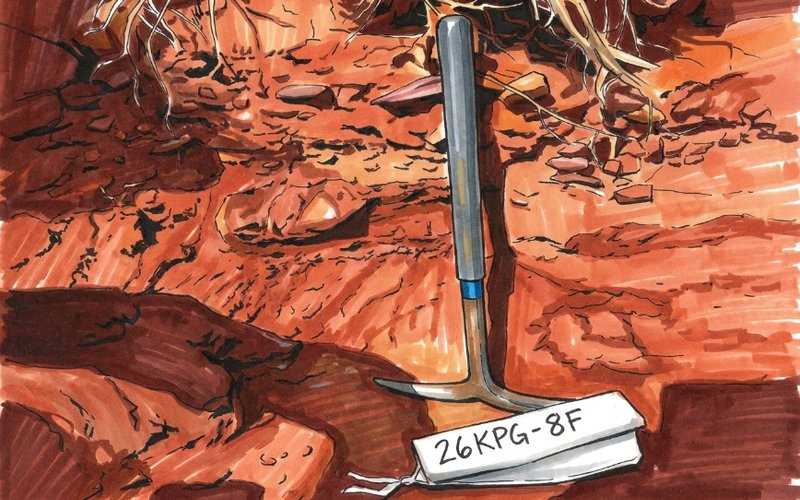
Sampling focused on the floodplain of the main creek extending south from Peninsula, where exposed paleo gravels occur within creek banks and across the broader drainage system.
Peregrine has mapped the gravels over widths ranging from approximately 43m to 185m, with an estimated average thickness of about 1m.
The material comprises poorly sorted sediments ranging from clay-sized particles through to cobbles and includes both gravels within the present drainage and older deposits preserved above the current floodplain.
The scale of the mapped corridor provides a substantial target for follow-up work, although the company has not yet established representative grades, continuity, or a mineral resource.
Bulk Testing Now Planned
Peregrine geologists observed both fine and coarse gold particles in the panned concentrates, requiring larger samples to assess grade, particle-size distribution and liberation characteristics more reliably.
The company is planning additional bulk sampling across Capricorn to determine whether the results can be reproduced over meaningful volumes and along the wider corridor.
That work will also examine how gold is distributed between different gravel fractions and whether localised coarse particles are materially influencing individual assay values.
Any assessment of potential mining economics will depend on the outcomes of this larger-scale test work and the remaining geochemical results.
Dry Processing under Review
Peregrine intends to trial dry blowing as a potential processing method for the gold-bearing gravels.
The technique—which does not require grinding, water, reagents, or wet tailings—could provide a comparatively simple processing option if recoveries prove suitable.
The mining lease application has been structured to align with WA’s mining development and closure proposal framework for small mining operations.
Further work remains subject to program-of-work and heritage approvals, including completion of the required development and closure documentation.
Bedrock Source Adds Upside
Peregrine believes the known Peninsula vein may not fully explain the scale of the anomaly.
The company is therefore developing a dual exploration and exploitation strategy under which evaluation of the gravels could also provide geological information pointing toward concealed bedrock mineralisation.
Technical director George Merhi said the corridor could provide “an additional, potentially low-cost pathway to early-stage gold extraction” if confirmed through further testing.
“It is highly unusual for such a large spatial dispersion of anomalous gold in gravel not to have a primary bedrock source in close proximity,” Mr Merhi said.
“We expect to evaluate the potential for concealed bedrock sources of gold in the process of exploiting this paleo gravel system.”
Get the wire before the market opens.
The ASX small-cap stories that matter, filed before 9am AEST. Curated by the Small Caps desk.