

- 01NVQ targets data-centre CDR
- 02GBR biochar project: ~2Mt biomass
- 03550k t CDR, 250k t biochar
- 04First commercial sales in 2026
NoviqTech (ASX: NVQ) is positioning subsidiary Coralia to supply high-integrity biochar carbon dioxide removal credits into rising demand from data centres and other industrial decarbonisation markets.
The strategy centres on the Great Barrier Reef biochar project in North Queensland, where Coralia has contracted about 2 million tonnes of invasive biomass across four properties.
The project targets 550,000 tonnes of carbon dioxide removal credits over its life under the Puro.earth standard, alongside about 250,000t of saleable physical biochar.
NoviqTech—which completed its 90% acquisition of Coralia in the March quarter—is now working toward on-site production trials, certification, offtake progression, and first commercial credit sales during 2026.
AI Growth Drives Carbon Removal Demand
Coralia’s strategy is built around the widening energy and emissions challenge created by AI workloads and rapid data centre expansion.
The presentation notes that a single ChatGPT query consumes about 10 times more energy than a typical Google search, citing International Energy Agency data.
Major technology companies including Microsoft, Google, Meta, Apple, and Amazon have public carbon-negative or net-zero commitments through the 2030 to 2040 period.
Coralia’s investment case rests on the view that efficiency gains alone cannot offset AI-driven emissions growth, requiring hyperscale data centre operators to source permanent carbon removal credits to bridge the gap to net zero.
Biochar Provides Physical Carbon Storage
Carbon dioxide removal differs from traditional offsets because it actively removes carbon dioxide from the atmosphere and stores it rather than paying for avoided emissions.
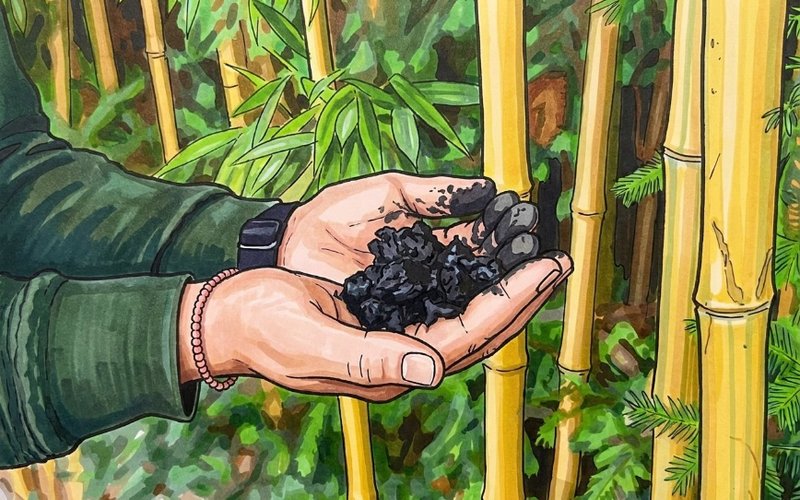
Biochar is a stable charcoal-like solid that stores carbon for long periods and can also be used in soil, concrete and construction applications.
Coralia’s process converts invasive biomass into biochar through low-oxygen pyrolysis, producing both a saleable physical product and a carbon dioxide removal credit.
The company contrasts this permanent removal model with traditional avoidance offsets, with high-integrity biochar carbon removal credits referenced at US$150 to US$220 per tonne compared with about US$5/t for legacy offsets.
Great Barrier Reef Project Anchors Strategy
The Great Barrier Reef biochar project targets invasive weeds such as the Chinese apple tree, which absorb carbon dioxide as they grow but release it back to the atmosphere when they rot.
Coralia also identifies invasive weed removal as a positive environmental action because those species can contribute to sediment runoff into the Great Barrier Reef.
The project process involves removing and chipping invasive weed biomass instead of burning it, heating the material in a pyrolysis machine and converting the carbon into a stable form.
The result gives Coralia two revenue channels from the same input: monetised carbon dioxide removal credits and physical biochar sales.
Pure DC MoU Supports Offtake Pathway
Coralia has signed a non-binding memorandum of understanding (MoU) with A Healthier Earth, the climate-tech arm of hyperscale data centre platform Pure DC.
The MoU covers assessment of a long-term offtake for at least 70% of carbon dioxide removal credits from the Great Barrier Reef project.
It also includes an optional joint venture pathway to co-build the production facility, subject to feasibility work and progression to binding terms.
On-site production trials are planned for May and June 2026, with joint feasibility work to continue through the 12-month MoU period before any potential heads of terms.
Biochar Adds Construction Market Optionality
Coralia is also targeting demand for physical biochar as a low-carbon input for concrete, construction and broader industrial markets.
The presentation cites cement as responsible for about 8% of global carbon dioxide emissions and says biochar additives can reduce that footprint by about 15%.
A strategic research partnership with Swinburne University of Technology is supporting independent validation of biochar concrete applications and the pathway toward supplier testing and commercial development.
Coralia is also targeting soil and agriculture, filtration, asphalt, plastic composites, and animal feed additives as adjacent markets for physical biochar.
Digital Infrastructure Links Both Markets
Data centre construction gives Coralia a potential link between its carbon credit and physical biochar strategies.
The presentation notes that data centre construction is about 40% concrete and highlights growing use of low-carbon concrete by global infrastructure and technology groups.
Amazon Web Services is rolling out low-carbon concrete in new data centres in Japan, while Meta has piloted and deployed low-carbon concrete in data centre builds.
Holcim is also piloting net-zero biochar concrete made with 100% recycled aggregates, reinforcing Coralia’s view that low-carbon construction inputs could become a scalable decarbonisation opportunity.
2026 Milestones Define Near-Term Path
NoviqTech’s near-term Coralia roadmap includes pilot trials and Puro.earth assessment work in the June quarter.
The September quarter targets Puro.earth certification, progression of offtake heads of terms with Pure DC and the Swinburne research partnership supporting low-carbon concrete deployment.
The December quarter targets first commercial CO2 Removal Certificate issuance and sale, expansion to additional properties, and a commercial partner for biochar concrete trials.
NoviqTech is also pursuing a name change and rebrand, cost discipline, asset rationalisation, and feedstock footprint expansion as part of the corporate outlook.
Get the wire before the market opens.
The ASX small-cap stories that matter, filed before 9am AEST. Curated by the Small Caps desk.