
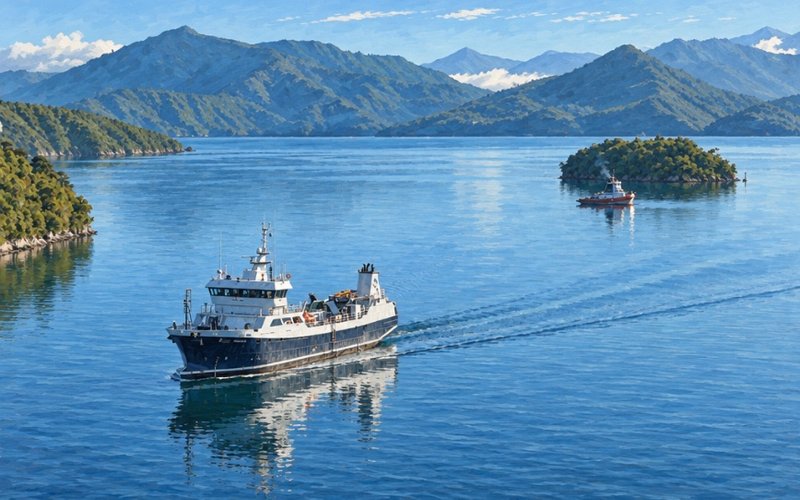

- 01NZ King Salmon returned to profit, earning A$24.9m in FY26.
- 02EBITDA hit A$31.9m as sales volumes rose to 5,885t.
- 03Emissions intensity fell 8%; biomass grew 46%.
New Zealand King Salmon Investments (ASX: NZK) has returned to profitability with record operating earnings and lower emissions intensity as improved fish survival and growth supported a recovery in harvest volumes.
The company generated net profit after tax of A$24.9 million (NZ$30.7m) for the 12 months ended 30 September 2026, compared with a net loss of A$5.1m (NZ$6.3m) over the preceding eight-month reporting period.
Pro-forma EBITDA reached A$31.9m (NZ$39.4m), exceeding the upper end of revised guidance of A$31.6m (NZ$39m).
Revenue reached A$171.2m (NZ$211.4m) as sales volumes increased to 5,885 metric tonnes from 3,260t, with North America and New Zealand accounting for 37% and 36% of revenue respectively.
While the longer reporting period contributed to the improvement, stronger aquaculture performance drove production efficiencies and helped rebuild livestock biomass ahead of further expansion.
Improved Feeding and Husbandry
NZ King Salmon harvested 5,993t on a gilled and gutted (G&G) basis, with closing liveweight biomass rising 46% to 6,215t.
Improved feeding and husbandry reduced mortality and supported a 13% improvement in the feed conversion ratio, with the increased biomass contributing a net fair value adjustment of A$10m (NZ$12.3m) to statutory earnings.
Average feed prices increased 16%, with shortages of fish meal and oil and a weaker New Zealand dollar contributing to rising costs.
“This year affirms our confidence in our stable platform from which to grow,” chair Mark Dewdney said.
“The board is pleased with the operational performance, and the measured and carefully sequenced approach to future growth.”
Fish Farming Flexibility
The Ronja King wellboat entered operations in May, allowing the group to transfer fish between farms and improve flexibility across its inshore and offshore network.
The company has installed two pens and a mooring grid at its Blue Endeavour offshore pilot farm, completing a systems test with fish transferred back inshore in November ahead of an anticipated February harvest.
The first full pilot cycle is scheduled to commence in December, while design work continues on the Tentburn recirculating aquaculture system (RAS) pilot and the future Cloudy Bay processing facility.
NZ King Salmon invested A$15.1m (NZ$18.7m) in capital expenditure during the year, including A$9.1m (NZ$11.2m) across Blue Endeavour, RAS, and Cloudy Bay.
The company finished September with net cash of A$39.1m (NZ$48.3m).
Lower Emissions Intensity
The recovery in harvest volumes helped reduce greenhouse gas (GHG) emissions intensity across all three emissions scopes by 8% to 12.82 tonnes of carbon dioxide equivalent per tonne (tCO2e/t) of G&G harvest.
Absolute emissions nevertheless reached 76,847t of carbon dioxide equivalent (CO2e) compared with 46,414t CO2e over the shorter preceding period, with the wellboat contributing to increased Scope 1 emissions.
Indirect value-chain emissions accounted for 95.4% of the total, while combined Scope 1 and 2 emissions intensity declined 6% to 0.59tCO2e/t of G&G harvest.
PricewaterhouseCoopers provided limited assurance over absolute Scope 1 and 2 emissions, but not Scope 3, and highlighted departures from GHG Protocol requirements including the classification of certain leased asset emissions.
The board opted against preparing separate climate-related disclosures under interim regulatory relief but intends to continue voluntary GHG reporting and limited assurance over Scope 1 and 2 emissions.
Higher Harvests to Offset Costs
NZ King Salmon expects pro-forma EBITDA of A$29.2m to A$36.5m (NZ$36m to NZ$45m) for FY27, with higher harvest volumes expected to offset increased feed and wellboat operating costs.
The group is targeting G&G harvest volumes of 7,600t to 8,800t in FY27 and anticipates a further increase to between 8,500t and 10,000t in FY28.
Capital expenditure is forecast at A$20.3m to A$24.3m (NZ$25m to NZ$30m) in FY27, with dividends remaining on hold for the foreseeable future as the group invests in growth.
Shareholders are expected to vote in mid-February 2027 on resolutions relating to a proposed share transaction involving China Resources Asset Management, Oregon Group, and the trustees of the Porus Holdings Trust.
Get the wire before the market opens.
The ASX small-cap stories that matter, filed before 9am AEST. Curated by the Small Caps desk.