
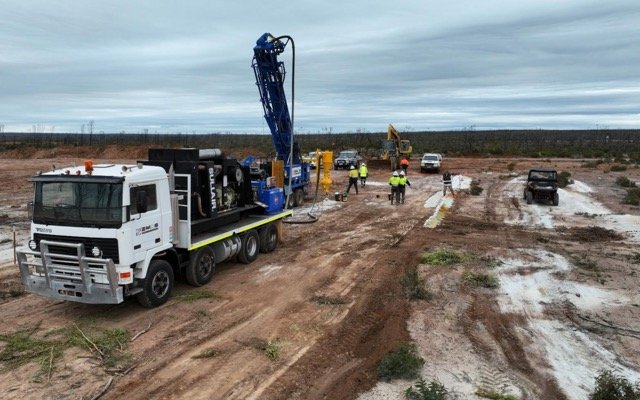

New holes from a 109-hole infill drilling campaign at the Kat Gap gold project in Western Australia have returned more high-grade intercepts for owner Classic Minerals’ (ASX: CLZ).
The results were generated from 11 holes for 680 metres, located immediately east of the recently-mined bulk sample pit.
Drilling was mostly concentrated on an area measuring 100m to 300m north along strike of the cross-cutting Proterozoic dyke.
Highlight assays were 10m at 16.19 grams per tonne gold from 37m, including 1m at 45g/t from 46m; 10m at 15.34g/t gold from 29m, including 2m at 43g/t from 31m; and 12m at 9.60g/t gold from 28m, including 4m at 25.34g/t from 36m.
Other notable intercepts were 6m at 8.68g/t gold from 59m, including 1m at 30.20g/t from 64m; 4m at 6.89g/t gold from 33m, including 1m at 16.10g/t from 36m; 4m at 6.69g/t gold from 26m, including 1m at 16.90g/t from 26m; and 13m at 2.66g/t gold from 41m, including 1m at 16.10g/t from 44m.
Drilling was conducted on 10m by 10m, and 10m by 5m spacings to hit further high-grade pinch and swell quartz veins beneath the bulk sample pit.
It is also expected to provide more accurate resource model data for final pit optimisation and design work.
Classic had previously drilled 35 holes for 2,125m during July and August and confirmed another 74 holes totalling 4,985m remain to be completed under the current program.
Closer-spaced drilling
The need for closer-spaced infill drilling came from the recent bulk sample mining operation where the pit was centred on an area of the resource block model, drilled on a 10m by 10m, and 10m by 5m drill pattern, which came closest to the surface.
The ore zone exposed during bulk sample mining showed strong evidence of pinching and swelling of the main quartz veins over relatively short wavelengths of around 15m.
To gain a higher level of confidence in the overall status of the current resource block model and to ensure adequate intersection of higher-grade components of the gold ore zone, Classic said drilling had to be conducted on at least 10m-spaced sections and 10m-spaced holes.
The spacing will enable an upgrade from Kat Gap’s current inferred status to indicated, which is needed for final pit design work.
The infill program will also dramatically reduce the number of grade-control reverse circulation holes required in pit once operations are underway.
Get the wire before the market opens.
The ASX small-cap stories that matter, filed before 9am AEST. Curated by the Small Caps desk.