
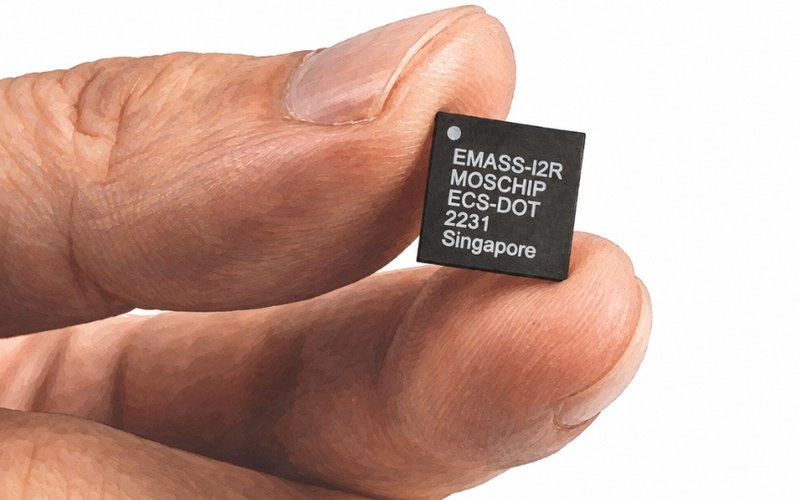

- 01Up to 56x less inference energy than selected chips.
- 02Up to 9x faster, with higher accuracy across four workloads.
- 03Core-only power figures; evaluation kits available via DigiKey.
Nanoveu (ASX: NVU) has reported new benchmark results for its EMASS subsidiary’s ECS-DoT-22 chip, showing markedly lower energy consumption per AI inference than selected published competing devices.
The tests used neural-network models purpose-built for the chip’s accelerator across keyword spotting, visual wake words, image classification, and anomaly detection.
Nanoveu measured improvements in processing speed of up to nine times against its earlier reference models on the same hardware, while achieving higher accuracy across all four workloads.
Against the published low-energy results of Syntiant Core 2 on three workloads and BrainChip (ASX: BRN) AKD1000 on anomaly detection, the new models used between 17 and 56 times less energy per inference.
The company also compared its results with MLCommons-verified measurements from Asygn’s ColibryNPU, finding energy consumption between 3.3 and 18 times lower across the four workloads at Asygn’s 40MHz operating point.
Reduced Power Demand
For keyword spotting, the optimised model consumed 0.564 microjoules (µJ) per inference against 3.07µJ for the 2024 reference model, while anomaly detection fell from 0.8µJ to 0.385µJ.
Image classification energy consumption fell from 5.5µJ to 2.67µJ, although visual wake words increased 6% to 3.94µJ despite improvements in accuracy and processing speed.
At a clock speed of 50 megahertz (MHz), keyword spotting ran nine times faster, image classification 4.5 times faster, and anomaly detection three times faster than the corresponding reference models.
Each new model exceeded the applicable MLPerf Tiny reference accuracy, with the keyword-spotting model recording 92.13% against the reference result of 91.66%.
Nanoveu measured the chip’s core supply consumption during inference, meaning the figures exclude other supply rails and board-level components rather than representing complete device energy use.
Customer Testing Support
Nanoveu is targeting battery-powered sensors, wearables, hearables, and industrial monitoring equipment that could process signals locally rather than transmitting continuous raw data to the cloud.
At 10 keyword-spotting inferences per second, its estimated chip-level AI compute consumption is approximately 6 microwatts, which could support continuously operating sensing applications.
ECS-DoT-22 evaluation kits are available through DigiKey following a distribution agreement disclosed on 10 November, allowing potential customers to test the technology on their own workloads, while EMASS expects to release its integrated development environment and AI compiler during November alongside the benchmark models and scripts needed for independent replication.
“These models were built for our accelerator, and the difference shows: more accurate than the reference on every workload, up to nine times faster, and keyword spotting and anomaly detection below a microjoule,” EMASS founder and Nanoveu director Mohamed Sabry said.
“This is the class-leading performance the next generation of always-on devices needs across hearables, wearables, smart devices, industrial sensing, robotics, and drones, and with the evaluation kits now on DigiKey, it is performance customers can put on their own bench.”
Get the wire before the market opens.
The ASX small-cap stories that matter, filed before 9am AEST. Curated by the Small Caps desk.