

- 01Gold trend tops 2km, doubling known strike.
- 02North mineralisation traced to 240m; remains open.
- 03More assays and resource modelling are pending.
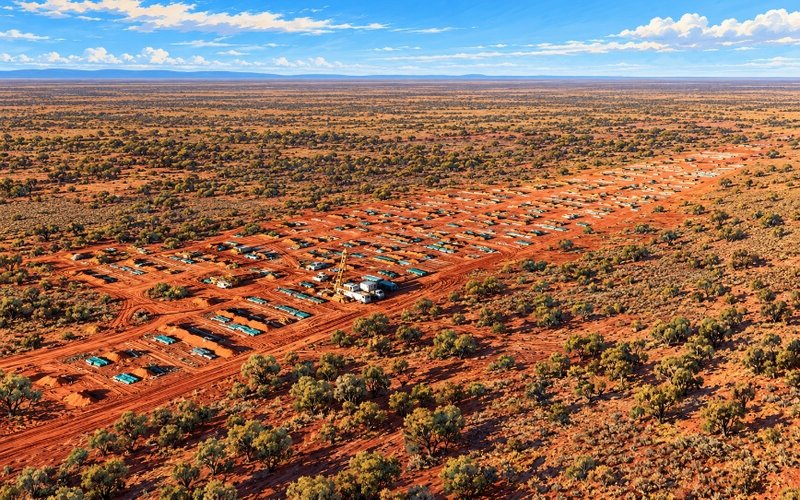
Marmota (ASX: MEU) has doubled the known strike of high-grade gold zones at its Greenewood discovery in South Australia after fresh drilling extended mineralisation northwards and at depth.
The latest results complement southern extensions identified at Mainwood earlier this month, taking the combined Greenewood-Mainwood mineralised trend beyond two kilometres.
Northern drilling encountered high-grade gold across most of the extension holes, with the mineralised system now traced through about 20 additional drill sections and the northern end of the system remaining open along strike and at depth.
The discoveries follow a 337-hole exploration campaign completed in mid-October, with further assays and resource modelling still to come.
Greenewood and Mainwood form part of the Golden Moon joint venture, in which Marmota holds 90%, and lie around 35km northwest of its wholly owned Aurora Tank gold deposit.
Northern Drilling
Marmota has tracked high-grade gold almost continuously from within 16 metres of surface to 240m downhole, with the deposit showing remarkable geological continuity and predictability and multiple holes featuring intersections containing over 40 gram-metres.
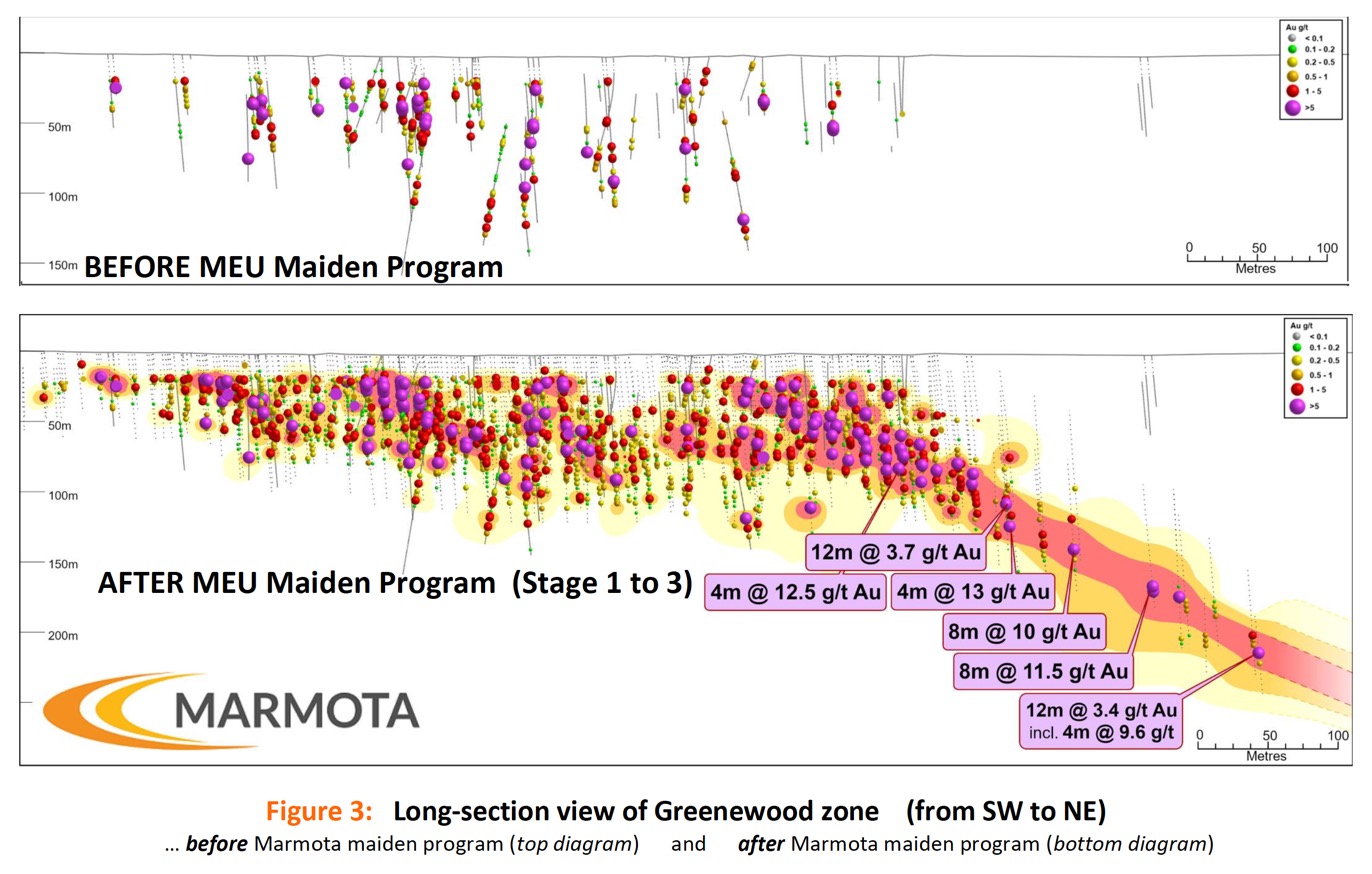
The second batch of results from the 2026 program included 8m at 11.5 grams per tonne gold from 184m downhole, including 4m at 15g/t.
Another intersection returned 8m at 10g/t from 152m, including 4m at 18g/t, while a separate 12m interval graded 4.5g/t from 132m.
Additional results included 4m at 12.5g/t from 92m and 20m at 2.1g/t from 88m, reinforcing the spread of higher-grade mineralisation across the northern extension.
Remaining 4m composite results are still being received, after which more detailed 1m assays are expected to contribute to Marmota’s Gawler Gold resource model.
Southern Discovery
Earlier October assays from the Mainwood zone established high-grade mineralisation at the opposite end of the trend, including 16m at 4.2g/t from 24m and 20m at 3.1g/t from 32m.
A broader 28m interval grading 2.1g/t from 36m added evidence of substantial mineralised widths in the southern extension, where Marmota had not previously drilled, while the combined results have expanded the known high-grade footprint in both directions rather than simply extending one established end of the discovery.
At one northern section, historical holes drilled in 2017 stopped short of a deeper high-grade zone subsequently intersected by Marmota, illustrating the importance of testing beneath previous drilling.
Marmota’s maiden program at Greenewood is yielding some of the best gold results seen in the Gawler Craton since the discovery of the Challenger deposit in 1995.
The program has already defined a nearly-continuous high-grade mineralised system, with excellent continuity along strike and multiple bonanza gold grades including 33m at 10g/t gold from 22m downhole, 22m at 5.1g/t gold from 49m, 1and 2m at 5.4g/t gold from 19m.
Ongoing Resource Work
The completed reverse circulation campaign totalled 32,085m, comprising 110 holes over 13,068m at Greenewood and 227 holes over 19,017m at Mainwood.
As well as testing northern and southern extensions, the program aimed to increase drill density to support an indicated resource classification for Greenewood and inform the broader Gawler Gold scoping study.
“Even before all the results are in, this program is already an outstanding success,” chair Colin Rose said.
“The two core exploration objectives [high-grade gold to the north and south, at depth] have both already been realised.”
“We are ramping the pace up further, generating the data as rapidly as possible so that we have the optimal answers to a variety of relevant production planning issues for Gawler Gold, including where we start first.”
Get the wire before the market opens.
The ASX small-cap stories that matter, filed before 9am AEST. Curated by the Small Caps desk.