
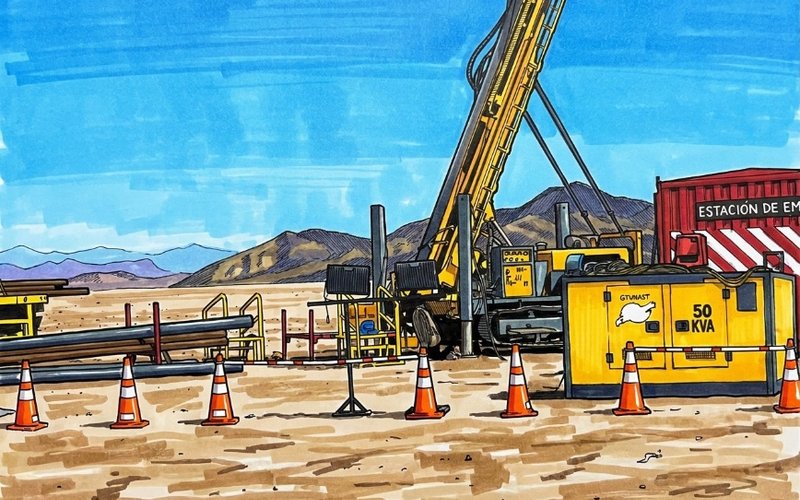

- 01- Visible Cu in 2nd hole; IOCG-style.
- 02- Intervals 219–510m; ~700m strike.
- 03- Assays due end-May (hole 3) and early-Jul (hole 4).
Lodestar Minerals (ASX: LSR) has confirmed visible copper and iron oxide copper gold-style mineralisation in the second diamond hole at its Three Saints project in Chile, strengthening its interpretation of a larger undercover mineralised system.
The company has observed multiple mineralised intervals in hole L3SDD004 from 219 metres to 510m, including visible native copper, chalcopyrite, pyrrhotite, magnetite and pyrite while drilling remains in progress.
L3SDD004—which sits about 700m from the maiden hole L3SRD003—was designed to test continuity of mineralisation across the annular magnetic negative anomaly interpreted as a demagnetisation zone.
Lodestar is yet to receive assays for either hole, with results from L3SRD003 expected by the end of May and results from L3SDD004 expected in early July.
Second Hole Extends IOCG Interpretation
L3SDD004 was drilled from the northern edge of the magnetic anomaly toward its centre, while the maiden hole was drilled from the southern edge toward the same target zone.
The two holes are angled toward each other along a north-east to south-west section to test the lateral expression of mineralisation within a geophysical anomaly approximately one kilometre in diameter.
The observed mineralisation between the two holes now sits more than 700m apart, highlighting the potential scale of the system beneath sand and gravel cover in the Atacama region, with the system remaining open at depth and also to the north, south, and between the two drilled holes.
The newer hole shows stronger, more continuous, and more pervasive alteration than the earlier one, with the alteration assemblage previously found at depth now identified at shallower levels.
It also confirms that the annular magnetic negative anomaly is the expression of a mineralised iron oxide copper gold (IOCG)-style system.
Assays to Define Significance
Lodestar cautioned that all current observations are qualitative, and that laboratory assays are required to determine copper grades and assess the significance of the mineralisation, with drill core to be submitted for multi-element analysis after detailed logging and cutting in La Serena.
Chief executive officer Coraline Blaud said that results from the second drill hole are contributing to an improved understanding of the system initially identified in the maiden hole.
“The ability to reproduce and extend mineralisation over a 700m strike length provides increasing confidence we are vectoring towards the core of the system,” she added.
The final hole depth will be determined by ongoing geological observations.
Three Saints is located in Chile’s Coastal Cordillera at an altitude of about 250m, around 35km from the coast and 20km from the main highway, in a region of established infrastructure and mining districts.
Get the wire before the market opens.
The ASX small-cap stories that matter, filed before 9am AEST. Curated by the Small Caps desk.