
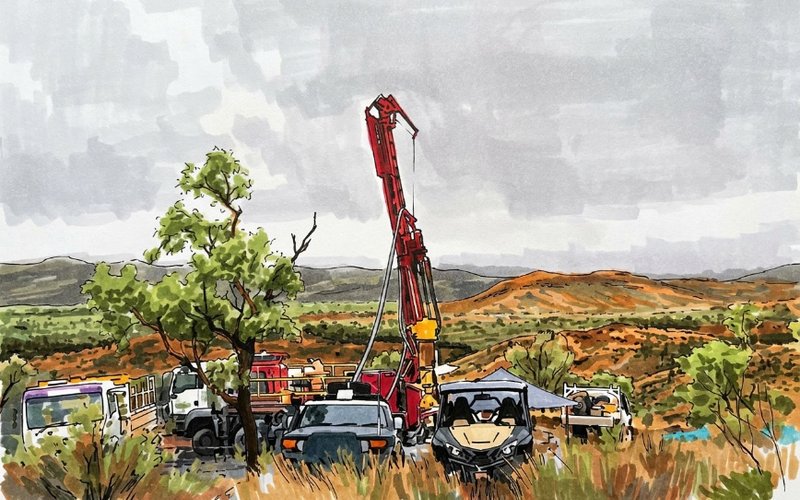

- 01EL34245 granted; 384 km2 in Harts Range for Sybil.
- 02Desktop to field: mapping, sampling.
- 03Ground EM to constrain conductor; drill pending.
Litchfield Minerals (ASX: LMS) has been granted exploration licence EL34245, covering approximately 384 square kilometres within the expanded Harts Range position in central Australia.
The licence allows the company to advance the Sybil copper target located approximately 34km south-east of its Oonagalabi polymetallic project.
Sybil was initially identified by Mithril Resources (ASX: MTH) through historical exploration across the Lizzie Creek area.
Subsequent exploration by Mithril recorded surface rock-chip results of up to 0.9% copper and 0.1% zinc at Sybil, with the Lizzie Creek target seen as occurring in a geological setting comparable to the nearby Basil copper-cobalt system.
Litchfield believes the multiple independent datasets, together with a broader gravity response and favourable geological and structural setting, support the planned follow-up at Sybil.
Sybil Review and Field Work
With the granting of EL34245, Litchfield will look to reassess Sybil as part of a broader, belt-scale review of Harts Range, moving it from desktop interpretation to field validation that will include geological mapping and resampling of historical copper occurrences.
Preliminary modelling of a historical airborne electromagnetic (EM) response indicated numerous large, shallow, and north-dipping conductor plates extending over more than 1km length at the target.
New ground EM work is expected to better constrain the geometry, strength, and depth extent of the conductive response ahead of future drill testing.
Litchfield will commence field work over the coming weeks, with the results to be integrated with existing geological and geophysical datasets to determine if the company progresses to more advanced target definition and drill testing.
Belt-Scale Strategy
Managing director Matt Pustahya said the new licence would enhance the belt-scale strategy.
“The value of our approach is that we can bring together work completed by different explorers at different times and for different purposes, and assess it within one geological framework,” he said.
“Sybil is a good example—none of those datasets on their own determine what is in the ground; however, together they give us a clearer reason to undertake the next stage of work as well as helping refine the direction of our efforts.”
“Our priority is to validate the historical information, better constrain the conductor with ground EM and determine whether the target warrants progression toward drilling.”
“This is the approach we are applying across Harts Range: integrate the evidence, reduce the geological uncertainty, and direct capital to the targets that continue to strengthen as more information is added.”
New Oonagalabi Targets
Litchfield is working on refining new targets at Oonagalabi and drilling a series of new holes across the Main Zone to further test scale, geometry and controls on the mineralisation identified to date.
Broad-to-narrow zones of mineralisation were recently encountered in Phase 3 drilling at Main Zone, with several holes confirming lateral and vertical continuity.
The work returned a best combined intercept of 68.26m at 0.62% copper, 1.44% zinc, and 4.3g/t silver from 10m that included 19.66m at 0.66% copper, 2.58% zinc, and 5.6g/t silver from 10m, as well as 14m at 0.52% copper, 1.55% zinc, and 6.1g/t silver from 36m.
The company will also test its evolving geological model, including the potential for a steeply dipping shear zone to be a key control on mineralisation, while targeting areas where this structural setting may have delineated higher-grade copper-zinc mineralisation.
Get the wire before the market opens.
The ASX small-cap stories that matter, filed before 9am AEST. Curated by the Small Caps desk.