
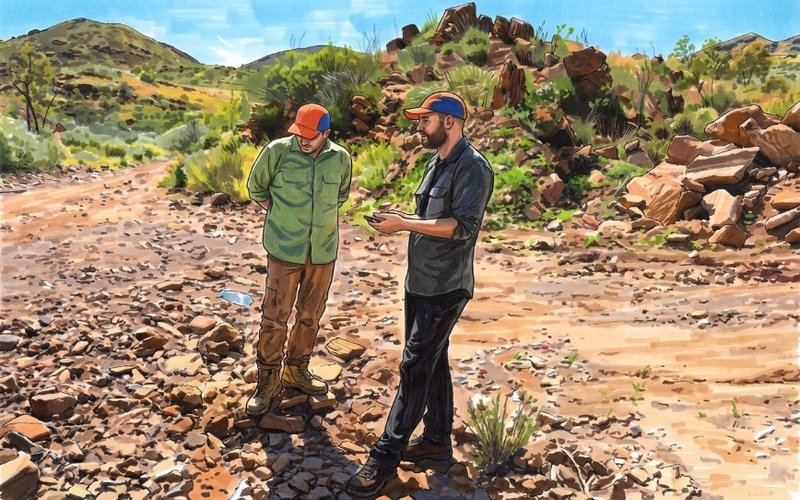

- 01Litchfield reframes Harts Range as belt-scale Cu-Ni system.
- 02BHP Xplor funding accelerates the model and targets.
- 03MT, seismic, gravity data map C2 conductor.
A review of Litchfield Minerals’ (ASX: LMS) Harts Range portfolio in the Northern Territory has reframed it from a collection of copper-nickel deposits and prospects into a belt-scale mineral system with the potential to host significant discoveries.
Research backed by funding from BHP Xplor under a nine-month accelerator program has materially advanced the company’s understanding of mineralisation across the region and strengthened its view that the belt carries key ingredients for large copper-nickel sulphide deposits.
Integrated datasets from magnetotellurics (MT), seismic reflection, gravity, magnetic, structural, and isotopic surveys have mapped parts of the system end-to-end.
Litchfield has subsequently placed the data in a coherent mineral systems model to help generate drill-ready exploration targets.
Strong and Deep Conductor
The data indicated fertile deep-source, long-lived, mantle-tapping structures and known sulphide mineralisation located above major crustal pathways.
The most significant finding appears to be the strong and deep C2 conductor sitting directly beneath the Blackadder-Baldrick nickel-copper-platinum group elements prospects (owned by private explorer Typhoon Minerals).
Crucially, the conductor is not evident in broader 50 kilometre-scale regional datasets and suggests further significant conductors may remain hidden in previously-explored areas where finer resolution MT surveys have not yet been completed.
Recent Oonagalabi Drilling
Harts Range hosts the Oonagalabi polymetallic (copper-zinc-silver-base metals) deposit 135km northeast of Alice Springs, where Litchfield recently identified thick copper-zinc mineralisation in Phase 3 drilling.
A best combined intercept of 68.26m at 0.62% copper, 1.44% zinc and 4.3 grams per tonne silver from 10m was reported from 11 reverse circulation holes for 1,772 metres and three diamond holes for 1,217.9m across the Bomb-Diggity, VT1, VT2, and Main Zone targets.
Litchfield will carry out two 50km-long MT and gravity line surveys with 1km MT and 500m gravity spaced stations across Harts Range to detect further C2-style conductors.
The company expects the new survey to provide more detail and higher resolution than the one that unearthed C2.
District-Scale Mineral System
Managing director Matt Pustahya said input from BHP Xplor had “fundamentally changed” the company’s view of Harts Range.
“While Oonagalabi remains a key focus of our exploration efforts, our understanding of the region has evolved significantly — we are now viewing it within the context of a broader, district-scale mineral system characterised by deep conductive architecture, long-lived mantle-tapping structures and repeated mafic and ultramafic magmatism with known sulphide mineralisation associated with major crustal pathways,” he said.
“We now see how the ingredients for large-scale copper-nickel sulphide deposits fit together across the broader Harts Range belt, and we believe the C2 conductor provides a compelling proof-point for our exploration model, demonstrating a direct link between deep conductive architecture and known mineralisation.”
He said the next phase of exploration would involve refining drilling around Oonagalabi and turning a belt-scale mineral system into a pipeline of drill-ready targets across the Harts Range portfolio.
Equity-Free Funding
BHP’s Xplor program gave Litchfield equity-free funding and access to a global network of technical experts, mentors, leadership coaches, technologies, and exploration methodologies that might otherwise be inaccessible to a junior company.
Mr Pustahya said it had accelerated the company’s understanding of the Harts Range mineral belt by encouraging a more structured, mineral systems-based approach to exploration.
“Through collaboration with BHP and the broader Xplor cohort, we have been able to integrate new datasets, advance our geophysical interpretations and use emerging technologies in our exploration workflow,” he said.
“The program has accelerated our technical capability and strategic thinking, helping us to think beyond individual prospects and towards belt-scale discovery opportunities.”
Get the wire before the market opens.
The ASX small-cap stories that matter, filed before 9am AEST. Curated by the Small Caps desk.