
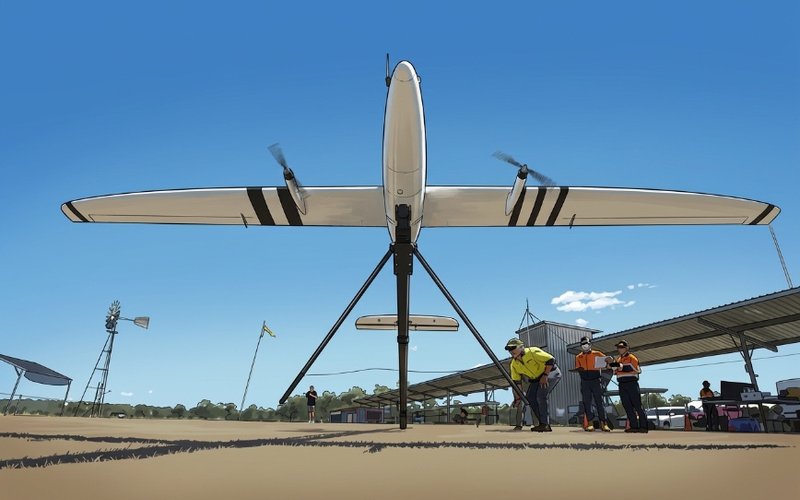

- 01Pegasus hits 2h/75km on Li-S 382Wh pack.
- 02Funding: $1.35m EATP grant.
- 03Two Li-S packs enable up to 8h/250km.
- 04Patents filed for BMS and pack design.
Li-S Energy’s (ASX: LIS) long-range Pegasus drone has completed an endurance flight of almost 2 hours over more than 75 kilometres, powered by a single Li-S lithium sulfur battery pack.
The twin-motor, five-metre wingspan drone combines an airframe and power systems developed by Queensland’s V-TOL Aerospace with an ultra-lightweight perovskite solar cell array fabricated by Halocell Energy in New South Wales and a 382 watt-hour lithium sulfur battery pack and management system designed and built by Li-S.
Funded by a $1.35 million grant under the Australian government’s Emerging Aviation Technology Partnerships (EATP) program, the drone was subjected to a series of test flights over Queensland, with the final endurance flight marking the completion of practical development and test work.
The drone was reported to have met expected performance measures, landing safely with battery capacity to spare.
On a same cell weight basis, the Li-S battery pack delivered 80% more range and flight time than would have been achieved by an equivalent high-performance professional lithium polymer UAV battery pack.
Longer Flight Missions
The Pegasus was designed to accommodate two Li-S battery packs and, with the latest improvements to Halocell’s solar array performance beyond those fitted to the current airframe, the platform is expected to be capable of flight missions of up to eight hours and 250 kilometres.
This duration is ideal for long endurance mapping and surveillance missions, as well as agricultural, utilities, and environmental monitoring.
Flight data will now be analysed by the partners to characterise platform performance and inform an assessment of the platform’s commercial potential.
Li-S Energy has filed two patent applications to protect innovative developments during the project relating to the battery management system and battery pack design.
Drone Demand Growth
Demand for long-endurance drones has grown exponentially across commercial and defence markets, with proposed US and Australian government investment in drone and counter-drone technologies now exceeding $100 billion.
Li-S chief executive officer Dr Lee Finniear said flight endurance and sovereign capability would be critical to Australia’s future in the sector.
“With our partners, we have shown what Australian innovation and collaboration is capable of,” he said.
V-TOL managing director Mark Xavier said Pegasus flew just as it had been designed to.
“Our airframe and power systems performed faultlessly throughout the flight, and pairing them with Li-S Energy’s new lightweight pouch cell battery system gives the platform an endurance advantage operators will immediately recognise,” he said.
“I am proud of what our engineers have delivered and our focus now turns to the pathway from successful trials to commercial platform sales.”
Get the wire before the market opens.
The ASX small-cap stories that matter, filed before 9am AEST. Curated by the Small Caps desk.