
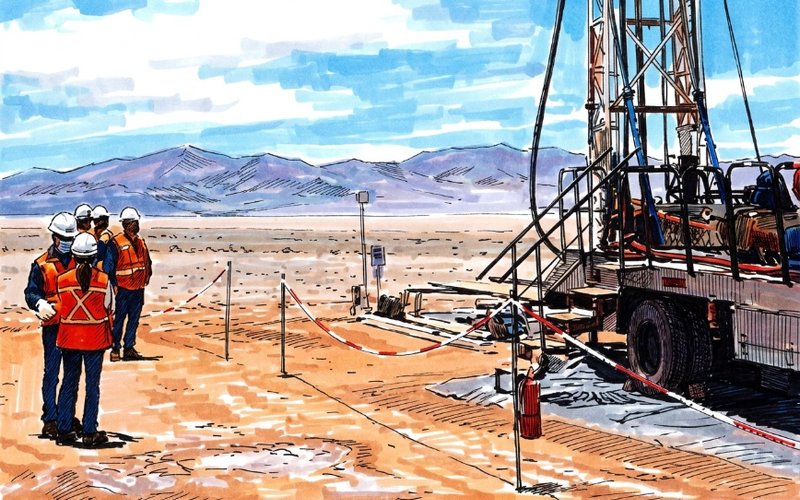

- 01Kachi brine project, Catamarca (LKE)
- 0211.1 Mt LCE resource
- 03Lilac Solutions' Ion Exchange DLE tech
- 04Li2CO3 >99.8% purity; 80-90% recovery; hours vs months
As demand for battery-grade materials continues to shape the global energy transition, developers of critical minerals are seeking efficient and sustainable extraction methods.
Lake Resources NL (ASX: LKE) is an Australian lithium developer focused on bringing cleaner, high-purity lithium to market from its flagship asset in South America.
Company Background
Minerals developer Lake Resources holds a substantial tenement package across prime salt lakes (salars) in Catamarca and Jujuy Provinces in northwest Argentina.
This region forms part of the renowned “Lithium Triangle”, an area encompassing parts of Argentina, Chile, and Bolivia that accounts for approximately half of the world's known lithium resources.
The company’s portfolio includes three early-stage exploration projects—Olaroz/Cauchari, Paso, and Catamarca—alongside its principal asset, the 100%-owned Kachi lithium brine project.
Lake's stated primary objective is to build a sustainable lithium supply chain capable of delivering high-purity lithium carbonate required for EV batteries and grid-scale energy storage systems.
Key Points
Flagship Asset: Kachi lithium brine project (Catamarca Province, Argentina)
Total Mineral Resource: 11.1 million tonnes LCE (including Measured, Indicated, and Inferred categories)
Technology Partner: Lilac Solutions, Inc. (providing proprietary Ion Exchange DLE technology)
Target Product: Battery-grade Lithium Carbonate (>99.8% purity)
The Kachi Project
The flagship Kachi project covers approximately 69,000 hectares over a salt lake basin south of existing regional operations.
Traditional lithium brine extraction relies heavily on expansive evaporation ponds, which require significant land area and extended processing timelines often exceeding 12 to 18 months.
To address these processing constraints and environmental considerations, Lake Resources partnered with California-based direct lithium extraction (DLE) specialist Lilac Solutions.
Under the commercial earn-in agreement, Lilac provides technology, engineering support, and project funding contributions in exchange for an equity interest of up to 25% in the Kachi project, subject to performance-based milestones.
IX Technology
Rather than utilising traditional solar evaporation, the Kachi development plan integrates Lilac's proprietary Ion Exchange (IX) technology.
According to company disclosures, this process operates as follows:
Rapid Processing: Extracted brine passes through ion exchange media, isolating lithium chloride in a matter of hours compared to months in evaporation ponds.
High Recovery Rates: Test work and demonstration plant runs demonstrated lithium recovery rates between 80% and 90%.
Purity & Quality: On-site demonstration testing produced battery-grade lithium carbonate with reported purity exceeding 99.8%.
Environmental Footprint: Spent brine, with lithium removed, is re-injected into the sub-surface reservoir, preserving water chemistry and maintaining a smaller surface footprint (0.5–1 sq km compared to 10–15 sq km for conventional evaporation ponds).
Recent Project Studies and Economics
Lake Resources released a Definitive Feasibility Study for Phase One of the Kachi Project in December 2023, followed by a DFS Addendum in August 2024 detailing updated capital and operating cost estimates.
Key financial and operational parameters outlined by the company include:
- Target Annual Production: 25,000tpa of battery-grade Lithium Carbonate (Phase 1).
- Operational Life: Initial 25-year operating lifespan.
- Upfront Capital Expenditure: Estimated at approximately US$1.16 billion.
- Operating Cost: Estimated at US$5,895 per tonne LCE, placing Kachi competitively on the global operating cost curve.
Critical Minerals Landscape
The global push towards decarbonisation and electrification continues to drive structural interest in critical minerals, particularly battery-grade lithium.
Government policies across major economies have increasingly emphasised responsible supply chains, lower carbon footprints, and high technical performance to avoid battery cell manufacturing defects.
Within this macroeconomic landscape, DLE technologies are receiving significant industry focus as potential alternatives to conventional hard-rock mining and pond-based brine evaporation.
However, industry analysts note that deploying novel DLE processes at commercial multi-thousand-tonne scale in high-altitude environments presents ongoing engineering and execution considerations for project developers across the sector.
Conclusion
Lake Resources occupies a distinct position within the ASX critical minerals sector as it seeks to commercialise ion-exchange direct lithium extraction in Argentina’s Lithium Triangle.
By pairing Kachi’s multi-million-tonne brine resource with Lilac Solutions' DLE processing technology, the company aims to establish a low-cost, high-purity lithium supply.
As Lake progresses project financing, engineering validation, and commercial development pathways, Kachi remains an active project to watch within the global energy transition landscape.
Get the wire before the market opens.
The ASX small-cap stories that matter, filed before 9am AEST. Curated by the Small Caps desk.