

- 01Gilmore: 29m at 1.2% tin, including 15m at 2.0%.
- 02Step-out hole hit 5m at 0.58% tin.
- 03Follow-up drilling planned before year-end.
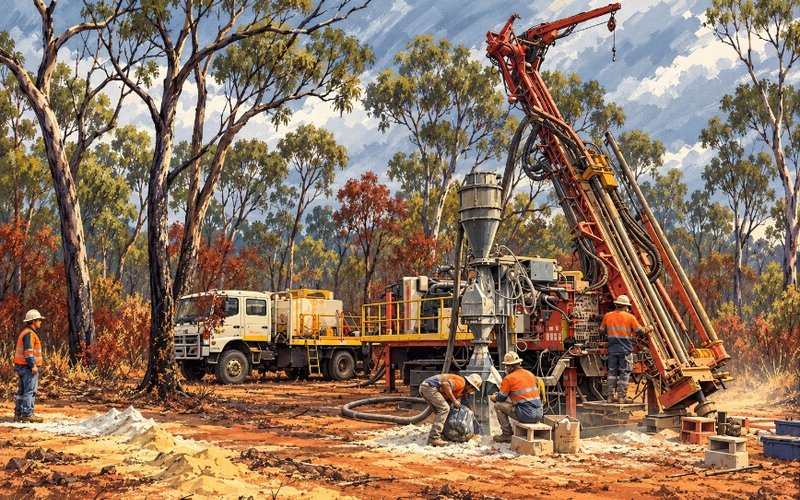
Koba Resources (ASX: KOB) has intersected thick, high-grade tin mineralisation in its maiden reverse circulation drilling program at its Mt Garnet tin-tungsten project in north Queensland.
The standout result from around the historical Gilmore Mine returned 29 metres grading 1.2% tin and 0.36% copper from 111m, including 15m at 2.0% tin and a higher-grade 2m section at 6.3% tin.
Another intersection 230m east of that hole returned 5m at 0.58% tin, providing an initial indication that mineralisation extends beyond the area of historical workings.
Koba also identified a tin-in-soil anomaly extending about 500m over and along strike from Gilmore, giving the new drilling results a broader exploration setting.
Across Gilmore and the nearby Stannex prospect, the 24-hole, 2,937m program has prompted Koba to plan further drilling at Mt Garnet while preparing to test targets at its Stannary Hills tin-tungsten project.
Standout Gilmore Tin Grades
Three initial holes totalling 277m tested ground immediately adjacent to the historical Gilmore Mine, marking the first drilling in that area for more than 45 years.
Between 1906 and 1922, Gilmore produced 26,169 tonnes at an average grade of 7.6% tin, with intermittent mining subsequently continuing between 1958 and 1980 to a depth of 193m.
The principal intersection also contained tungsten and silver, with the 15m higher-grade tin interval carrying 0.58% copper and 33 grams per tonne silver.
“With just three holes completed to date, these results reinforce Gilmore’s status as a high-priority target,” chief executive officer Ben Vallerine said.
“Initial follow-up holes will be included in our next drilling program before year end, in conjunction with drilling at the Kitchener and Jiminy prospects within the Stannary Hills project.”
Wider Stannex Mineralisation
Approximately one kilometre northeast of Gilmore, 21 broadly spaced Stannex holes totalling 2,660m tested a tin-in-soil anomaly extending across 2km of strike.
The initial program encountered both narrower higher-grade tin zones and broader lower-grade intervals, including an intersection of 10m at 0.25% tin and a separate near-surface interval containing 1m at 1.9% tin.
Tin anomalism is associated with induced polarisation chargeability anomalies and previously identified high-grade rock-chip results, which Koba will use to refine its next targets.
Drilling additionally encountered a 3m interval grading 3.4% zinc, 1.5% lead, 65g/t silver, and 31g/t indium, although the company cautioned that these base-metal occurrences do not always coincide with tin and intends to investigate whether their distribution can assist future exploration.
Follow-Up Drilling
Koba will continue with geological mapping and sampling of tungsten targets across Mt Garnet during the rest of 2026 to advance targets towards drilling in 2027.
The company also intends to conduct infill and extensional drilling at Gilmore before year end to test the extent of mineralisation around the historical mine and along strike.
Further drilling at Stannex in early 2027 will examine continuity, geological controls, and untested portions of the wider anomaly.
Earthworks have already begun at the Kitchener and Jiminy prospects within Stannary Hills, where maiden drilling is scheduled to start later in October.
Get the wire before the market opens.
The ASX small-cap stories that matter, filed before 9am AEST. Curated by the Small Caps desk.