
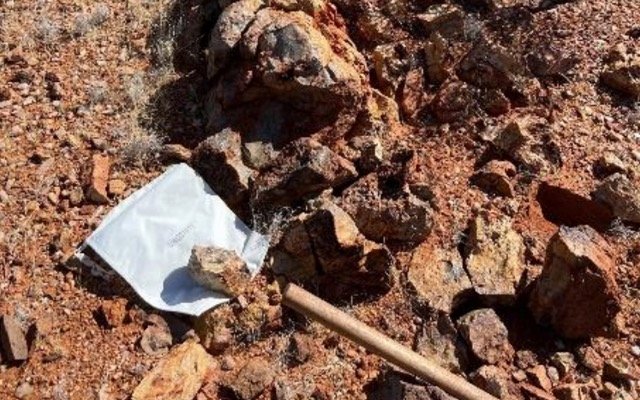

Kingfisher Mining (ASX: KFM) has again extended the mineralisation at the MW2 target within the Gascoyne mineral field in Western Australia, with a strike length of over 2.4 kilometres.
Recent rock chip results have also returned the highest neodymium-praseodymium oxide ratios seen to date.
The MW2 mineralisation is believed to occur in five parallel lodes associated with ferrocarbonatite dykes in a 300-metre-wide zone over a 2.4km strike.
Latest surface sample results from the outcropping high-grade monazite mineralisation included 30.54% TREO (total rare earth oxides) with 5.08% neodymium-praseodymium; 16% TREO with 2.62%; 24.04% TREO with 4.06%; and 11.43% TREO with 1.77% neodymium-praseodymium.
Other results were 21.02% TREO with 3.58% neodymium-praseodymium; and 20.86% TREO with 3.59%; 18.45% TREO with 3.16%; and 14.81% TREO with 2.13% neodymium-praseodymium.
Kingfisher said the substantial strike and width of the MW2 mineralised zone has been “highly encouraging”, with ongoing exploration focused on targeting large-scale carbonatite intrusion plugs and high-grade rare earth elements (REE) mineralisation associated with ferrocarbonatite dykes.
Emerging REE zones
Kingfisher chief executive officer James Farrell said the MW2 results highlight the significant potential of emerging high-grade carbonatite REE zones as a regional scale discovery.
“There are strong indications that the REE mineralisation forms part of a larger carbonatite system,” he said.
“Our exploration plans for this year will include multiple drill programs as well as significant field work as we seek to advance these large-scale carbonatite targets.”
Mick Well exploration
Mapping and surface sampling at the Mick Well target has also resulted in the identification of new areas of mineralisation which appears on a different trend, with an east-west strike.
It also has a higher neodymium-praseodymium ratio than other outcropping REE mineralisation in the Mick Well area.
First-pass sampling results included 0.3% TREO with 0.05% neodymium-praseodymium; 1.99% TREO with 0.46% neodymium-praseodymium; and 0.21% TREO with 0.04% neodymium-praseodymium.
They are believed to confirm the significance of northeast-trending magnetic features associated with high-grade mineralisation and the late-stage intrusion of ferrocarbonatite dykes.
Re-interpretation of the results from discovery drilling also indicate a northeast strike for the mineralisation.
Get the wire before the market opens.
The ASX small-cap stories that matter, filed before 9am AEST. Curated by the Small Caps desk.