
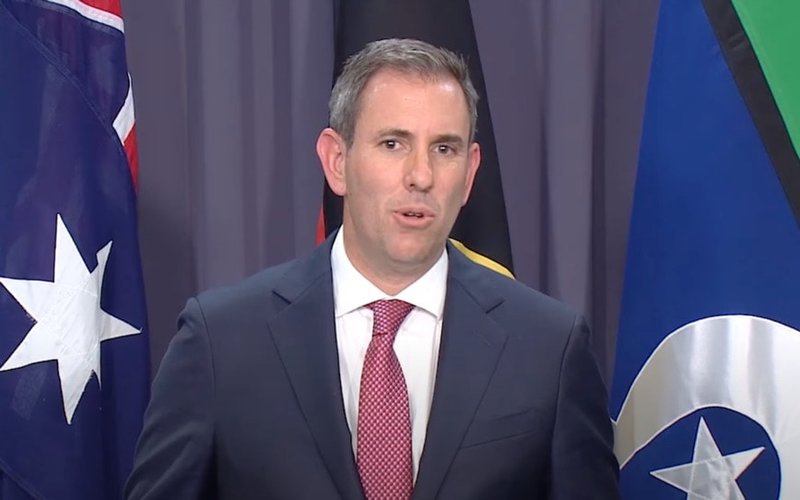

Treasurer Jim Chalmers has a ready excuse when higher interest rates continuously carve a further hefty slice of family non-discretionary spending.
He simply points at the current Reserve Bank Governor and says that they make interest rate decisions independent of Government.
That is true as far as it goes but if you take a deeper dive into the numbers, you find that the Federal Government coffers are also being heavily bolstered by rising tax revenues that for some are taking a bigger chunk out of their wallet than even higher interest rates.
In simple terms the current economic environment might be very tough for many people – particularly those with large mortgages and inflating costs – but they are absolutely ideal for boosting Government tax revenue.
Strong jobs market boosts income tax
A strong jobs market and people working multiple jobs to make ends meet leads to a really strong uptake in income tax revenue.
Likewise rising incomes which might help households trying to keep pace with rising prices also add a healthy fillip to tax revenues.
That is one of the main reasons why this week’s Mid-Year Economic and Fiscal Outlook (MYEFO) Budget update might even be showing a continuing Budget surplus, despite Treasurer Chalmer’s $23 billion spend on cost-of-living relief that was targeted to help low-income families while not adding to inflation.
The national accounts made it clear that a strong 6.3% rise in household income tax payable in the September quarter was even more culpable than the rise in interest payments for reducing the living standards of many Australians.
As the Australian Bureau of Statistics put it: “Income taxes drove the rise, in the absence of the Low- and Middle-Income Tax Offset (LMITO) which ceased over 2022-23.”
Bracket creep quietly raising taxes
Bracket creep – which sees taxpayers rise to higher tax brackets as their income rises – has also played a part in what can only be described as a massive rise in income tax.
Last year, the 2021 September quarter figures put the total household tax take at $65.1 billion, which has risen to $90.9 billion in the current figures.
This 40% lift is not as large in percentage terms as the more than doubling of mortgage interest payments from $11.2 billion in the 2021 September quarter to $29.7 billion but it is larger in dollar terms at $25.8 billion.
It should also be remembered that the uber-low pandemic interest rates were responsible for last year’s numbers so the rapid rise in mortgage payments, while still a shock, was perhaps more understandable than the rapid increase in household taxation, which has more than doubled in a decade.
Real income falling
Real disposable household income per capita in Victoria fell to the lowest level since June 2014, which is a good indicator of how difficult the situation is for some households, even as high immigration masks the overall picture to produce a marginal amount of economic growth.
In this context, the arrival of the stage 3 tax cuts in the middle of the coming year are not so much about “reducing” income taxes but about paying back some of the gains reaped by a “progressive” income tax system in which the lack of inflation indexing of the tax scales results in a handy – and hefty – rise in tax paid over time.
There are many arguments to be made about how well the stage 3 tax cuts are targeted, although it should be pointed out that high income earners save the most tax because they also pay the most.
What should not be controversial is that the ability of the Federal Government to balance its books through such a system should be shared with households, which are doing it tough as they attempt to also balance their budgets.
Get the wire before the market opens.
The ASX small-cap stories that matter, filed before 9am AEST. Curated by the Small Caps desk.