

- 01Targets ~20kg of 99.99% HPA for testing.
- 02ECU and Simulus advance Lake Hope pilot work.
- 03Tests support process validation and scale-up.
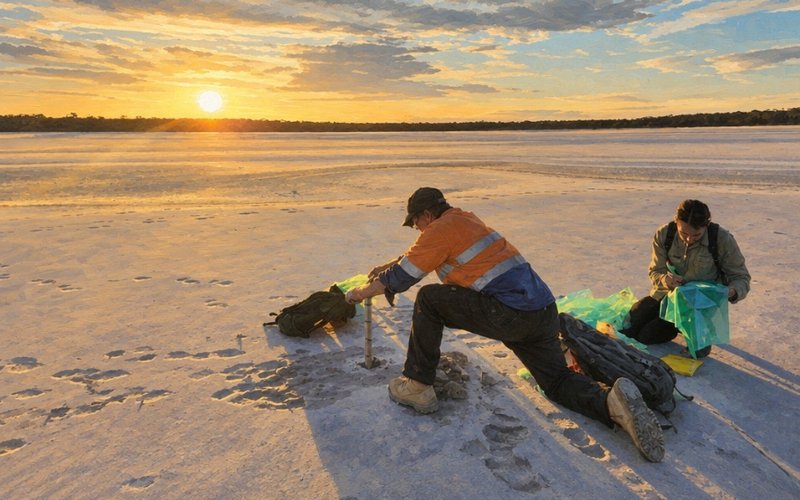
Impact Minerals (ASX: IPT) is progressing a staged laboratory and pilot-scale test work program at its Lake Hope project in Western Australia, targeting approximately 20 kilograms of candidate 4N (“four nines”, IE 99.99%) high-purity alumina (HPA).
The product could be made available to prospective customers after undergoing independent verification, giving the developer further evidence of its proposed processing route.
Testing spans multiple stages of the Lake Hope flowsheet, with Edith Cowan University (ECU) and specialist contractor Simulus Group handling different elements of the work.
The program builds on earlier laboratory research as Impact prepares technical parameters for larger-scale operations and advances Lake Hope as its principal development priority.
Testing Across Two Facilities
ECU is constructing a pilot facility at Joondalup under a collaboration supported by the Australian Government’s Cooperative Research Centres Projects program.
The university’s role covers the mineral processing, leaching, and related development work needed to establish how the process performs beyond initial laboratory testing.
Simulus has been engaged for stages involving corrosive reagents and hydrogen chloride gas including leaching, crystallisation, separation, and subsequent thermal processing.
Its remit also includes preliminary assessment of off-gas management and recovery, which will inform how the individual steps might operate together.
Path from Laboratory to Pilot
The work will move from batch optimisation and locked-cycle testing into larger sequential pilot operations, allowing Impact to examine recovery and impurity behaviour under recycle conditions.
Investigations will establish leaching conditions, residue washing, and filtration performance before assessing aluminium chloride hexahydrate (ACH) crystallisation and impurity rejection.
Thermal trials will then consider ACH decomposition and alumina calcination, with particular attention to conversion, final purity, and contamination control.
“We are proving each step of our flowsheet, from the lab through to a pilot plant, with the aim of making about 20 kilograms of HPA that can be independently tested and presented to potential customers,” chair Jim McKerlie said.
“These are practical and necessary steps that validate the process and delivers the data we need to scale up with confidence, [and] I’m delighted with the progress the Impact team and our partners at ECU and Simulus are making.”
Broader HPA Strategy
The latest program follows Impact’s proposal to change its name to Altrica Advanced Materials, reflecting a strategic shift towards HPA development rather than its previous broader exploration purview.
Shareholders are due to vote on the proposed name at the annual general meeting on 30 November.
Impact has completed a pre-feasibility study at Lake Hope and is progressing towards a definitive feasibility study, with the staged testing designed to inform subsequent scale-up decisions.
The company also holds a 50% interest in Alluminous, whose operational HiPurA pilot plant in Perth produces HPA for customer qualification, providing a separate strand of its HPA activities.
Get the wire before the market opens.
The ASX small-cap stories that matter, filed before 9am AEST. Curated by the Small Caps desk.