
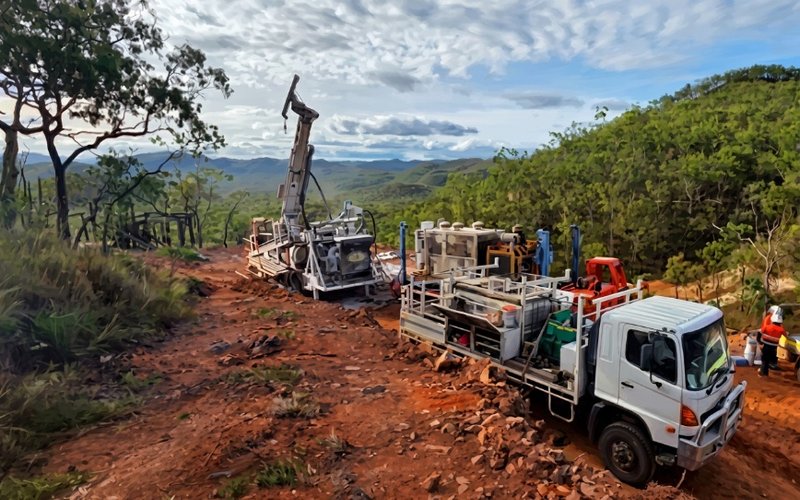

- 01Union Jack: 3 RC holes hit sulphides; DHEM planned.
- 02Isabel: 10 DD (~1,800m) + 1×200m Ext; start soon.
- 03Isabel: Ag/In/Tin/Cu/Pb/Zn in quartzites; to 150m.
Iltani Resources (ASX: ILT) has confirmed sulphide-rich mineralisation at Union Jack, while preparing to start diamond drilling at Isabel and Isabel Extended within a week, as part of its Herberton project regional exploration program in northern Queensland.
The regional program is testing targets within trucking distance of a potential Orient processing plant, with the aim of defining high-grade base metal, silver, and indium satellite resources that could add material value to the broader project.
At Union Jack, three reverse circulation holes for 666 metres intersected sulphide mineralisation, while a review of historical Isabel core confirmed high-grade polymetallic mineralisation containing silver, indium, tin, copper, lead, and zinc.
Iltani plans 10 diamond holes for 1,800m at Isabel and one 200m hole at Isabel Extended, with the Isabel program expected to take about two months.
Meanwhile, Orient drilling has reached hole 103 of an initial 110-hole program, which Iltani expects to complete within two weeks before moving to a planned next phase.
Union Jack Follow-Up
Union Jack drilling tested geophysical targets and historical workings within the Boonmoo Sag Caldera, with all three holes intersecting sulphide mineralisation and two prepared for a follow-up downhole electromagnetic (DHEM) survey later this year.
One hole returned 4m at 5.5 grams per tonne silver, 2.3g/t indium, and 0.30% copper from 166m, while another intersected 14m at 2.5g/t silver, 0.8g/t indium, 0.16% lead, and 0.17% zinc from 5m, with the reported intervals representing downhole rather than true widths.
The holes, which tested an area with no surface expression of the mineralisation at depth, marked the first drilling in the central Boonmoo Sag Caldera since the 1980s, with Iltani planning to use DHEM to better resolve mineralisation geometry and extent.
“We now know the Union Jack system hosts sulphide-rich mineralisation—we just have to work our way through the system to find the economic grades,” managing director Donald Garner said.
“Based on the excellent results to date, we are planning the next phase of drilling—more drilling delivering more tonnes, more grade, and more metal as we grow the Orient Mineral Resource”.
Isabel Drilling Set to Start
Historical Isabel diamond core reviewed at the Geological Survey of Queensland’s Exploration Data Centre confirmed massive sulphide mineralisation hosted in quartzites.
These included 4.27m at 168g/t silver, 654g/t indium, 0.5% tin, 1.1% copper, 1.6% lead and more than 30% zinc, with the interval reported as a downhole width.
A second historical interval returned 5.18m at 100g/t silver, 363g/t indium, 0.4% tin, 0.4% lead, and 20.4% zinc, with Iltani noting that mineralisation preferentially occurs within more competent quartzite units.
Whereas the historical drilling tested Isabel to about 90m below surface, Iltani’s upcoming program will test to 150m and extend initial holes further east to assess a possible parallel lode around 50m from the main lode.
At Isabel Extended, the planned 200m diamond hole will target historical high-grade polymetallic mineralisation before a DHEM survey is used to determine its geometry and extent for follow-up drilling.
Get the wire before the market opens.
The ASX small-cap stories that matter, filed before 9am AEST. Curated by the Small Caps desk.