
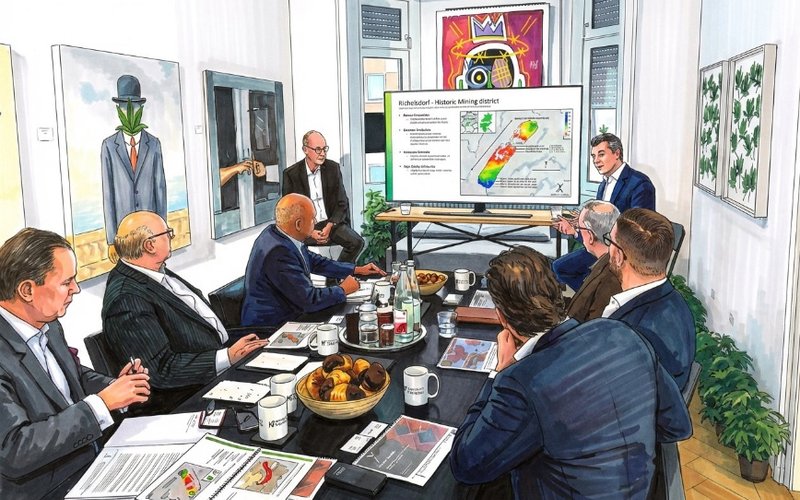

GreenX Metals (ASX: GRX) has completed its 90% acquisition of Group 11 Exploration, holder of the exploration licences for the Tannenberg copper project in Germany.
The licence area has expanded seven-fold since GreenX signed a joint venture and earn-in agreement in August 2024 to now cover approximately 1,900 square kilometres, comprising the Tannenberg 1 and Tannenberg 2 exploration licences.
GreenX has issued A$3 million worth of shares to the vendors for a total of 3,487,147 shares based on the 10-day volume weighted average price.
The vendors' remaining 10% interest in Group 11 will now be free-carried until completion and announcement of a feasibility study, or they have the option to convert it into an 0.5% net smelter royalty.
If GreenX announces a Scoping Study for the license area within five years from 1 August 2024, it will issue the vendor an additional 5 million GRX shares on completion of the first such study.
Validation of Historical Estimates
GreenX has made significant progress across the Tannenberg project in the past 15 months, providing a strong technical foundation for exercising the option.
A 1940 historical estimate based on a 1935 to 1938 drilling campaign across four zones identified 728,000 tonnes of contained copper at an average grade of 2.6% in part of the Tannenberg project licence area, later validated by an independent 1984 historical estimate that showed consistent grades of 2.1% copper plus 25 grams per tonne silver, with 169,000t of contained copper and 6.5 million ounces of silver.
Initial assay results from the first six holes of an ongoing scanning and petrophysical program over 47 archived 1980s cores have shown mineralised widths of 1.0 to 3.7m, significantly exceeding the narrow thicknesses used in the 1940 estimate.
Standout intercepts include 1.5m at 2.7% copper and 55g/t silver, and 3.7m at 1.2% copper and 17g/t silver, supporting the exploration hypothesis that the system extends well beyond the Kupferschiefer shale that was the sole focus of the original 1930s drilling.
European Policy Support
Copper is now listed as a strategic raw material under the EU Critical Raw Materials Act, which provides pathways for accelerated permitting and strategic funding for domestic supply.
Germany's €1 billion raw materials fund, launched via the state development bank KfW, is actively investing in critical minerals, with the fund committing €150 million in December 2025 to co-develop Vulcan Energy's lithium project—the largest such equity transaction for a raw materials project in Germany to this point.
Vulcan's development financing is also supported by the European Investment Bank, which is contributing €250 million, and the German government, which is providing grants worth €204m.
Germany's copper-intensive industries—including automotive, engineering, electrical, and chemical—remain among the largest in Europe, collectively accounting for more than 25% of gross domestic product.
Exploration and development activity across Germany has accelerated in response to these policy and market signals, with Anglo American actively exploring the Löwenstern and Leine-Kupfer copper projects nearby.
Germany has a long-standing mining tradition and remains active in mineral production today, with K+S operating large-scale potash mines just 4km from the Tannenberg licence area in the state of Hesse.
Ongoing Work Programs Advancing
GreenX continues to advance a co-ordinated suite of exploration activities at Tannenberg that includes logging, assaying and hyperspectral scanning of remaining historical core; reprocessing and analysis of historical geophysical data; and collation and digitisation of historical geological, mine development, and production data.
The company is also planning to conduct twin drilling to verify historical estimates and establish a mineral resource estimate in accordance with the JORC Code.
The original Tannenberg exploration licence was extended for a further three years, while a second large Tannenberg exploration licence covering 1,628 sq km was awarded and is valid for three years, with the option to extend for an additional three.
Chief executive officer Ben Stoikovich said that – with its scale, prospectivity, location, and history – the potential upside of the Tannenberg project is enormous.
"The work completed during 2025 has significantly advanced our understanding of the project's geological model and confirmed the robustness of the historical results," he said.
"Our progress comes at a time when Europe is placing unprecedented emphasis on securing domestic sources of strategic raw materials, with both Germany and the wider EU introducing measures designed to accelerate permitting, support project development, and improve security of supply."
Get the wire before the market opens.
The ASX small-cap stories that matter, filed before 9am AEST. Curated by the Small Caps desk.