

- 01EL8: shallow uranium plays in Namibia/Aus; 181 Mlb U3O8.
- 02U-pgrade™ lowers acid-leach needs for calcrete deposits.
- 03Namibia & Australia assets: Koppies 76.2 Mlb; Angela 31 Mlb.
As the global energy landscape increasingly turns toward low-carbon baseload power, uranium exploration and development companies are stepping into the spotlight.
Among ASX-listed resource developers, Elevate Uranium (ASX: EL8) has built a distinct corporate profile focused on shallow, surficial uranium deposits across tier-one mining jurisdictions in Namibia and Australia.
Elevate’s core strategy centres on identifying, expanding, and developing shallow uranium deposits with low-cost operational potential.
Backed by a resource inventory of 181 million pounds (Mlb) of U₃O₈, active discovery programs, and its proprietary U-pgrade™ beneficiation process, the company is advancing a portfolio designed to capitalise on long-term nuclear fuel demand.
Elevate holds strategic land positions across Namibia and Australia, providing geographic and regulatory diversification across its 181 Mlb global resource base.
Namibian Uranium Assets
Namibia is one of the world's premier uranium-producing nations, home to long-life operations such as Rössing and Husab.
Elevate Uranium holds strategic acreage in the Erongo region, comprising an overall resource inventory of 123.7 million pounds of U₃O₈.
- Koppies Uranium Project: 100%-owned asset boasts a total resource of 76.2 Mlb U₃O₈. This includes the main Koppies deposit (55.9 Mlb), with 78% or 43.6 Mlb in the JORC Indicated category), alongside satellite deposits at Hirabeb (10.2 Mlb Inferred) and Namib IV (10.1Mlb Inferred).
- Marenica Uranium Project: Elevate recently increased its interest to 90% in the Marenica deposit, which holds a 52.8 Mlb U₃O₈ resource (giving Elevate an attributable share of 47.5 Mlb).
- Capri Project: An active exploration area where widespread uranium mineralisation has been identified over a broad geographical footprint.
Australian Portfolio
Elevate Uranium maintains 100% ownership or joint-venture interests in high-grade Australian projects totaling 57 million pounds of U₃O₈ resources.
- Angela Project (Northern Territory): Holds a resource of 31 Mlb U₃O₈ at an average grade of 1,310 parts per million (ppm), one of the highest-grade undeveloped Australian uranium resources.
- Napperby Project (Northern Territory): Hosts 8.0 Mlb U₃O₈ at 382 ppm and is situated close to Elevate's Minerva project.
- Thatcher Soak (Western Australia): A calcrete-hosted deposit carrying an 11 Mlb U₃O₈ resource.
- Minerva Project & JV Interests: Encompasses historical high-grade uranium and gold drill intercepts, complemented by regional project acquisitions like Napperby.
The U-pgrade*™*** Process
Surficial calcrete deposits typically present a processing challenge, since the carbonate minerals they contain drive up acid consumption to the point acid leaching is uneconomic.
The alternative to acid leaching is the high temperature slow kinetics alkali leach.
U-pgrade™ was developed specifically to address this by pre-concentrating the ore ahead of leaching rather than sending the full mined volume straight to leach, which is the conventional approach.
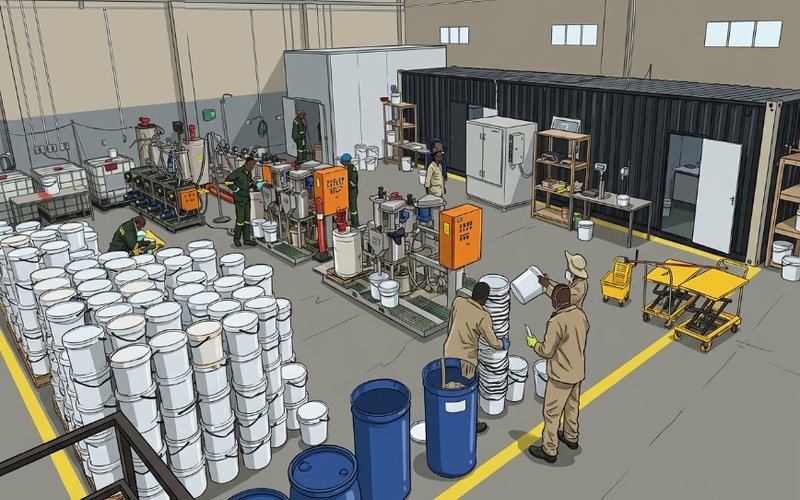
All five stages of the U-pgrade™ pilot plant in Namibia are now in continuous operation, processing bulk samples of Marenica ore.
Results confirmed across Stages 1 to 4 show a cumulative mass rejection of approximately 88%, uranium recovery of 79%, and a seven-fold upgrade in grade, lifting the ore from a head grade of 89 ppm to 590 ppm U.
These pilot-scale results are in line with the historical bench-scale test work the process was originally developed on.
Stage 4's calcite flotation step also removes the carbonate load from the leach feed, allowing a simpler ambient-temperature acid leach over four to six hours rather than a heated, longer-residence alkali leach circuit, a change that materially reduces the size, energy demand, and operating cost of the downstream leach plant.
Stage 5, uranium flotation, is the final upgrading step ahead of leaching.
In historical bench-scale testwork this stage lifted the concentrate a further six to eight times, to around 4,240 ppm U.
Pilot-scale results from Stage 5 are due in the fourth quarter of 2026.
Macroeconomic Context
The backdrop for uranium developers remains tied to macro trends driving global energy transition strategies.
Governments worldwide are increasingly categorising nuclear energy as a critical component of carbon-free baseload power generation.
Key market factors influencing the sector include:
- Global Decarbonisation Mandates: Increased emphasis on zero-carbon energy generation has led several major economies to extend reactor operating lifespans and commit to new nuclear builds.
- Supply Chain Diversification: Security of supply considerations have driven utilities to seek long-term off-take sources from stable, mining-friendly jurisdictions such as Namibia and Australia.
- Critical Minerals Focus: Uranium’s role in energy security has renewed market interest in pre-production projects that possess clear pathways toward resource expansion and process efficiency.
Conclusion
Elevate Uranium offers exposure to the global uranium sector through a dual-jurisdiction pipeline in Namibia and Australia, a 181 Mlb U₃O₈ resource base, and a proprietary beneficiation process now being proven at pilot scale.
As exploration, infill drilling and the U-pgrade™ pilot program progress toward a Scoping Study for Marenica, the company remains an active contributor to the broader Australian narrative around critical transition minerals.
Get the wire before the market opens.
The ASX small-cap stories that matter, filed before 9am AEST. Curated by the Small Caps desk.