
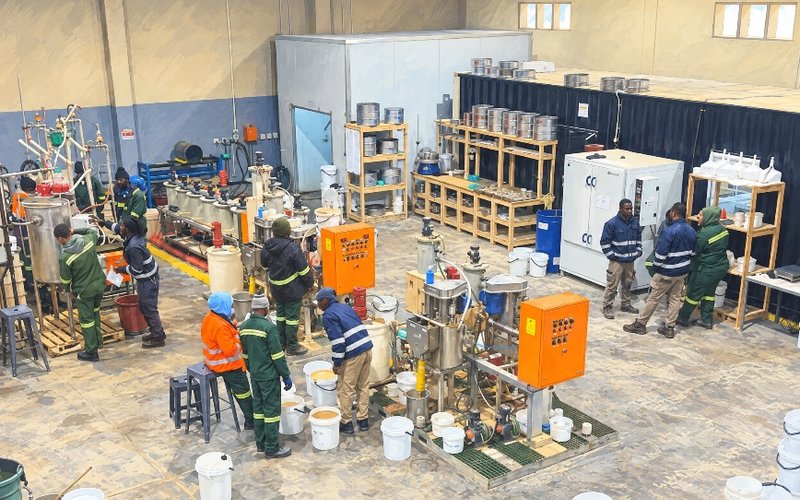

- 01Rejected 88% of ore, retaining 79% of uranium.
- 02Grade rose 7x, from 89ppm to 590ppm.
- 03Final circuit and resource updates due in December quarter.
Elevate Uranium (ASX: EL8) has rejected approximately 88% of the original ore mass in the first four stages of its U-pgrade pilot plant in Namibia while retaining 79% of the uranium.
The process lifted the Marenica project feed from 89 parts per million uranium to 590ppm, delivering a sevenfold increase in grade before the final concentration stage.
The results provide pilot-scale support for the company’s processing approach, which aims to reduce the material requiring leaching and simplify the treatment of calcrete-hosted uranium ore.
Elevate also completed extensive drilling at Marenica and the Namib IV resource area during the September quarter, with further resource and processing results scheduled over coming months.
The company finished September with $22.2 million in cash after incurring $4.08m in exploration expenditure and has since reduced its active drilling fleet from four or five rigs to one, with lower exploration spending forecast.
Reshaped Leaching Requirements
U-pgrade comprises five sequential steps involving scrubbing, attrition, desliming, calcite flotation, and uranium flotation, with the first four now tested in continuous pilot operation.
The calcite flotation step removes carbonate minerals that ordinarily prevent acid leaching of calcrete ore, allowing the upgraded material to undergo an acid leach at ambient temperature over four to six hours.
Conventional alkaline treatment of this ore type requires temperatures above 92 degrees Celsius and residence times of 24 to 36 hours, whereas Elevate estimates the shorter leach time could reduce required circuit volume by a factor of approximately 25.
The fifth uranium flotation stage was commissioned in August and is undergoing optimisation, with integrated results from the complete circuit expected in the December quarter.
Elevate expects the final stage to provide a further sixfold to eightfold grade increase, although that performance has yet to be demonstrated in the integrated pilot results.
Marenica Drilling Update
At Marenica, 718 drill holes totalling 31,115 metres were completed and downhole gamma probed during the quarter, predominantly to increase confidence in material currently classified as Inferred.
The work is designed to support conversion into the Indicated resource category, alongside exploration of possible extensions beyond the existing resource footprint.
The project currently contains a mineral resource of 134.5 million tonnes grading 180ppm triuranium octoxide (U3O8), following a resource re-evaluation earlier this year that doubled the reported grade.
New bulk samples reflecting the higher resource grade are scheduled for pilot processing in the December quarter to test whether recovery and mass distribution improve relative to the earlier low-grade sample.
An updated Marenica resource estimate is also planned for the December quarter, ahead of a scoping study program scheduled to begin in the March 2027 quarter.
Koppies Work Progress
At the Namib IV area of the Koppies uranium project, 191 holes covering 5,408m targeted resource infill, mineralised extensions and geological prospects outside existing Inferred resources.
The company plans to test Koppies ore through the pilot plant in the March 2027 quarter, extending evaluation of U-pgrade beyond Marenica.
Elevate increased its interest in Marenica Minerals to 85% after completing the acquisition of a further 10% from Xanthos Mining in July.
A separate agreement to purchase another 5% from Millennium Minerals had its completion deadline extended to 30 October, with the proposed transaction set to lift Elevate’s holding to 90% if completed.
Get the wire before the market opens.
The ASX small-cap stories that matter, filed before 9am AEST. Curated by the Small Caps desk.