
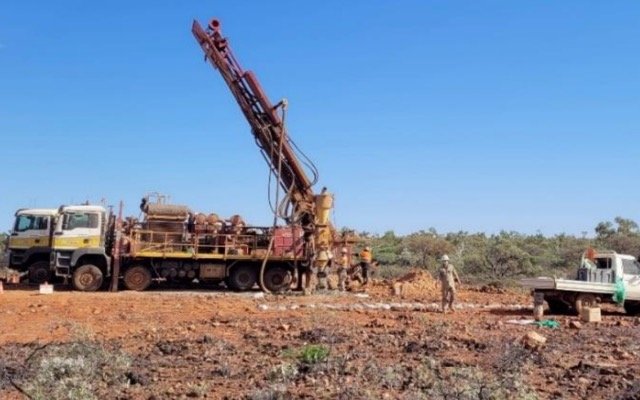
Dreadnought Resources (ASX: DRE) has identified a mix of rare earth elements (REEs) at the C1 to C5 carbonatites within its wholly-owned Mangaroon project in Western Australia.
The company discovered six coherent zones of REEs, niobium, titanium and phosphorus mineralisation during drilling of an 82-hole program for a total 7,813 metres.
Two holes at C2 were drilled through the carbonatite complex into country rock, indicating a conservative original magnetic interpretation.
Reinterpretation of the magnetic data has nearly doubled the extents of the complex to approximately 6.5 kilometres in strike length and 1km in width.
Dreadnought managing director Dean Tuck said drilling has exceeded expectations.
“Our first pass, wide-spaced drilling at C1 to C5 has delivered multiple zones of rare earths including a mineralised zone at C3,” he said.
“Importantly, the carbonatite complex remains completely open and is interpreted to be larger than we originally thought.”
Different mineralised bodies
Carbonatite intrusions across the world are known to host multiple elements as different mineralised bodies within the same intrusion.
Examples include Mt Weld in Australia, Ngualla in Tanzania and Araxa in Brasil.
Since the C1 to C5 carbonatite complex at Mangaroon has minimal outcrop, Dreadnought designed a first-pass reverse circulation program to drill through cover and into fresh rock.
Mr Tuck said the company aims to confirm the extent and complexity of the interpreted carbonatite intrusions, define zones of mineralisation and better understand the cover regolith and depth of weathering.
Numerous wins
Drilling returned numerous wins including the new zones of REE mineralisation, thick mineralised intercepts in weathered and fresh carbonatites, multiple carbonatite and syenite intrusions confirming a carbonatite-alkaline intrusive complex, and a highly weathered carbonatite up to 152m depth which could host residual mineralisation.
Dreadnought’s exploration program will now move onto 80m by 80m spaced angled-hole drilling over all six of the mineralised areas, starting at C3.
The program will continue into December and recommence in the new year.
Assays are expected to continue through to the end of the March 2023 quarter.
Project location
The Mangaroon project covers more than 5,300 sq km of the Mangaroon Zone in the state’s Gascoyne region.
Part of the project is targeting nickel-copper-platinum group elements (PGE) and is subject to a 70% earn-in arrangement with Canadian company First Quantum Minerals.
Dreadnought has located outcropping high-grade gold-bearing quartz veins along the Edmund and Minga Bar Faults, outcropping high-grade REE ironstones and outcropping high tenor nickel-copper-PGE blebby sulphides in the recently-defined Money intrusion.
