
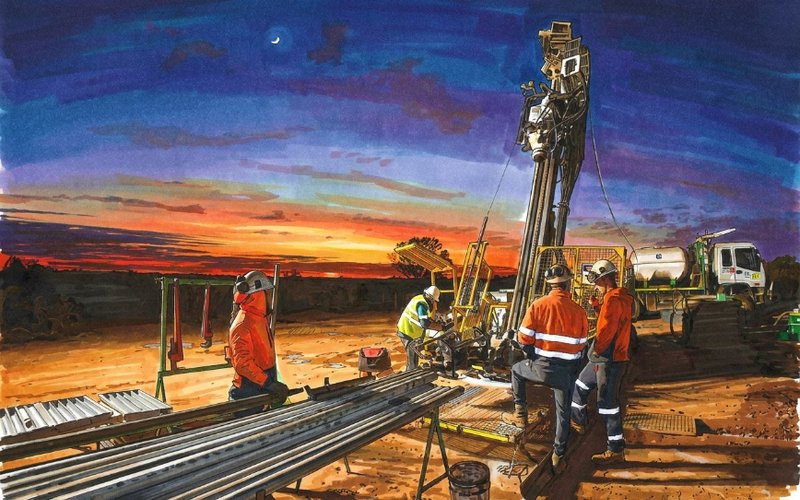

- 0115km Mangaroon gold anomaly along Minga Bar.
- 02Targets to be ranked for 2026-27 discovery drilling.
- 03Star of Mangaroon: 27,000 oz at 11.1 g/t.
Dreadnought Resources (ASX: DRE) has defined a strong gold-in-soil anomaly extending for approximately 15 kilometres along the Minga Bar shear at its 100%-owned Mangaroon gold project in Western Australia’s Gascoyne region.
The anomaly runs between and beyond the Cullen’s Find, Midday Moon, and Midnight Star prospects, giving Dreadnought a continuous corridor for follow-up work after reconnaissance drilling at the end of 2025 returned gold mineralisation at all three areas.
Detailed mapping and further surface sampling will now be used to refine and rank targets for discovery drilling by the end of 2026 or early 2027, with additional soil and stream sediment results from Mangaroon expected through August and September.
The company’s wider Mangaroon strategy combines this discovery work with the Star of Mangaroon, where it has defined a 27,000-ounce resource grading 11.1g/t gold and is pursuing a model intended to generate cash flow while continuing broader exploration.
The work adds a second active gold discovery pipeline alongside the company’s Illaara gold project, where final assays released on 10 August outlined 13 mineralised corridors over more than 40km of combined strike after first-pass air core drilling tested only about 10% of the greenstone belt.
Minga Bar Targets Taking Shape
The Minga Bar shear is generally about 0.5km to 1.5km wide within Mangaroon and brings several geological units into structural contact, with the newly defined soil anomaly largely following the more altered and deeply weathered part of the shear.
Reconnaissance reverse circulation (RC) drilling completed in 2025 included 25m at 1.0g/t gold from 22m at Cullen’s Find, including 12m at 1.4g/t gold.
A separate hole at the prospect returned 2m at 4.4g/t gold from 81m including 1m at 8.7g/t gold.
Midnight Star returned 4m at 3.2g/t gold from 12m including 1m at 11.4g/t gold, while Midday Moon produced a lower-grade polymetallic intersection of 3m at 0.3g/t gold, 0.2% copper and 0.2% bismuth from 62m.
The soil and stream sediment sampling remains an early-stage targeting tool and is not sufficient to establish the geological and grade continuity required to define a mineral resource.
Broader Mangaroon Program
Minga Bar forms part of a broader target-generation program across Mangaroon, where stream sediment sampling has highlighted seven camp-scale prospects and Dreadnought is progressively moving from regional anomalies to defined drilling targets using soil geochemistry, mapping and structural interpretation.
Target definition is under way at High Range North, High Range Northwest, High Range South, Minga Bar, and Bordah, while first-pass work at Mangaroon South is expected to add another stream of results during August and September.
A trial induced polarisation survey produced strong resistivity anomalies and offsets at Cullen’s Find, but conductivity was affected by electromagnetic coupling in the weathered zone, leaving Dreadnought to base drill targeting on the soil anomaly, detailed magnetics, mapping and structural interpretation.
“Pleasingly, these anomalies are largely constrained within the more altered and deeply weathered zone of the Minga Bar shear making it easier to follow up with detailed mapping and target ranking work,” managing director Dean Tuck said.
“We look forward to the results of follow up work and to build upon the significant gold intercepts from our 2025 reconnaissance program.”
Parallel Illaara Pipeline
At Illaara, a 493-hole air core program covering about 35,000m identified 13 anomalous mineralised corridors ranging from about 1.5km to more than 7km in strike, with Black Oak extended beyond 7km and CRA-Homestead defined over about 2km.
Results from Black Oak included 18m at 0.8g/t gold from 36m to end of hole (EOH), including 3m at 1.8g/t gold, while CRA-Homestead returned 6m at 0.4g/t gold from 117m to EOH including 3m at 1.1g/t gold.
The first-pass program narrowed nearly 60 square kilometres of drilled greenstone belt to about 5 to 10 sq km of priority ground, with follow-up infill air core drilling scheduled to start at Black Oak and CRA-Homestead during August ahead of RC target testing later in 2026.
All Illaara intercepts are reported as downhole lengths with true widths unknown at this stage, and further first-pass air core drilling is planned in new parts of the project during September or October as Dreadnought continues building its 2026 discovery pipeline.
Get the wire before the market opens.
The ASX small-cap stories that matter, filed before 9am AEST. Curated by the Small Caps desk.