
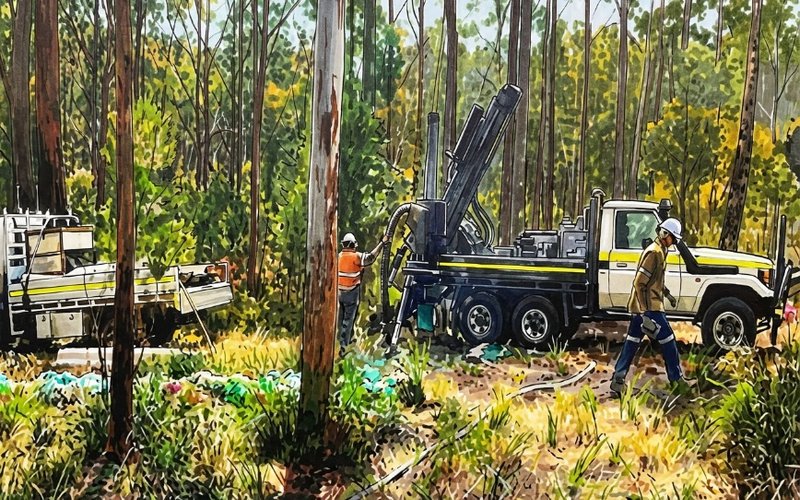

Critical Resources (ASX: CRR) has confirmed that maiden drilling at its Amoco gold-antimony project in New South Wales has defined a substantial mineralised orogenic system.
The company said broad alteration, strong pathfinder geochemistry and Hillgrove-style mineralogical features will underpin the next phase of targeted exploration.
The update follows Critical yesterday completing its acquisition of the Cap Burn gold project in New Zealand’s Otago region, where the company is scheduled to begin inaugural drilling in the coming weeks.
Critical has now secured full ownership of the Cap Burn exploration permit after receiving ministerial consent and completing the associated land access transfer.
The company said the project provides shareholders exposure to a highly prospective structural corridor located about 11 kilometres from OceanaGold’s Macraes gold camp.
Amoco Drilling Defines Orogenic System
Critical reported that its maiden reverse circulation program at Amoco validated the geological model, confirming a fault-controlled orogenic system with multi-element anomalism across several drill holes.
Surface rock sampling previously returned up to 17.9 grams per tonne gold and 0.7% antimony, with drilling intersecting quartz–sulphide veins, broad hydrothermal alteration, and structurally focused mineralisation.
The company highlighted intercepts including 1m at 0.38g/t gold and 22.7g/t silver from 36m, as well as a 22m interval of alteration with elevated gold, silver, and antimony.
Petrographic studies currently underway aim to refine vectors toward higher-grade zones, supported by structural mapping and further geochemical analysis.
Permitting is also progressing for extended drilling across the 2km gold-in-soil anomaly, with future programs targeting potential feeder structures beneath surface high-grade samples.
Cap Burn Acquisition Completed
Critical Resources said Cap Burn strengthens its broader New Zealand gold portfolio, which now includes prospective ground across the Otago and Reefton regions, with managing director Tim Wither saying the acquisition “marks a significant step forward for Critical Resources in New Zealand.”
Cap Burn hosts an arsenic-in-soil anomaly coincident with the Cap Burn Fault, a structure interpreted as a primary control for orogenic gold systems in the belt.
Legacy drilling intersected shallow mineralisation including 9m at 0.24g/t gold and 1.8m at 0.76g/t gold, results the company said resemble early-stage intersections that preceded the Rise and Shine discovery.
The upcoming program will test down-plunge targets beneath the arsenic halo, reflecting a refined geological model informed by recent regional discoveries, with permit transfers for additional tenements underway, and field mapping and geochemical programs scheduled to begin once approvals are completed.
The company said its low-cost, multi-permit position provides long-term exploration optionality across 1,794 sq km of underexplored but highly mineralised terrain.
Get the wire before the market opens.
The ASX small-cap stories that matter, filed before 9am AEST. Curated by the Small Caps desk.