

- 01Lindfield PFS: 3Mtpa; NPV pre-tax A$821m, IRR 26.6%; post-tax A$458m, IRR 18%.
- 02Open pit near Julia Creek; Parkes plant.
- 03MRE: 713Mt @0.32% V2O5; no ore reserve.
Critical Minerals Group (ASX: CMG) has completed a pre-feasibility study (PFS) for its Lindfield vanadium project, outlining an integrated open cut mine near Julia Creek in north-western Queensland and a Vanadium Electrolyte (VE) manufacturing facility at the Parkes Special Activation Precinct in New South Wales.
The preferred 3-million-tonnes-per-annum development case delivers a pre-tax net present value (NPV) of A$821 million and internal rate of return (IRR) of 26.6%, with a post-tax NPV of A$458m and IRR of 18%.
Total development capital is estimated at A$981m, peak funding at A$736m, and payback at seven years across a 31-year mine life.
A staged build would commission the Parkes facility from 2028 using third-party vanadium pentoxide before targeted mine production in 2030, bringing forward revenue while the larger mine and processing complex is developed.
3Mtpa Preferred Case
The PFS assessed 1Mtpa, 3Mtpa and 4Mtpa scenarios, selecting the middle case because it generated substantially greater returns than the smaller option without the higher capital intensity of the largest development.
The 1Mtpa case produced a pre-tax NPV of A$72m and IRR of 13%, while the 4Mtpa case returned A$594m and 21.8% against A$1,180m of capital, compared with A$981m for the preferred case.
Prepared to an accuracy range of plus or minus 25% in March 2026 Australian dollars, the model applies a 9% discount rate, an A$ to US$ exchange rate of 0.67, a 30% company tax rate, a 2.5% Queensland royalty and a 2% federal critical minerals production incentive.
Sensitivity analysis identified VE pricing, mineralised material grade, and metallurgical recovery as the critical value drivers, with a 20% VE price reduction lowering pre-tax NPV to A$118m and a 20% increase lifting it to A$1,641m.
Resource Supports Long Mine
The Lindfield mineral resource estimate (MRE) contains 713Mt at 0.32% vanadium pentoxide and 130 grams per tonne molybdenum, comprising 491Mt of Indicated Resources and 222Mt of Inferred Resources.
Development planning focuses on the weathered domain because it offers less complex and lower-cost processing, with this portion containing 322Mt at 0.31% vanadium pentoxide and 110g/t molybdenum.
The economically mineable mineralised material scheduled as run-of-mine (ROM) feed totals 95Mt at 0.41% vanadium pentoxide and 152g/t molybdenum, representing 13% of the MRE and 30% of its weathered component.
The production target comprises 89Mt of Indicated Resources and 6Mt of Inferred Resources, meaning no Ore Reserve has been declared and further drilling is planned during the definitive feasibility study (DFS) to support higher-confidence resources and a targeted maiden reserve.
Mining and Processing Design
Lindfield’s shallow, sub-horizontal and weakly consolidated mineralisation supports conventional open-pit mining with excavators and trucks but no drill and blast, reducing operating complexity compared with a typical hard rock operation.
The sequence prioritises the lowest strip-ratio material and maintains two working faces, with waste initially placed outside the pit before operations transition to in-pit dumping and progressive rehabilitation behind the mining front.
Mining would deliver a consistent 3Mt of ROM feed annually and keep the strip ratio below 1.6:1, initially processing higher-grade TLBB material before reclaiming stockpiled TLBA and TLBD material.
Forecast vanadium pentoxide output ranges from 10,000t to 12,000t annually during the first 16 years and averages 10,577t, before moving to about 6,000t annually as the lower-grade stockpiles become the principal feed source.
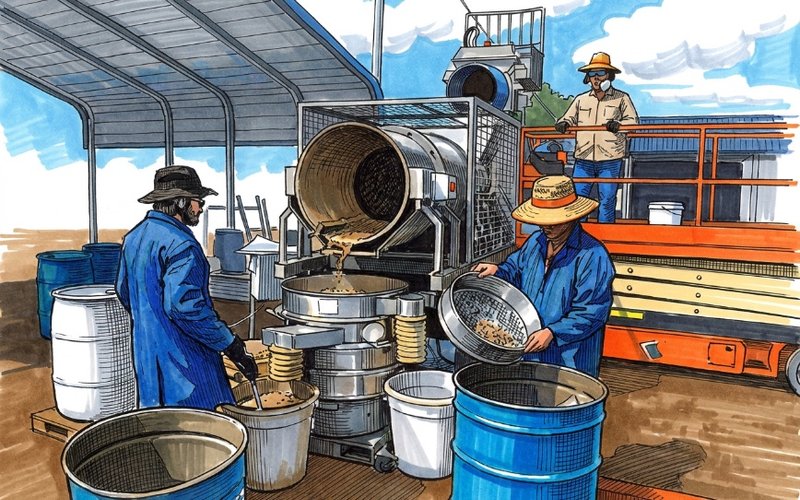
The processing design uses scrubbing, screening, cyclones, and flotation to reject gangue before sulphuric acid leaching, followed by solvent extraction, ion exchange, precipitation, and calcination to produce vanadium pentoxide and molybdenum trioxide.
Electrolyte Stage to Advance First
Pilot-scale physical separation work supported a 92% beneficiation recovery assumption, while the broader model applies a 74.5% process plant recovery and identifies further recovery optimisation as the highest-impact DFS workstream.
The first development phase is a modular 24-million-litre-per-year VE plant at Parkes with estimated capital of A$47.5m, configured as four 6-million-litre trains and expandable towards 72 million litres as demand grows.
Third-party vanadium pentoxide supply has been confirmed as available from 2027, allowing the facility to operate during the expected 18-to-24-month gap before Lindfield can provide its own feedstock.
Across the mine life, Lindfield is forecast to produce 236,351t of vanadium pentoxide and about 1.57 billion litres of VE, including average annual VE output of 73 million litres during the initial 16 years.
Critical Minerals Group is holding VE offtake discussions across four continents, with its integrated mine-to-electrolyte strategy targeting battery storage demand associated with renewable grid firming and artificial intelligence data centre growth.
Funding and Execution Remain Key
The staged strategy separates the A$47.5m Parkes facility from the A$934m mine development, but project finance remains unsecured and construction cannot proceed unless Critical Minerals Group raises the required equity, debt or government-backed funding.
Preliminary engagement has included Australian concessional finance agencies and potential US funding bodies, while alternative structures could include a joint venture, partial project sale, or full sale that reduces the company’s economic ownership.
The PFS identified 161 risk items including 20 rated high priority, led by consistent production of at least 99.5% purity vanadium pentoxide, acid consumption, funding, binding offtake, permitting, exchange rates, and constrained mineralised material.
About 91Mt or 12% of the MRE is overlain by constrained land associated with the former MDL522 area, including 20Mt or 22% of scheduled material, with Critical Minerals Group working with the relevant Queensland department on a resolution.
Near-term DFS priorities are completing the metallurgical pilot plant program, improving recovery, securing competitively priced sulphuric acid and sodium hydroxide supply, advancing binding offtake negotiations, and pursuing government finance to support the targeted final investment decision.
Get the wire before the market opens.
The ASX small-cap stories that matter, filed before 9am AEST. Curated by the Small Caps desk.