

- 01Basal-clay REE under Mposa HMS; avg TREO 525ppm.
- 028 km area; 57% >500ppm TREO; top 987ppm.
- 03ANSTO desorption to gauge recoverable ionic-adsorbed REE.
Chilwa Minerals (ASX: CHW) has confirmed widespread rare earth element (REE) mineralisation in clays directly beneath the Mposa heavy mineral sands (HMS) deposit in southern Malawi.
Assays from 200 basal clay samples returned total rare earth oxide (TREO) grades averaging 525 parts per million, with results ranging up to a peak of 987ppm TREO.
Covering an area of approximately 8 kilometres, the results point to the potential for a stacked critical minerals opportunity within Chilwa’s contiguous licence area.
Metallurgical desorption test work will now assess whether the rare earths occur in a recoverable ionic-adsorption clay (IAC) form.
HMS Sonic Drilling
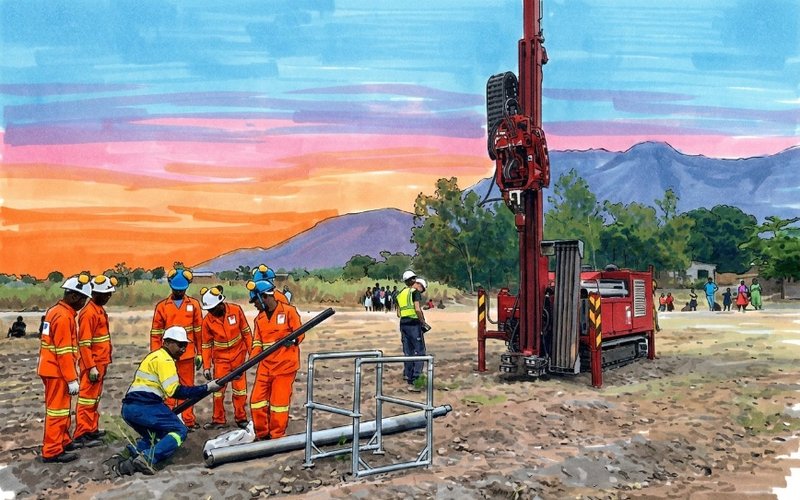
Chilwa collected the samples during regular HMS sonic drilling extending into the basal clay unit beneath the mineral sands horizon at Mposa.
The program confirmed 114 of the 200 samples, or 57%, returned grades above 500ppm TREO, while a further 17 samples exceeded 750ppm TREO including one hit of 987ppm TREO.
The samples came from the top of a clay unit known to extend to depths of tens of metres, which has not yet been systematically tested.
Chilwa identified an encouraging rare earth basket enriched in magnet rare earths comprising neodymium, praseodymium, dysprosium, and terbium, averaging approximately 21% of TREO, with heavy rare earth oxides averaging approximately 19.6% of TREO across the dataset.
The average neodymium-praseodymium oxide content was approximately 102ppm, with the company noting that these higher-value elements carry a significant share of rare earth basket value.
Ionic Clay Test Work
The key question now shifts from grade confirmation to recoverability.
Chilwa will send representative clay sample composites to the Australian Nuclear Science and Technology Organisation (ANSTO) in Sydney for ammonium-sulphate desorption test work.
That process will assess the proportion of contained rare earths recoverable in ionic-adsorbed form, which is the critical value driver for clay-hosted rare earth systems.
Managing director Cadell Buss said the assay results had opened a new front for the company.
“Clearly there is a lot of work ahead of us, notably leachability test work, however the results are especially compelling in terms of co-location with our mineral sands deposits,” he said.
“It would essentially be a dual-commodity mine —with heavy mineral sands at surface and rare earths in the clays beneath.”
Broader Critical Minerals Position
Chilwa is advancing several critical minerals programs across its Lake Chilwa licence, including HMS development, the Nakombe niobium-REE discovery, carbonatite-hosted REE targets, and the emerging ionic clay REE program.
The Mposa result adds a potential second commodity layer beneath an established HMS deposit rather than a separate stand-alone exploration concept.
The company will also consider deeper drilling at other HMS deposits on the licence—particularly the larger Mpyupyu deposits, which are also underlain by clays.
Mpyupyu covers an area of approximately 15 sq km—nearly three times the size of Mposa—giving Chilwa scope to test whether the rare earth opportunity extends beyond the initial corridor.
Get the wire before the market opens.
The ASX small-cap stories that matter, filed before 9am AEST. Curated by the Small Caps desk.