


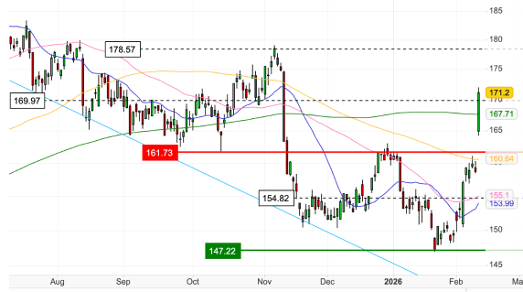
- 01CBA up 8%, reasserting Big Four relevance.
- 02NPAT $5.45b, up 6%.
- 03Dividends: $2.35/sh interim, fully franked.
- 04Valuation gap vs ANZ/WBC; premium priced.
Results expected on Thursday:
AMP (AMP) | ASX Limited (ASX) | Breville (BRG) | Charter Hall Long WALE REIT (CLW) | Insurance Australia Group (IAG) | Pro Medicus (PME) | South32 (S32) | Temple & Webster (TPW) | Paladin Energy (PDN) | Origin Energy (ORG) | Orora (ORA) | Northern Star Resources (NST)
We have spent much of the past year asking whether the dominance of Australia’s major banks was fading. Growth capital has flowed into small caps, tech, and thematic plays.
Yet in a single session, Commonwealth Bank of Australia (ASX: CBA) shifted the narrative.
With its share price jumping 8% to above $171, CBA did more than post a strong result. It reignited the debate about the role of the “Big Four” in portfolios and reminded us that scale, balance sheet strength and pricing power still matter.
The move sent ripple effects across ANZ (ASX: ANZ), Westpac (ASX: WBC) and NAB (ASX: NAB), lifting sentiment across the broader financial sector.
While many investors have been hunting for explosive upside in emerging names, we are now being reminded that sometimes the largest institutions can still deliver the sharpest market reactions.
Key Takeaways We Need to Focus On
- The Profit Engine: CBA delivered a cash net profit of $5.45bn, up 6%. In a high-interest-rate environment where funding costs and competitive mortgage pricing are under pressure, that level of growth tells us the core franchise remains highly efficient and well managed.
- Dividend Growth: A fully franked interim dividend of $2.35 per share reinforces CBA’s status as the income cornerstone of many Australian portfolios. For income-focused investors, particularly in a market where yield remains prized, this matters.
- The Valuation Gap: CBA is now trading on significantly higher multiples than ANZ or WBC. The premium has widened, creating what we would describe as a “dilemma of success”. The better CBA performs, the more demanding its valuation becomes.
- Economic Resilience: Despite persistent cost-of-living pressures, 87% of CBA mortgage customers are ahead on their repayments. That datapoint is critical. It signals resilience in household balance sheets and provides comfort around asset quality, at least for now.
The Investor’s Pain Point: Too expensive to hold?
An 8% rally is welcome. But we must separate excitement from discipline.
At around $171, CBA’s valuation sits in territory that demands near-flawless execution. When a stock is priced for perfection, even marginal disappointments can have an amplified impact. If the Reserve Bank shifts policy unexpectedly, or if competition in the mortgage market intensifies, a premium-rated stock has further to fall than peers trading on lower multiples.
Source: CBA, daily chart (2026)
For long-term holders, the issue is increasingly about concentration risk. As CBA’s market capitalisation expands, its weight in benchmark-aware portfolios grows automatically. We are seeing portfolios become structurally “CBA-heavy”, sometimes unintentionally.
That forces a difficult question. Do we take profits and rebalance, or do we continue to hold a dominant franchise that has consistently delivered? In our view, this is not about abandoning quality. It is about managing exposure prudently.
Diversifying Beyond the Giants: 3 Financial Names to Watch
If we feel our exposure is skewed toward the major banks, selective allocations to small and mid-cap financials can add differentiated growth drivers.
The objective is not to replace CBA, but to complement it.
Judo Capital (ASX: JDO): The SME Alpha Play
Source: JDO, daily chart (2026)
We see Judo Capital as one of the more distinctive growth stories in Australian banking this year.
While the major lenders contend with mature balance sheets and modest system credit growth, Judo continues to carve out share in the SME segment, where relationship banking still matters.
Its January update showed gross loans and advances at roughly $13.4 billion, keeping it firmly on track for its FY26 target range of $14.2 billion to $14.7 billion.
In a market short on genuine growth, that momentum stands out. The model is beginning to demonstrate operating leverage, with scale translating into improved efficiency and earnings power.
Attention now turns to the 1H26 result due on 17 February. Management has reiterated full-year Profit Before Tax guidance of $180m to $190m, about 50% ahead of FY25’s $125.6m.
That uplift is underpinned by a Net Interest Margin target of 3.0% to 3.1%, well above larger peers. We also note the bank’s decision to lift its five-year term deposit rate to 5.00% p.a., suggesting strong appetite to secure funding for further loan growth.
The key question for us is how credit quality tracks in a higher-for-longer rate environment, though to date performance metrics have remained within expectations.
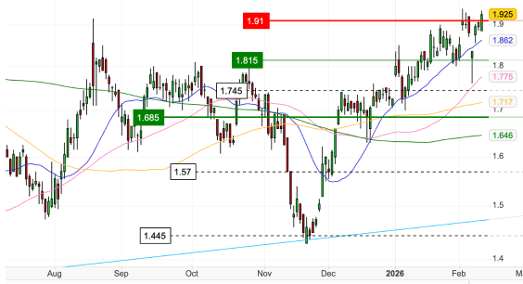
From a technical perspective, the trend remains constructive. The shares have recovered steadily from their 52-week lows of $1.35, with accumulated volume around $1.85 suggesting firm underlying support. While momentum indicators have cooled marginally in recent sessions, the broader volume profile continues to align with the upward trend. Consensus expectations imply further upside as the bank progresses toward its FY26 milestones, reinforcing our view that Judo offers differentiated exposure within the regional financials landscape.
Pepper Money Ltd (ASX: PPM): A Strategic Yield and M&A Play, Why This Non-Bank Lender Captures Interest
Source: PPM, daily chart (2026)
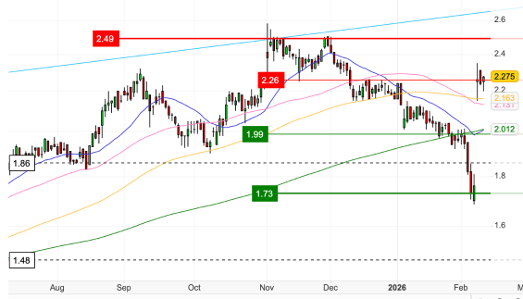
We have seen a decisive re-rating in Pepper Money this week, with the shares surging around 28% as Challenger (ASX: CGF) confirmed advanced discussions around a strategic partnership or acquisition vehicle.
The logic is clear. Challenger gains access to Pepper’s asset-backed securities origination platform, while Pepper secures a potential pathway to crystallise value via a scheme of arrangement reportedly pitched at $2.60 per share.
At the same time, Pepper continues to consolidate its position in non-bank lending, notably through the absorption of Westpac’s $21.4 billion RAMS mortgage portfolio. That combination leaves us viewing PPM as both a corporate event opportunity and a structurally scarce asset in specialist lending.
The full-year 2025 result, due 18 February, marks an inflection point. After a period of margin pressure from elevated funding costs, consensus points to a 13.8% lift in EPS over the coming year.
The dividend profile remains compelling, with trailing yields between 7.6% and 9.4% depending on entry level.
Our focus will be on integration progress within RAMS, the trajectory of capital-light servicing income and whether Net Interest Margin has stabilised.
Technically, the move has been emphatic. The shares have cleared both medium and long-term moving averages and are consolidating in a $2.20 to $2.30 range, with support now forming around $2.15. Momentum indicators are elevated but not extreme. From here, the valuation anchor increasingly centres on the mooted $2.60 proposal, implying roughly 15% event-driven upside should discussions translate into a formal transaction.
HUB24 (ASX: HUB): Platform Scale Meets Structural Tailwinds
Source: HUB, daily chart (2026)
We continue to view HUB24 as one of the clearest structural growth stories in Australian wealth management. As capital rotates away from legacy institutional platforms toward more agile, technology-led operators, HUB24 has positioned itself at the centre of a winner-takes-most dynamic.
The January update underscored that momentum, with record quarterly net inflows of $5.6 billion lifting Funds Under Administration to $152.3 billion. Eight consecutive quarters ranked first for net inflows speaks to sustained adviser demand rather than cyclical noise.
With 9.3% platform market share, we see a business steadily compounding scale advantages.
The upcoming 1H26 result on 19 February will test whether that growth can continue at high margins. After FY25 Underlying NPAT rose 44% to $97.8m, expectations are elevated.
Strategic initiatives such as the IRIS retirement solution with TAL and the pilot of myhub, an AI-enabled advice ecosystem, suggest HUB24 is moving further into advice technology rather than remaining a pure administrator. We think this deepens adviser stickiness and reinforces recurring revenue streams.
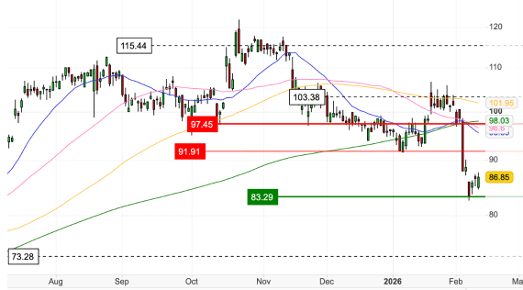
Technically, the recent pull-back from January highs has reset positioning. Trading around the mid-$80s, the shares have found support near $82.29, with momentum indicators cooling from previously stretched levels. Within a 52-week range of $48.80 to $122, the current consolidation appears constructive. A supportive earnings outcome could see renewed interest build toward the $100 level, particularly against an 18.4% annual revenue growth outlook.
The Verdict: Balance Over Blind Loyalty
CBA has demonstrated that it remains a powerhouse. A $5.45 billion cash profit, 6% growth, an 8% share price jump to $171.40, a $2.35 fully franked dividend, and 87% of mortgage holders ahead on repayments collectively reinforce the strength of the franchise.
But strength comes with valuation risk. The premium to ANZ and WBC is material. Concentration risk is real. As disciplined investors, we must weigh quality against price.
Our conclusion is not to rotate out of the Big Four wholesale. It is to balance them.
By combining CBA’s stability and income profile with selective exposure to specialist and mid-cap financials such as Pepper Money, Hub24, we can position portfolios to capture both resilience and growth as the Australian financial cycle evolves.
Get the wire before the market opens.
The ASX small-cap stories that matter, filed before 9am AEST. Curated by the Small Caps desk.