
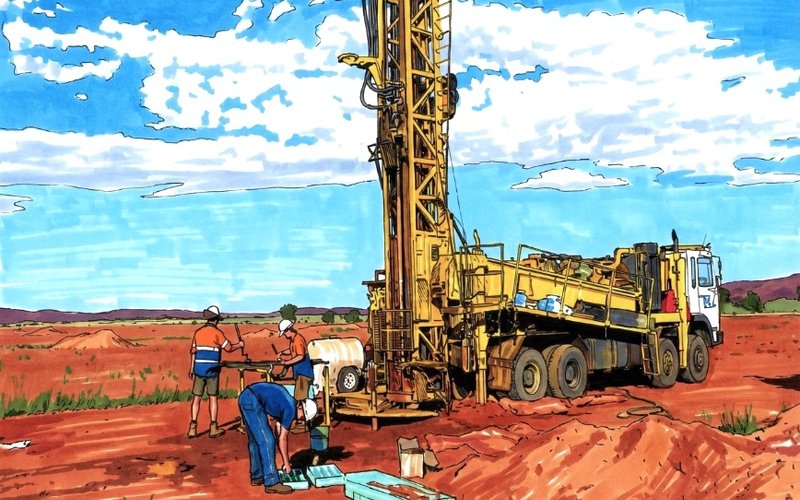

Caprice Resources (ASX: CRS) has confirmed gold mineralisation to at least 400 metres vertical depth with Phase 4 drilling at the Vadrians prospect within its Island gold project in Western Australia’s Murchison region.
Caprice has received results from two diamond holes that intersected gold at 294m and 415m down dip.
Highlight hits were 2.0m at 2.7 g/t gold from 413m, and 2.45m at 1.8 grams per tonne gold from 281m including 1.0m at 6.9g/t gold from 293.0m.
The company is already planning a follow-up test, as it believes both holes clipped the outer edge of a plunging lode.
Metallurgical Drilling Program
The company has also received standout grades in its initial metallurgical drilling program to test density, rock properties, and structural information in the lead-up to a future maiden mineral resource estimate.
Best intercepts included 9.0m at 9.1g/t gold from 106m with 7.0m at 11.6g/t, validating previous reverse circulation (RC) drilling results.
The fully funded Phase 4 program will continue into 2026, comprising a planned 10,000m of aircore (AC) drilling, 7,000m of RC drilling, and 3,000m of diamond drilling (DD).
Previous exploration confirmed that Island’s mineralised corridor extends across 5km of strike 1km wide, and features multiple banded iron (BIF) formation units up to 30m thick.
BIF units are the primary hosts to large-scale gold systems across the Murchison.
Three Rigs Currently On Site
Managing director Luke Cox said three rigs are currently working on site, with the RC drilling chasing strike and dip extensions, the DD testing down-plunge growth, and the AC drilling exploring for new near-surface targets across a 5km corridor.
“Hitting gold at circa 400 vertical metres is an exceptional outcome and confirms the system persists at depth with the clear potential to extend even further," Mr Cox said.
He noted that the depth profile identified at Vadrians is also seen in major deposits across the Murchison where systems commonly continue to depths of between 600 and 1,500 vertical metres.
"These results continue to enhance our model, drill targeting, and general understanding of the controls on high-grade mineralisation at the Island project."
Get the wire before the market opens.
The ASX small-cap stories that matter, filed before 9am AEST. Curated by the Small Caps desk.