
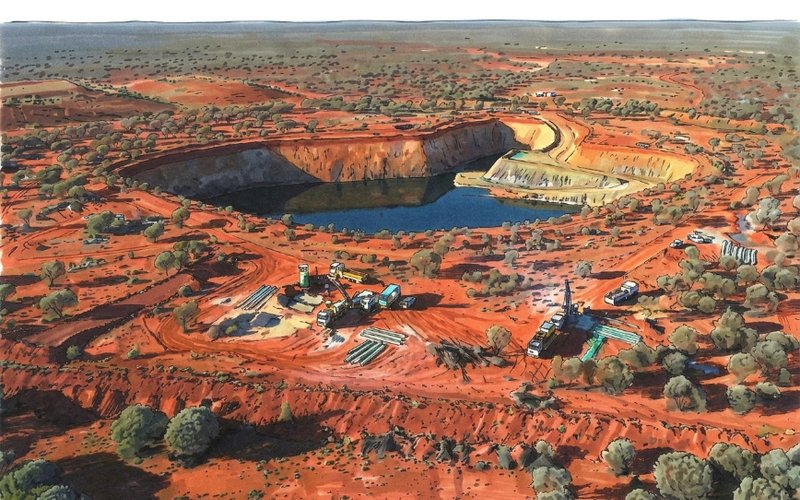

- 01Visible gold in Two Mile Hill holes; assays pending.
- 02Drilling past 550m; aims to boost resource confidence for PFS.
- 03Visible gold isn't assay; lab results needed.
Brightstar Resources (ASX: BTR) says multiple deep diamond drill holes at the Two Mile Hill deposit within its Sandstone Gold Project have encountered visible gold, adding geological support to an underground development case ahead of a Sandstone pre-feasibility study targeted for 2H CY26.
The immediate takeaway is supportive but provisional: assays are still pending, and the significance of the visual observations depends on whether laboratory results support a material resource-confidence upgrade.
This is not an early-stage discovery program, but rather, an infill campaign inside a known deposit, meaning the near-term issue is less about proving gold is present and more about whether the drilling can lift confidence in ounces already in the resource.
The drilling extends to more than 550 metres below surface, which points to a deeper underground focus rather than adding shallow open-pit inventory.
Brightstar said the program is aimed at upgrading mineral resource confidence for inclusion in the planned Sandstone PFS.
The company was also explicit about the main caveat: visible gold is not a substitute for assays.
Brightstar said the visible grains are typically less than 1 millimetre and estimated visually at less than 0.01% of the mineralised zones.
In practical terms, that means readers do not yet have the grade and width data needed to judge whether these observations translate into economically meaningful intersections.
Two Mile Hill Context
Two Mile Hill sits within Brightstar’s Sandstone Gold Project in Western Australia, one of the company’s three core hubs alongside Laverton and Menzies.
At deposit level, the current combined mineral resource for Two Mile Hill-Shillington stands at 753,000 ounces at 1.5g/t gold.
That includes 664,000 ounces at 1.6g/t for Two Mile Hill itself and 91,000 ounces at 1.5g/t for Shillington.
Those numbers show why this drilling matters: two Mile Hill is not a fringe target inside the hub. It is already a meaningful part of the Sandstone inventory.
At the broader hub level, previous Brightstar disclosures described Sandstone as holding a 2.4Moz resource at 1.5g/t gold.
Earlier this month, the company reported assay-backed drilling results from other Sandstone deposits including Bull Oak, Vanguard, Indomitable East and Havilah, with work designed to support both resource updates and PFS studies.
That sits within a larger strategy Brightstar has outlined in prior presentations and filings.
Following consolidation moves in the district, including the Alto Metals transaction and the proposed acquisition of Aurumin, the company has been assessing Sandstone as a district-scale development centred on consolidated tenure and potential central processing options.
Even so, management has also described aspects of Sandstone timing and some broader production ambitions as aspirational rather than formal production targets.
That distinction remains important when considering what this drilling does and does not de-risk.
Program Scope and Numbers
The current Two Mile Hill infill program totals about 9,100 metres across 20 drill holes, using RC pre-collars with diamond tails.
One disclosed RC pre-collar, TMHRCD26001, reached 511 metres before the diamond component, highlighting the depth and technical character of the program.
Brightstar said assays for all holes are pending and expected in coming weeks.
The company said the drilling is targeting a resource-confidence upgrade to support the Sandstone PFS targeted for delivery in 2H CY26.
Management also indicated the results could support a meaningful contribution from an underground operation at Two Mile Hill to that study, subject to assays, subsequent modelling and ongoing study work.
In late April, Brightstar’s quarterly update said the company had completed a A$193 million equity raising and a US$120 million senior secured bond to finance the Goldfields development and progress Sandstone drilling and feasibility work.
More recently, on 25 May 2026, Brightstar said its board had approved final investment decision for the 100% owned Goldfields Project, supported by key approvals including the Mining Development and Closure Proposal from DMPE and a Part V Works Approval from DWER, along with an EPC contract with GR Engineering Services Limited for a 1.5Mtpa Laverton processing plant.
What Comes Next
The first milestone to watch is straightforward: assays from the current Two Mile Hill holes.
That is the point at which the market can test whether the visible gold observations line up with grades and widths capable of improving resource classification and reinforcing an underground mining case.
After that, the next likely step is updated geological interpretation and resource work feeding the Sandstone study pipeline.
Earlier company guidance pointed to mineral resource updates during CY26 and a PFS in 2H CY26.
So the relevance of today’s visual observations depends on whether they are converted into a more robust inventory in the right confidence categories.
There is also a practical portfolio question.
Brightstar is already balancing Sandstone against execution of the Goldfields build, including the 1.5Mtpa Laverton processing plant and a first-gold target in the June quarter of 2027, according to the company’s recent filings.
That creates a watchpoint around management bandwidth and capital deployment, even if Sandstone remains the longer-dated development option.
Assays Are the Test
This update adds another supportive data point for Brightstar’s Sandstone story by showing visible gold in multiple deep Two Mile Hill drill holes, and it aligns with the company’s push to improve resource confidence ahead of the 2H CY26 PFS.
But the investment significance is not settled by visual observations alone: the next important proof point is whether assays and later modelling convert that geological encouragement into a stronger, more defensible underground case.
The main risks are familiar and were largely spelled out by Brightstar in earlier disclosures.
Assays may disappoint relative to visual impressions. Resource conversion may prove harder than hoped.
Future development still sits under permitting, heritage and execution requirements.
The company’s annual report also highlighted ongoing sensitivity to gold prices, funding conditions and project delivery.
And while Brightstar has moved toward owned processing at Laverton, its historic monetisation model has relied on third-party processing arrangements, underlining that Sandstone still needs to move from resource scale to a study-backed, financeable development case.
Get the wire before the market opens.
The ASX small-cap stories that matter, filed before 9am AEST. Curated by the Small Caps desk.