
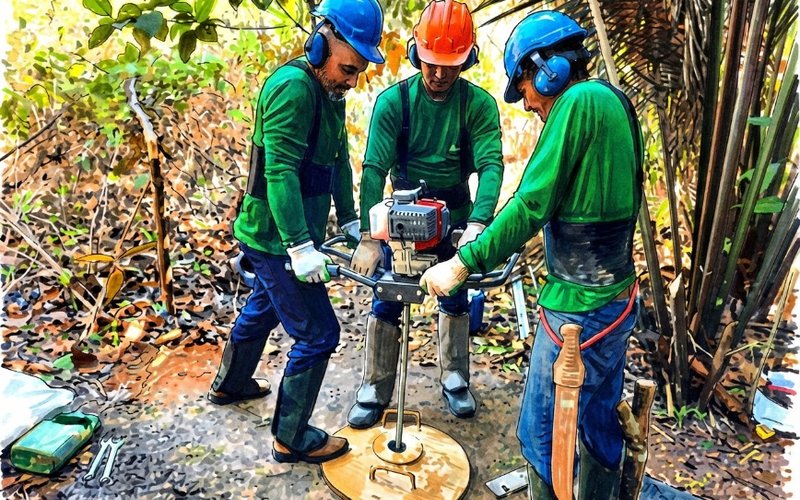

Brazilian Critical Minerals (ASX: BCM) has released the first results from infill auger drilling at the Ema rare earth elements (REE) project in the nation’s Apui region, aimed at increasing confidence in the mineral resource estimate.
A total of 24 holes of the 101-hole program returned thick mineralised intercepts with the highest grades of neodymium-praseodymium (NdPr) located at the bottom of holes within the semi-weathered zone and directly above the fresh rock interface.
Grades above 200 parts per million for magnetic REE – including NdPr, dysprosium, and terbium – reinforced the high-quality composition of the mineralisation and the potential for a long-life, low-cost in-situ recovery (ISR) project.
Valuable heavy REE to more than 31% of the magnetic rare earth oxide composition at the end of holes underscored the economic potential of Ema’s lower saprolite zone, suggesting that deeper drilling could further improve the viability of an ISR operation.
Widespread Additional Mineralisation
Infill drilling outside of the initial starter zone area delivered sufficient rare earth grades and thicknesses to confirm four kilometres of additional mineralisation across a total spread of 82 square kilometres.
Significant assays included 10 metres at 1,048ppm total rare earth oxides (TREO) from 10m, ending in 1,443ppm; 6m at 1,033ppm TREO from 2m, ending in 1,089ppm; and 6m at 1341ppm TREO from 9m, ending in 1299ppm.
Drilling was designed on 300m centres—the same used in the central starter area, which facilitated the inclusion of 248 million tonnes of Indicated material into the current mineral resource estimate of 943Mt.
Large-Scale Ionic Clay System
Managing director Andrew Reid said the initial results met the company’s expectations for a large-scale ionic clay system.
“Ema continues to deliver exactly what we expect — continuity, predictable grades, and a clean clay-hosted profile optimised for ISR,” Mr Reid said.
“With the ISR extraction method already field-tested and proven, each new batch of drilling enhances our confidence in the project’s scale, economic potential and long-term development trajectory.”
“The combination of demonstrated ISR amenability, continuous mineralisation geometry, and consistent rare earth distribution positions Ema as technically mature and globally competitive—these results further strengthen its transition from exploration into near-term ISR deployment and mineral resource conversion,” he added.
Get the wire before the market opens.
The ASX small-cap stories that matter, filed before 9am AEST. Curated by the Small Caps desk.