
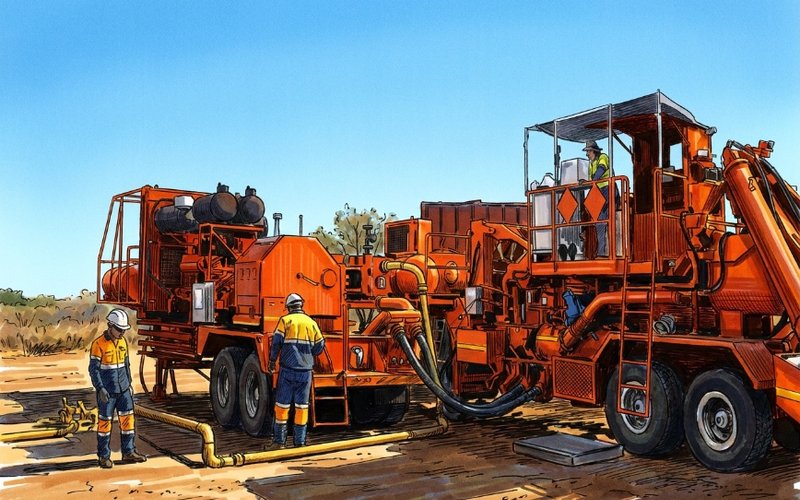

- 01Pitse 3.5B in production testing after stimulation.
- 02Gas breakthrough to gauge flow; target >70 GJ/d.
- 03BFS Phase 2 to advance LNG pathway.
Botala Energy (ASX: BTE) has moved Pitse Pilot well 3.5B into commercial production testing after completing hydraulic stimulation at its wholly owned Serowe coal bed methane project in Botswana.
The stimulation was the final reservoir-preparation activity before controlled dewatering, gas breakthrough, and flow testing can determine whether the well can sustain commercial gas production.
Botala recovered about 700 barrels of stimulation fluid—representing around 30% of the injected volume—after reducing wellhead pressure from approximately 47 pounds per square inch to below atmospheric pressure.
The company is targeting sustained output above its internal development benchmark of about 70 gigajoules per day, while cautioning that successful stimulation does not itself establish commercial production.
Results from well 3.5B will inform future well design, reserves assessment and field development planning for Botala’s LNG pathway while supporting completion of the Phase 2 mini-LNG Bankable Feasibility Study (BFS).
New Pathways Connected
Water from the surrounding coal began flowing into the well immediately after depressurisation, demonstrating hydraulic communication between the wellbore and the stimulated reservoir and indicating that new pathways had connected with the coal’s natural cleat network.
No proppant was recovered during flowback, which Botala considers evidence that the sand remains in place to support the newly created pathways rather than returning to surface with the treatment fluid.
The single stimulation was conducted over 1.5 hours using 2,200 barrels of fluid and 43.5 tons of sand, with the remaining treatment fluid moving into the coal formation as pressures equalised.
Controlled dewatering is now progressively reducing reservoir pressure towards the point where methane can desorb from the coal matrix, enter the connected cleat network and begin flowing into well 3.5B.
Longer-Term Production Testing
Gas production is expected to build as water output declines, with first gas breakthrough to confirm connection to the gas-bearing reservoir before longer-term testing establishes production volume and sustainability.
A nearby analogue well, MAS-13, previously sustained about 120GJ per day, while Botala’s current modelling indicates output above approximately 70GJ per day could support its commercial development concept.
“Today marks the point where years of exploration, reservoir evaluation and engineering begin to translate into measurable production performance,” chief executive officer Kris Martinick said.
“The next stage is straightforward in its objective—we must progressively reduce reservoir pressure, bring gas into the well, and determine how much the well can produce.”
“We have passed every checkpoint to date and eagerly await first gas from 3.5B as we advance our scalable domestic gas development at a time of increasing regional demand for reliable energy.”
The first of four development phases, Pitse is targeting a six-well cluster to underpin the BFS for an initial Serowe-to-Leupane development producing about 3.5 petajoules of LNG annually from approximately 108 wells, with near-term milestones comprising first gas, flow testing, and updated reserves certification.
Get the wire before the market opens.
The ASX small-cap stories that matter, filed before 9am AEST. Curated by the Small Caps desk.