
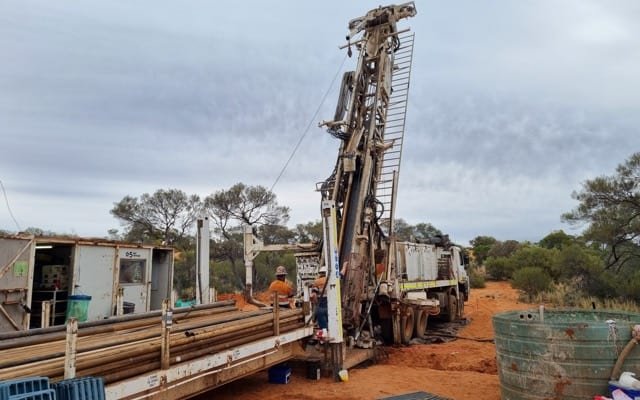

Final assays from drilling at Barton Gold’s (ASX: BGD) 223 Deposit within the Tunkillia project in South Australia have identified multiple broad and high-grade intersections outside the current resource estimate and up to 150 metres below the current open pit model.
Drilling of 37 holes for a total 9,214m produced key intercepts of 6m at 2.51 grams per tonne gold from 43m, 4m at 2.88g/t gold from 50m, 11.3m at 4.04g/t gold from 174m, 12.05m at 0.89g/t gold from 219.95m, 14.8m at 1.01g/t gold from 394m, and 11m at 3.7g/t gold from 185m.
The consistency of results is believed to demonstrate potential to add a second zone of depth extension to the 965,000-ounce resource estimate, following the identification in January of a potential 500m long extension.
A host of shallow high-grade assays next to 223 Deposit also indicate a new zone of shallow quartz vein-hosted mineralisation, offering a potential expansion to the resource estimate and providing follow-up drill targets.
Extensions and growth
Barton managing director Alex Scanlon said exploration continues to prove considerable potential exists for extensions and growth in tested and previously untested areas of the deposit.
“These results in particular, highlight potential for entirely new shallow high-grade structures adjacent to our 2020 resource block model,” he said.
“We expect to release an updated resource estimate for 223 Deposit later this financial year.”
Major drilling program
Barton commenced a major drilling program in September to target depth extensions of 223 Deposit and the newly-identified Area 51 gold zone.
Over 90% of drilling which formed the foundation of the current resource estimate was completed between 1996 and 2008, during which period the gold price sat below US$500 per ounce.
As a result, depth extensions and regional targets at 223 Deposit were poorly tested.
Broad intersections
Assays in December and January confirmed broad intersections outside the 2020 block model in previously untested areas at the southern end of 223 Deposit.
These results indicated potential to add mineralisation from a 500m long ‘south plunge’ depth extension into the current resource estimate.
Mr Scanlon said the latest results further enhance this possibility, with multiple significant assays sitting outside the block model.
“They also highlight the potential to add mineralisation from another 300m-long zone located in the northern end of the Main Deeps target,” he said.
Get the wire before the market opens.
The ASX small-cap stories that matter, filed before 9am AEST. Curated by the Small Caps desk.