
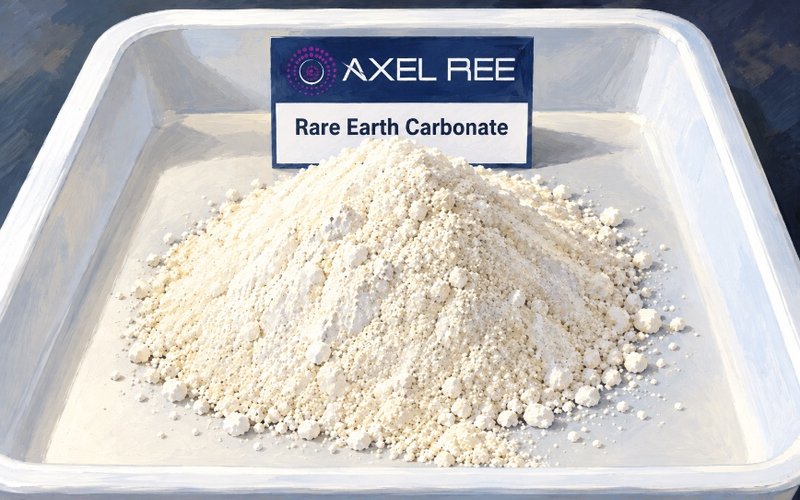

- 01Woolrich MREC graded 54.4% TREO.
- 02Test achieved 97% TREO precipitation without impurity removal.
- 03MREC contained 34.1% NdPr and very low uranium/thorium.
Axel REE (ASX: AXL) has produced a high-grade mixed rare earth carbonate (MREC) as part of ongoing metallurgical test work on samples from the Woolrich ionic rare earth elements deposit within its Caladão project in Brazil.
In situ recovery-simulated testing in Australia by Core Resources employed a blended feed of pregnant leach solution (PLS) from column tests with filtrate from an earlier precipitation test to produce 15.11 grams of dried MREC grading 54.4% total rare earth oxides (TREO) MREC.
Approximately 97% TREO and 99% mixed rare earth oxides (MREO) precipitation was achieved from PLS without the costly impurity removal stage used by most rare earth processing circuits.
The final MREC contained 35.9% MREO of the total rare earth oxide content including 34.1% neodymium-praseodymium and 1.75% dysprosium-terbium within the TREO basket, confirming a significant contribution from the four rare earth elements used in high-performance permanent magnets.
The product also returned very low concentrations of uranium (0.78 parts per million) and thorium (0.10ppm) alongside low aluminium and iron.
Simplified Recovery Flowsheet
The results represent an important step forward in evaluating Woolrich’s downstream processing characteristics, highlighting the potential to develop a simplified rare earth recovery flowsheet with a reduced number of treatment stages using magnesium sulphate leaching and magnesium bicarbonate precipitation.
They demonstrate that rare earths recovered during laboratory column leaching can be further concentrated into a MREC intermediate, providing additional support for Axel’s proposed hydrometallurgical development pathway.
Further metallurgical test work will assess the consistency of feed solution chemistry, precipitation performance, and final product quality across representative operating conditions before the flowsheet can be considered for commercial-scale design.
Axel is believed to be the first operator in the state of Minas Gerais to develop an ISR process from ionic adsorption clays.
‘Encouraging Foundation’
Managing director Dr Patience Mpofu was pleased with the continued progress of the Woolrich metallurgical program.
“It is particularly encouraging that we have achieved a 54.4% TREO product with excellent precipitation performance without requiring a dedicated impurity removal stage in this test circuit,” she said.
“This highlights the potential advantages of Woolrich’s leach solution chemistry and provides an encouraging foundation for developing a simpler and more efficient downstream processing route as we advance towards field-scale testing.”
“The exceptionally low uranium and thorium concentrations in the final product are also particularly significant as they demonstrate the potential benefits of Woolrich’s naturally buffered mineralised regolith, which has consistently shown limited mobilisation of impurities during magnesium sulphate leaching.”
High-Value Basket
The Woolrich MREC product delivered an indicative gross contained rare earth oxide basket value of US$42.72 per kilogram, based on October rare earth oxide spot prices.
Neodymium-praseodymium and dysprosium-terbium account for approximately 92.8% of the calculated basket value and represent 35.9% of the TREO content, highlighting the significant contribution of high-value magnet rare earths to Woolrich’s product composition.
The results provide further encouragement for Axel’s ongoing assessment of Woolrich as a potential ionic rare earth development project.
Additional metallurgical testing will be needed to establish overall recovery performance, process consistency, and commercial product specifications.
Get the wire before the market opens.
The ASX small-cap stories that matter, filed before 9am AEST. Curated by the Small Caps desk.