
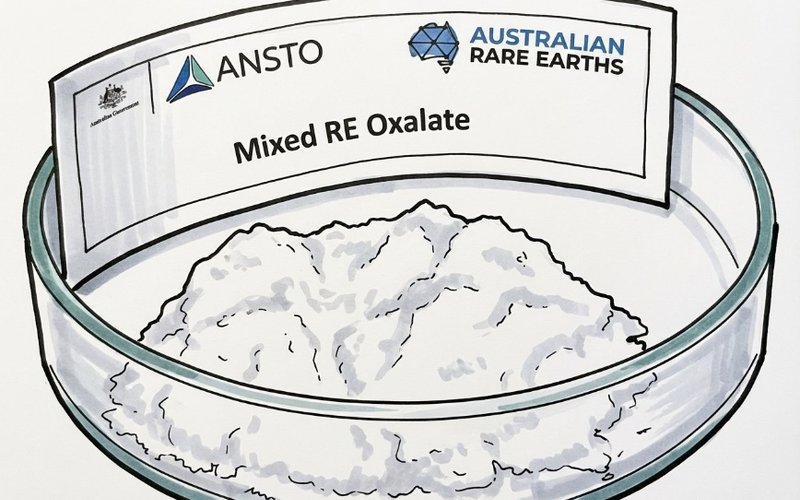

Australian Rare Earths (ASX: AR3) has simplified and improved the processing flowsheet for its Koppamurra ionic clay project in South Australia, resulting in the production of a high-purity mixed rare earth oxide (MREO).
Recent metallurgical test work demonstrated a viable process to produce the MREO using conventional low-risk calcination and oxalic acid precipitation.
This introduces a downstream purification pathway considerably more straightforward than mixed rare earth carbonate flowsheets used by similar projects.
China is the world’s largest producer and exporter of oxalic acid — known for its use as the active ingredient in many commercial rust and stain removers — with alternate sources of supply coming from India, Japan, South Korea, and Europe.
High Rare-Earth Recovery
Australian Rare Earths was able to demonstrate that MREO production using oxalic acid precipitation could achieve 99.9% rare-earth recovery from solution while rejecting most impurities.
Calcination converts the mixed rare-earth oxalate product to a final marketable MREO, removing the oxalate (carbon-oxygen) component and water as gases and converting the material into a stable oxide projected to contain approximately 98.6% of rare earths plus yttrium oxide, and just 1.4% total impurities by weight.
The end product comprises a high proportion of magnet rare earth elements plus significant quantities of yttrium, gadolinium, samarium, and lutetium—all of which are subject to China’s expanded export controls and tightening global supply conditions.
Australian Rare Earths considered a range of factors when deciding the optimal product strategy for Koppamurra before determining that production of a MREO would be the most cost-effective and economically beneficial option.
Complete and Scalable Pathway
Managing director Travis Beinke said the new flowsheet demonstrated a complete and scalable pathway from ore through to saleable rare earth intermediates using conventional processing techniques.
“The oxalate route has delivered very strong recoveries, excellent impurity rejection, and a rare earth assemblage highly-attractive for the production of magnets, plus other strategically-constrained elements such as yttrium,” he said.
Early discussions with potential customers seeking mixed rare earth feedstocks have indicated an MREO product would be “attractively positioned” in the marketplace, offering better material handling characteristics, lower transport costs, reduced impurity levels, and higher overall product quality.
“In an environment of tightening global supply chains and expanding export controls, these results support our strategy to deliver a technically robust, cost-effective, and geopolitically relevant rare earth supply option.”
“Optimisation work at ANSTO is now underway to inform the Pre-Feasibility Study, and we will continue to engage with our potential downstream customers.”
Get the wire before the market opens.
The ASX small-cap stories that matter, filed before 9am AEST. Curated by the Small Caps desk.