
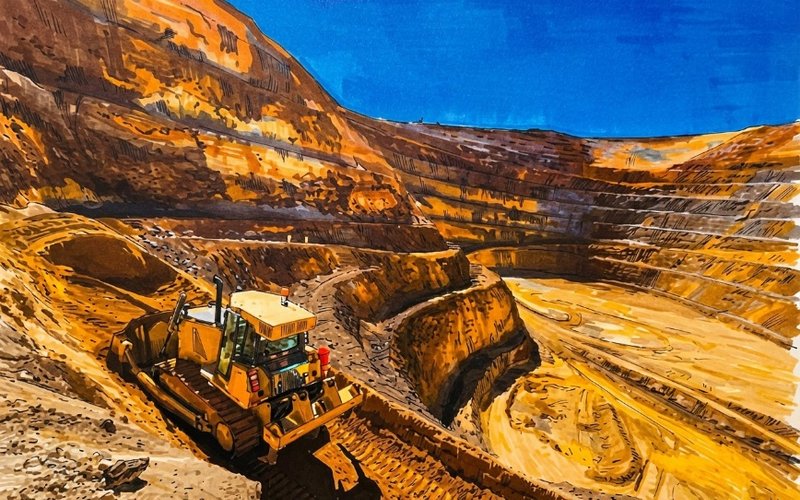

First assays from diamond drilling at Australian Mines’ (ASX: AUZ) Boa Vista gold project in Brazil have confirmed strong and broad gold mineralisation within the interpreted mineralised envelope.
Results for the first three holes of an 11-hole campaign at the VG1 prospect showed mineralisation present over broad down-hole intervals and higher-grade internal zones, consistent with the company’s exploration model for the project.
VG1 hosts an inferred resource of 8.47 million tonnes at 1.23 grams per tonne gold for 336,000 ounces within a gold-in-soil anomaly more than two kilometres long, trending to the west-northwest and up to 350m wide.
The prospect remains open along 600m of strike and at depth to 120m tested, with widths up to 85m.
Second-Highest Interval
One of the holes returned 160.8 gram-metres, the second-highest gram-metre result reported at Boa Vista to date—behind only a historical intercept of 166.2 gram-metres.
Other highlight assays were 120m at 1.34g/t gold from 117m including 16m at 3.53g/t from 117m, 54m at 1.15g/t gold from 141m, and 4m at 4.28g/t gold from 106m within a broader zone of 144m at 0.62g/t from 106m.
Australian Mines will incorporate the results into ongoing geological interpretation and targeting, alongside assays for the remaining eight holes when they become available.
Subject to further exploration and appropriate studies, the company believes Boa Vista may have the potential to support a low-cost, long-life open-pit gold operation.
Multiple Visible Gold Hits
Australian Mines has drilled 15 holes to date at VG1 with multiple intercepts exceeding the 20-gram metre threshold with a peak value over 160 gram-metres and numerous intersections reporting visible gold.
Historical drilling at VG1 returned multiple high-grade intercepts well above a 20 gram-metre threshold, with highlights of 104.5m at 1.59g/t gold including 23.5m at 4.51g/t (166 gram-metres) and 102.3m at 1.18g/t gold including 6.4m at 6.96g/t (121 gram-metres).
Gram‑metre drilling results provide a useful comparative indication of mineralisation strength, with values exceeding 100 gram-metres generally considered strong indicators of robust mineralisation and intercepts above 20 gram-metres an indicator of prospective mineralisation intensity.
Following receipt of the outstanding assays, the company will look to refine its strategy for exploring resource definition potential and assess its follow-up drilling priorities to test the project’s strike and down-dip continuity.
Get the wire before the market opens.
The ASX small-cap stories that matter, filed before 9am AEST. Curated by the Small Caps desk.