

- 01ASX 200 +1.37% to 8,844; weekly +0.9%
- 02US payrolls 57k; Fed hold odds at 83%
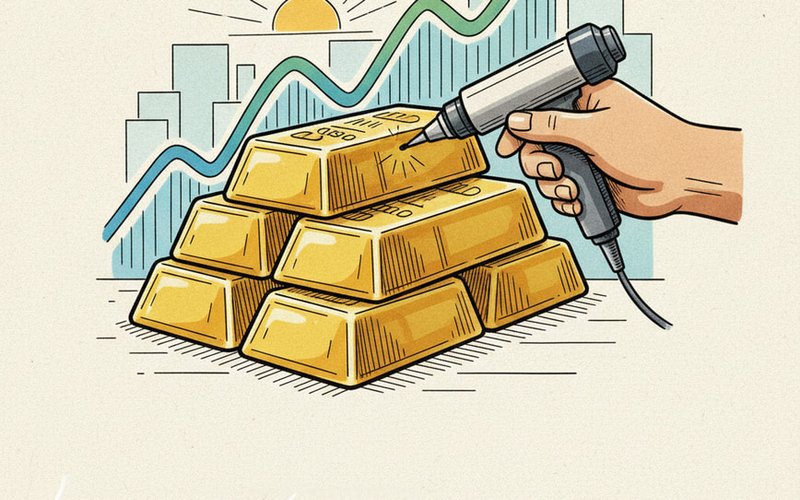
- 03Gold above 4,100; rebounds after dip
- 04AUD ~0.694; near 3m low
ASX Weekly Wrap: Gold Whipsaws, Soft US Jobs Data Spark Friday Surge
ASX 200 rallies 1.37% to 8,844 as weak US payrolls ease Fed hike bets and gold rebounds above US$4,100, capping a choppy week bridging the FY26 close and FY27 open.
In brief
- ASX 200 closed at 8,844.4, up 1.37% on Friday and 0.9% for the week
- June US payrolls of 57,000 badly missed forecasts, lifting Fed hold bets to 83%
- Gold bounced back above US$4,100 after touching a nine month low near US$3,942
- AUD/USD steadied near US$0.694 but remains close to a three month low
Today's Market Close
The S&P/ASX 200 powered to its highest close in a week on Friday, finishing up 119.9 points, or 1.37%, at 8,844.4. The broader All Ordinaries added a similar 1.31% to 9,048.3. It was the benchmark's best single session in over a month and capped a week that had spent most of its time drifting lower before Friday's sharp reversal.
The catalyst arrived from offshore. US non-farm payrolls for June printed at just 57,000 against expectations of around 110,000, the softest headline print since February, with both the April and May figures revised down. The unemployment rate nonetheless slipped to 4.2% as participation eased. The soft jobs number pushed the CME FedWatch implied probability of a July Federal Reserve hold to 83%, from around 68% ahead of the release, and sent gold surging back through US$4,100 an ounce, just days after bullion touched a nine month low near US$3,942.
That gold rebound flowed straight into the local market. The Materials sector jumped 2.6%, with most gold miners rallying between 7% and 10% intraday. Catalyst Metals (ASX: CYL) was the standout across the entire index, surging 19.2% to $6.09 after reporting record annual gold output at its Plutonic operation, with FY26 production of 104,000 ounces in line with guidance and the balance sheet debt free with $423 million of liquidity. Genesis Minerals (ASX: GMD), Vault Minerals (ASX: VAU) and Boss Energy (ASX: BOE) also delivered quarterly updates that broadly met revised FY26 guidance, adding to the sector's positive tone.
Healthcare was the other standout, up around 2% and now roughly 20% higher since its June 3 low, though still down about 20% year to date. CSL has rallied more than 30% off that same low, recovering the entirety of an earlier profit warning selloff. The major banks edged higher into the close, while Suncorp Group (ASX: SUN) reaffirmed FY26 guidance and outlined a costlier FY27 reinsurance program, with chief executive Steve Johnston due back from medical leave on 6 July.
Offshore leads into the session were mixed rather than uniformly positive. Wall Street closed split overnight, with the Dow Jones Industrial Average touching a fresh record high, up 1.14% to 52,900.07, while the S&P 500 finished flat at 7,483.24 and the Nasdaq slid 0.8% to 25,832.67 as a two session semiconductor rout continued to bite.
Aussie Weekly
It was a week defined by two distinct halves: a soft, choppy stretch bridging the end of the 2025-26 financial year and the start of FY27, followed by Friday's decisive rally that pulled the index back into the black. From last Friday's close of 8,764, the ASX 200 ultimately finished the week at 8,844.4, a gain of roughly 0.9%, but the path there was far from smooth.
Monday saw miners and gold producers lift the index 0.6% to 8,817.8 as iron ore and bullion firmed. Tuesday, the final trading day of FY26, told a different story: a large late session sell order hit the Gold Sub-Index hard, down 4.6%, alongside a similar hit to real estate stocks, in what looked like institutional portfolio rebalancing rather than any shift in commodity fundamentals. The index fell 44.7 points to 8,778.7. That closed out the financial year with the ASX 200 up around 3% in price terms, or roughly 6.1% to 6.3% on a total return basis including dividends, its weakest financial year performance since FY22. Materials led all sectors for the year, up 48.2%, followed by energy (+9.8%) and consumer staples (+9.7%), while healthcare (-37.5%), information technology (-37.1%) and telecommunications (-12.4%) were the laggards.
Wednesday, the first session of the new financial year, brought a further 0.6% fall to 8,722.9 as Cotality's national home value index recorded its largest monthly decline since December 2022, down 0.4%, hitting the major banks and consumer discretionary names as investors weighed the flow-through from three RBA rate hikes earlier in the year plus May budget changes to negative gearing and capital gains tax settings. Gold also extended its slide that day, briefly dropping below the psychologically significant US$4,000 mark. Thursday was a near dead heat, the index adding just 1.6 points to 8,724.5 as a Bank of America upgrade to National Australia Bank offset broader weakness, before Friday's payrolls-driven surge closed out the week.
On the data front, Australia's S&P Global Composite PMI was revised up to 50.4 in June from a preliminary 49.8, with services returning to expansion at 50.5 and manufacturing strengthening to 51.5. Less encouraging was May's trade figures, which showed an unexpected deficit of $3.02 billion, the largest since December 2015, as exports fell 6.9% on weaker mineral shipments while imports rose 2.6% on heavy industrial equipment. Building approvals also fell for a third consecutive month.
The Reserve Bank's June meeting minutes, released mid-week, maintained a broadly hawkish tone, flagging the Middle East conflict and persistently weak productivity growth as the two key risks to the outlook, and reiterating the board has not ruled out further tightening after three hikes earlier in 2026. Markets nonetheless continued to price only around a 15% chance of an August hike, with roughly half to two thirds of participants now viewing the current 4.35% cash rate as the peak of the cycle and the first cut not expected until late 2027.
International
Wall Street's week was defined by a sharp bifurcation rather than a clean directional move. Semiconductor names bore the brunt of profit-taking, with the Philadelphia Semiconductor Index (SOXX) falling around 11.6% over two sessions as Applied Materials, Micron, Intel, AMD and Nvidia all retreated. Tesla fell 7.5% on Friday even after reporting record second quarter deliveries of 480,126 vehicles, up 25% on the prior year and beating estimates by around 18%, in a classic sell-the-news reaction. Value and defensive sectors, healthcare, staples, utilities and materials, all gained more than 2% on the week, and the equal-weight S&P 500 outperformed its cap-weighted counterpart by around 70 basis points to set a fresh record.
Zooming out, the first half of 2026 was described by strategists as one of the strongest six month stretches for a diversified stock, bond and commodity portfolio since 2021, despite war in the Middle East, oil doubling and then collapsing, and sharp swings in Fed rate expectations. The Nasdaq 100 gained close to 20% over the half, but the so-called Magnificent Seven megacaps actually lost around 2% on a total return basis as investors rotated toward AI infrastructure builders, chips, memory and power, over AI deployers. Barclays estimates semiconductor and computer hardware names alone drove roughly 87% of the S&P 500's first half gains, underlining just how narrow the rally has been beneath the index-level numbers. New Fed chair Kevin Warsh made his first appearance at the ECB's Sintra forum this week, reassuring global counterparts that the US central bank intends to remain internationally engaged.
Asian markets were volatile through the week. A rotation out of high-flying AI and semiconductor names hit China hard on Thursday, with the Shanghai Composite down around 2% to 4,029 and the Shenzhen Component sliding nearly 3.9%, exacerbated by reports that Apple is in talks to source memory chips from Chinese suppliers ChangXin Memory and Yangtze Memory, a move that risks scrutiny from US policymakers. Japan's Nikkei 225 fell over 2% the same day before rebounding more than 1.4% on Friday to finish near 69,700, buoyed by an improving Bank of Japan Tankan survey reading. South Korea's Kospi jumped 2.8% on Friday, with Samsung Electronics up 7% and SK Hynix up close to 5%, even as South Korean CPI accelerated to a two and a half year high of 3.2% in June, cementing expectations of a Bank of Korea hike at its July 16 meeting. In Europe, euro area inflation eased to 2.8% in June from 3.2%, leaving the ECB split over whether further tightening is still warranted, while the Bank of England's Andrew Bailey ruled out near term rate cuts despite a softening UK economy.
Commodities
Gold had a volatile week but ended firmer, bouncing 2.3% overnight into Friday to reclaim US$4,100 an ounce after touching a nine month low of roughly US$3,942 just three days earlier. The metal remains down close to 5% year to date and around 26% below its late January record above US$5,500, but the sharp swings underline how sensitive bullion remains to shifting Fed rate expectations, with Friday's weak payrolls print doing most of the heavy lifting for the rebound.
Oil continued its retreat from wartime highs, with Brent crude slumping to around US$68.50 a barrel, down from levels near US$120 in March. Saudi Aramco resumed loadings from Ras Tanura after a near four month halt, UAE exports rebounded roughly 30% to near record highs, and US-Iran talks in Doha produced what negotiators described as positive progress, though the next round is not expected until after Iran's mourning period for its late supreme leader concludes on July 9. Iran continued to warn tankers over Strait of Hormuz routing, keeping some geopolitical risk premium alive even as flows have recovered to around 75% of pre-war levels.
Copper rose around 1.1% to roughly US$6.18 a pound, up close to 23% over the past year but down about 5% over the past month as expectations of eventual further Fed tightening weigh on the industrial demand outlook. Goldman Sachs has argued the broader conflict-related disruption could ultimately support longer-run copper demand via electric vehicle adoption, renewable energy investment, defence spending and AI infrastructure build-out. Iron ore has held up relatively well through the period, averaging above US$105 a tonne in recent weeks on the back of firmer Chinese demand and elevated shipping costs, though it remains sensitive to any further downside surprises from Chinese manufacturing data.
The Australian dollar recovered modestly to around US$0.694 by Friday, up roughly a quarter of a percent on the softer greenback, but remains not far off a three month low near US$0.687 struck earlier in the week. The currency's fortunes continue to hinge on the widening gap between a cautious RBA, now seen close to the end of its hiking cycle, and a Federal Reserve whose path has become considerably less certain following Friday's payrolls miss.
Outlook
The Aussie market enters the new financial year in a genuinely two-sided position. On one hand, a softer domestic PMI read, resilient services activity and the prospect of the RBA's tightening cycle being at or near its peak all argue for a constructive medium term backdrop for rate-sensitive sectors including financials and property. On the other, the unexpected trade deficit, falling building approvals and a housing market showing its largest monthly value decline in over three years suggest the cumulative effect of three RBA hikes and this year's budget changes is only now starting to bite, a dynamic that will likely keep bank earnings under scrutiny through August reporting season.
Offshore, the picture is similarly mixed. Friday's weak payrolls print has bought the Fed some room to hold in July, which should support risk assets and gold in the near term, but it has not resolved the deeper question hanging over Wall Street: whether an equity rally driven overwhelmingly by a narrow band of semiconductor and AI infrastructure names can broaden out, or whether valuations there have simply run ahead of fundamentals. The unwinding of the Middle East risk premium in oil is a net positive for inflation globally and for Australian input costs specifically, but continued volatility around Hormuz shipping and the uncertain outcome of the next round of US-Iran talks means that relief cannot yet be taken for granted.
With gold whipsawing between nine month lows and sharp rebounds within the same week, and leadership within the ASX 200 rotating from miners to financials to healthcare and back again on a near daily basis, stock and sector selection is likely to remain more important than broad market direction over the coming weeks. Key watch items into the following fortnight include the RBA's read-through from the softer trade and housing data, the trajectory of US Fed rate expectations following the payrolls miss, developments out of the delayed US-Iran talks, and whether China's technology-led selloff proves temporary or the start of a broader rotation away from AI infrastructure names that have driven so much of this year's global equity gains.
Get the wire before the market opens.
The ASX small-cap stories that matter, filed before 9am AEST. Curated by the Small Caps desk.