
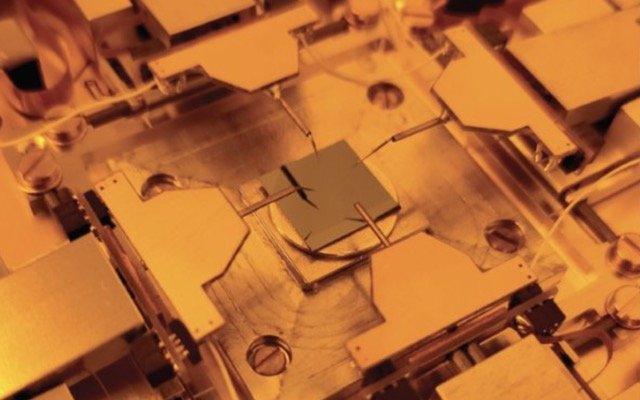

Archer Materials (ASX: AXE) closed out the September quarter (Q1 FY2023) with $25.3 million in cash to fund ongoing development of its “world-first qubit processor technology”.
The company is developing advanced semiconductor devices, including chips relevant to quantum computing and medical devices – focusing on its 12CQ quantum computing qubit processor chip (12CQ chip), and lab-on-a-chip biochip (biochip).
During Q1 FY2023, Archer made “significant steps” in refining its 12CQ chip technology, which it is developing to allow for mobile quantum computing-powered devices.
Major milestones for the period included nanofabricating devices that electrically integrate its qubit material.
The devices were fabricated on a silicon wafer using foundry-compatible lithography processes.
Archer was able to demonstrate that a controlled electric current can be passed through the qubit material at room-temperature.
This was in-line with previous state-of-the-art electronic transport measurements performed on isolated qubit material in February 2021 and June 2020.
Archer executive chairman Greg English said the advanced lithography semiconductor fabrication processes were also able to achieve sub-10 nanometre biochip device components.
“Archer staff ambitiously set out to achieve sub-10nm fabrication to bring Archer in-line with the feature size lithographic processing capability of leading players in the semiconductor industry.”
Scaling fabrication
To scale-up the fabrication of its 12CQ chip devices and components, Archer will need to work with industrial-scale manufacturers in the global semiconductor supply chain.
As part of this, Mr English said, in July, the company had successfully performed state-of-the-art 3D electrostatic finite element modelling in conjunction with in-house software to show the 12CQ device’s compatibility with existing fabrication processes.
He said this work resulted in an agreement with GlobalFoundries to advance the 12CQ quantum chip technology.
“The agreement with GlobalFoundries will provide Archer with access to the technology, facilities and manufacturing processes of GlobalFoundries and will allow the companies to work together on 12CQ device and circuit design and technology development.”
Archer will explore pathways with GlobalFoundries for potential high-volume manufacturing of the 12CQ chip devices and components.
Patents secured
Also, during Q1 FY2023, Archer locked-in a Hong Kong patent for its 12CQ chip.
Mr English said securing the Hong Kong patent means all the current applications for the 12CQ chip have now been granted.
In addition to Hong Kong, the 12CQ chip is protected by patent systems in the US, China, Japan, South Korea, Europe and Australia.
Biochip
As well as advancing the 12CQ chip, Archer is also developing a biochip based on a unique graphene technology.
The chip enables the complex detection of come of the world’s most deadly communicable diseases.
During Q1 FY2023, Archer focused on micro and nano-fabrication of biochip device components and is looking to combine them with “biologically relevant reactions” to detect various diseases.
In May, Archer revealed it had made “significant progress” towards fabrication of a sub-10nm biochip.
This was progressed further during Q1 FY2023, with Archer managing to fabricate sub-10nm features “reproducibly and reliably” using several “advanced lithographic processes” on a silicon wafer in a clean-room environment.
“The work is a significant achievement and represents a technology development breakthrough for the company,” Archer stated.
The company added its sub-10nm fabrication is “in-line” with the current best-in-class processes in the semiconductor industry for chip feature sizes – providing it with a “significant competitive advantage”.
Get the wire before the market opens.
The ASX small-cap stories that matter, filed before 9am AEST. Curated by the Small Caps desk.