
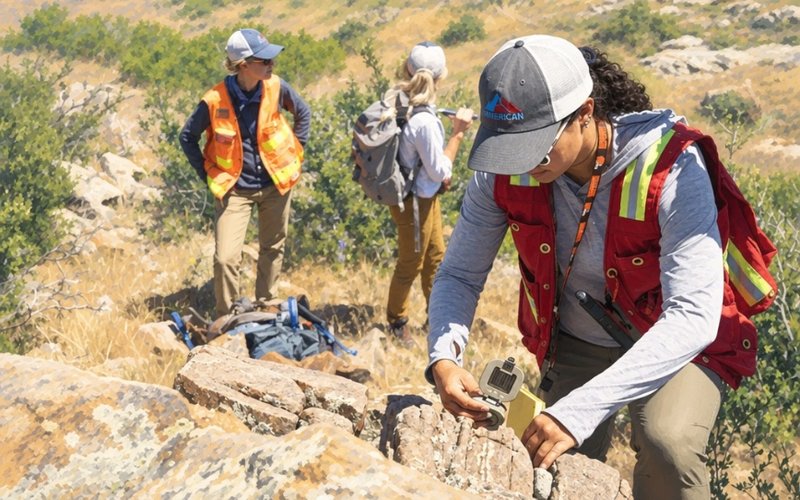

- 01ARR finishes 18-hole Halleck Creek drill program
- 02Near-surface hits extend ~200m; grades reach 4,242ppm TREO
- 03Assays to inform updated resource estimate
American Rare Earths (ASX: ARR) has completed its 2026 feasibility drilling program at the Halleck Creek rare earths project in Wyoming, with mineralisation extending almost 200 metres from surface in several holes.
Certified results from all 18 holes at the Cowboy State Mine development area cover 2,879.6m of drilling and will underpin an updated mineral resource estimate.
Across 1,318 geological samples, average total rare earth oxides (TREO) reached 3,327 parts per million, with 84% of samples exceeding the 1,000ppm resource cut-off grade.
The results support further evaluation of the near-surface open pit concept at Red Mountain as the company progresses its feasibility work.
Halleck Creek hosts an existing mineral resource of 2.63 billion tonnes at 3,292ppm TREO, containing 8.65Mt of rare earth oxides.
Broad Intervals from Surface
Four of the 12 newly reported holes intersected mineralisation above the resource cut-off from at or near surface through to depths of approximately 200m.
One standout interval returned 199.95m at 4,242ppm TREO from surface, while another delivered 199.91m at 4,159ppm TREO over the same near-surface setting.
A further hole recorded 199.50m at 4,149ppm TREO, reinforcing the continuity identified across the Red Mountain drilling area, along with higher-grade zones including 46.50m at 5,291ppm TREO.
The newly reported 932 sample intervals averaged 3,257ppm TREO, broadly consistent with the 3,497ppm average from the first six holes released in September.
Magnet Rare Earth Content
Magnet rare earth oxides averaged 925ppm across the full program, representing 27.8% of TREO in the sampled material.
Neodymium and praseodymium oxides accounted for 22.7% of TREO, providing further compositional detail for the planned resource update.
Core recovery averaged 96.2% across 1,226 logged runs, although recovery was lower within the weathered material close to surface.
Lower average grades in several holes reflected intersections of intrusive rocks outside the main mineralised host and will help refine geological boundaries.
Resource Model Evolving
The 18-hole program—which ran from 14 May to 23 August—was designed to increase geological confidence in areas relevant to the proposed initial mining sequence.
American Rare Earths is incorporating the completed assays and geological interpretation into an updated Cowboy State Mine resource model for the feasibility study.
“With all eighteen holes reported, the consistency we saw in the first tranche has held up across the full program,” chief development officer Andrew Conover said.
“The holes that intersected other intrusive units are valuable as well, because they help us define the boundaries of the mineralised host as we build and increase the confidence in the updated geological model for the Feasibility Study.”
Additional density, metallurgical, geotechnical and groundwater information generated during the drilling program is intended to inform the broader technical assessment, and the company will also complete a final instrument survey of drill collar locations before using the coordinates in resource estimation.
Get the wire before the market opens.
The ASX small-cap stories that matter, filed before 9am AEST. Curated by the Small Caps desk.