
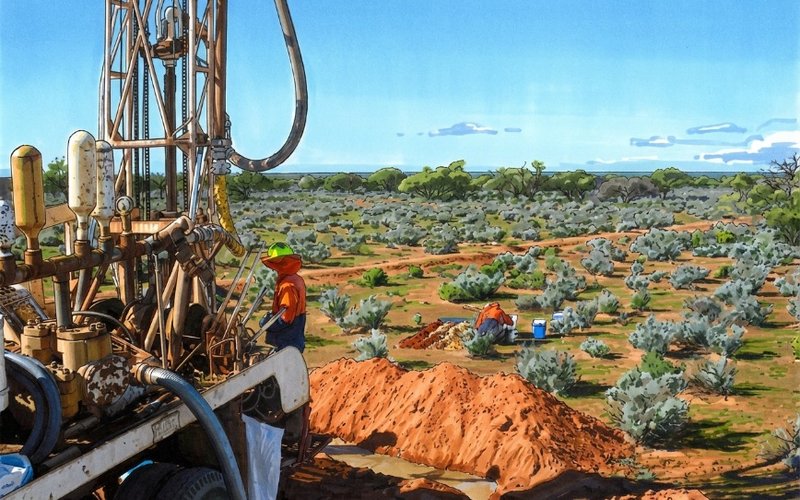

Alligator Energy (ASX: AGE) has successfully completed construction of its Samphire pilot plant, advancing to the critical Field Recovery Trial (FRT) phase with results expected in Q1 2026, a key de-risking event for its in-situ recovery (ISR) uranium development pathway.
This milestone underscores the company's strategic pivot from explorer to developer, underpinned by a strengthened financial position and a clear vision for its flagship project.
Samphire is positioned to become Australia’s next ISR uranium mine, advancing at a time when ISR projects globally are becoming increasingly favoured for their lower capital intensity, scalable development pathways, and reduced surface disturbance compared with conventional mining.
Pilot Plant Construction Update
Alligator Energy recently announced the practical completion of its Samphire pilot plant construction, a significant achievement the company delivered not only on schedule but also under budget.
This demonstrates robust project management and cost control capabilities, which are crucial for advancing a project of this scale.
The construction phase, which commenced in early October, was executed with a strong safety record, reporting only one minor first-aid incident throughout the program.
With construction complete, control of the site has formally transferred back to Alligator Energy, enabling the commencement of final pre-operation activities, which are integral to ensuring the pilot plant is fully ready for its upcoming trials.
Specifically, Stage 3 dry commissioning and Stage 4 wet commissioning began in early January 2026.
These commissioning phases are critical for testing the plant's mechanical and electrical systems, as well as its operational integrity with water, before the introduction of lixiviant for uranium recovery.
The successful completion of these stages will validate the plant's readiness to perform the vital FRTs, laying the groundwork for future development stages.
Compelling Uranium Opportunity
The Samphire project stands out as a highly attractive uranium development opportunity, offering compelling project economics and significant leverage to a strengthening uranium market—particularly given the company’s current market capitalisation of approximately $135 million.
Importantly, Samphire has already demonstrated economic viability at the scoping study level—delivering a robust net present value of $257m, supported by a low upfront capex of just $131m, to produce approximately 12 million pounds of uranium.
These results were underpinned by a long-term uranium price assumption of US$75/lb, which is notably conservative relative to today’s market, with the current long-term price sitting at circa US$86/lb.
With strong fundamentals already established and uranium prices continuing to strengthen, Samphire represents a highly leveraged, value-accretive development asset with clear upside potential as the project advances toward the next stage of development.
Field Recovery Trials Commence
The completion of the pilot plant paves the way for the highly anticipated FRT, which is scheduled to commence in February 2026.
The FRT represents a pivotal technical de-risking step for the Samphire project, designed to comprehensively validate the performance and recovery characteristics of the ISR method specific to the Blackbush deposit's geology.
During the trial, Alligator Energy will gather essential data on various parameters, including uranium recovery from the well patterns, in-situ chemistry, hydrogeology, reagent usage, and ion exchange efficiency.
This detailed assessment is fundamental to optimising the operational design and ensuring the economic viability of a full-scale ISR operation.
Initial FRT results are anticipated in Q1 2026, with further data collection and analysis continuing through Q2 2026.
BFS Expected in 2027
These results will directly inform the Bankable Feasibility Study (BFS), which is targeted for completion in early 2027.
The BFS will consolidate all technical, economic, and environmental studies into a comprehensive document, forming the basis for a final investment decision and securing project financing.
Prior to this, the project had already secured key regulatory milestones, including the granting of its retention lease in January 2025, and the approval of its Program for Environmental Protection and Rehabilitation in August 2025, enabling on-ground activities.
The retention lease is essentially a mining lease encompassing a smaller area, allowing Alligator to conduct expanded field testing and materially advance the project toward development.
Strategic Refocus and Financial Strength
Alligator Energy's strategic refocus and strengthened financial position further reinforce its transition to a developer.
In a decisive move, the company completed the divestment of its non-core Northern Territory uranium assets to DevEx Resources for a total consideration of $7.5m.
This divestment effectively streamlines Alligator's portfolio, allowing for a concentrated focus on the Samphire Project, which is central to its near-term production strategy.
This strategic rationalisation provides a significant boost to the company's liquidity and funding flexibility.
With a closing cash balance of $25.3m at the end of September 2025, this financial capacity is critical for funding the advanced development activities at Samphire, additional drilling to be conducted at Samphire and its Big Lake project, as well ensuring the project remains on its accelerated timeline.
This cash position excludes the additional $7.5 million expected from the NT asset sale in early 2026, providing further balance sheet resilience as the project moves through its most capital-efficient development phase.
Highly Capable Management Team
The strategic refocus is also evident in the calibre of the management team assembled to drive the Samphire Project forward.
The appointment of Andrea Marsland-Smith as chief executive officer, effective 1 July 2025, along with key executives like chief financial officer Joe Sutanto, general manager of operations David Brink, and general manager of approvals & sustainability Christian Knott, demonstrates a clear commitment to project execution and value creation.
The relocation of the company's head office from Brisbane to Adelaide further solidifies the direct operational focus on South Australia, ensuring closer proximity and oversight of the flagship Samphire project.
South Australia is a globally recognised uranium jurisdiction, with multiple permitted and operating uranium mines including Olympic Dam, Honeymoon, Beverley, Beverley North and Four Mile, providing a proven regulatory and operating framework for ISR development.
Near-Term Catalysts Ahead
Alligator Energy is positioned for a series of critical near-term catalysts that are expected to de-risk the Samphire Project and provide significant insights into its development pathway.
Investors will be keenly watching for the initial FRT recovery results anticipated in Q1 2026, which are fundamental to validating the technical assumptions underpinning the ISR project.
Alongside the FRT, Alligator Energy's 2026 activity plan includes progressing mining lease permitting, a crucial regulatory step toward establishing a full-scale mining operation.
Furthermore, an updated Mineral Resource Estimate (MRE) is planned for H1 2026.
This update will build upon the existing Blackbush MRE of 18.0 Mlbs total uranium, with 14.2 Mlbs Indicated at an average grade of 786ppm U3O8, potentially enhancing the project's overall resource confidence and scale.
The updated MRE will also incorporate results from the nearby Plumbush satellite deposit, located approximately 5 kilometres from Blackbush, further strengthening the production profile.
Beyond the current Resource, Samphire hosts an Exploration Target of 14-75 Mlbs, with only around 28% of the interpreted paleochannel system tested by modern drilling, highlighting meaningful upside potential.
The company is planning an extensional drilling program at Samphire following completion of the FRT to test the paleochannel continuity, with the aim of converting the exploration target to a resource and expand the resource footprint.
Big Lake Drilling Planned
In addition to the activities at Samphire, Alligator expects to commence drilling at the Big Lake project in March 2026 (subject to weather), following encouraging early results from a project that has emerged as a regional-scale opportunity in a newly recognised uranium province.
Australian Mining Prospect recognised Big Lake as its "2025 Discovery of the Year", with the project geologically analogous to world-class ISR uranium districts in Kazakhstan, Wyoming, and Texas.
These developments coincide with tightening global uranium fundamentals, with demand forecast to increase by approximately 28-30% by 2030 as nuclear capacity expands worldwide.
Alligator Energy is strategically positioned to advance its Samphire uranium project towards production, marked by the successful completion of its pilot plant and the upcoming commencement of field recovery trials.
With a strengthened financial position following asset divestments and a clear development timeline, the company is poised to de-risk its in-situ recovery pathway.
Get the wire before the market opens.
The ASX small-cap stories that matter, filed before 9am AEST. Curated by the Small Caps desk.