
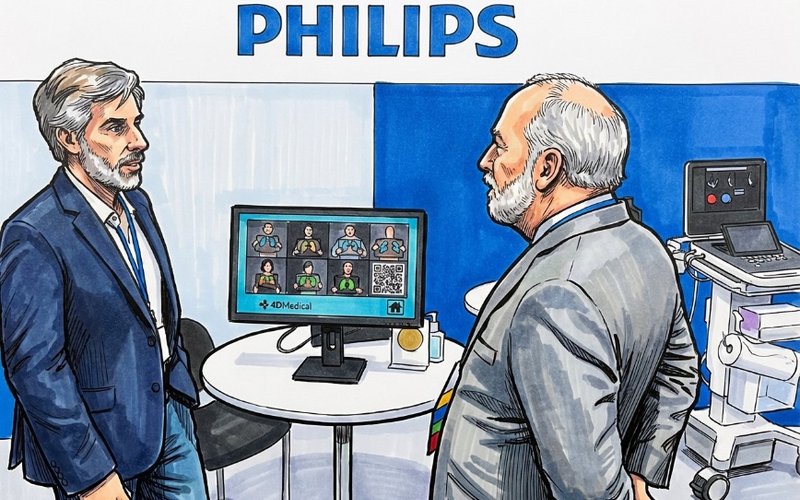

4DMedical (ASX: 4DX) has secured a minimum US$10 million (A$15 million) order commitment for its CT:VQ imaging solution under an expanded distribution agreement with Philips.
Under the agreement, Philips will distribute CT:VQ through its established commercial network, providing direct access to major hospital systems and imaging centres across North America.
The deal includes joint marketing and co-branding initiatives, with the collaboration formally launched at the Radiological Society of North America annual meeting.
Philips has committed to a minimum customer-order value of US$10m across calendar years 2026 and 2027, underwritten through structured contractual milestones.
FDA-Approved Technology
CT:VQ is the first FDA-cleared imaging technology capable of producing quantitative ventilation-perfusion data from routine non-contrast CT scans.
It eliminates the need for radiotracers and specialised nuclear medicine infrastructure, which improves scheduling efficiency, broadens patient access, and simplifies regulatory requirements.
The technology also delivers higher image resolution and precise quantification, allowing the extensive US CT scanner base to perform advanced lung-function imaging without additional hardware.
Philips will assign specialist sales and clinical personnel with specific CT:VQ targets, enabling deeper engagement with clinicians and radiology departments, providing revenue visibility as market traction grows and materially strengthening its commercial scale in respiratory imaging.
4D chief executive officer Andreas Fouras said the partnership offers “compelling validation of CT:VQ as a transformative solution in pulmonary imaging” while giving 4DMedical access to Philips’ “world-class leadership, resources and reach.”
Massive Addressable Market
More than one million nuclear ventilation-perfusion scans are performed in the US each year, with an average reimbursement of about US$1,150 per scan—an addressable domestic annual market of more than US$1.1 billion and over US$2.6b globally.
4D expects CT:VQ to capture a significant share of this market over time and believes the technology can ultimately displace all nuclear VQ scans due to its clinical and operational advantages.
The company said continued collaboration with Philips would focus on accelerating commercial adoption and expanding hospital access to CT:VQ throughout North America.
Co-ordinated marketing programs and the deployment of the dedicated Philips personnel will also support further market-expansion activities.
Get the wire before the market opens.
The ASX small-cap stories that matter, filed before 9am AEST. Curated by the Small Caps desk.